Hello, my little niches

A couple of weeks ago, I came across this nifty video, which I feel compelled to share.

In this panic-stricken economy, many companies are looking to new media for a solution to their branding problems. Some people found it: Twitter. I’ll admit that I have a Twitter account, and I’m not nay-saying the tool. However, like the above video argues, I’m reticent to latch on to this platform while it’s still in its “escalation” phase. This means that the buzz is greater than the quality of the content, and use of the platform is still largely experimental.

Still, certain marketing luminaries believe this is the answer, and I haven’t experienced many discussions about where Twitter, in particular, is headed. To wit, when I asked Scott Monty, head of Social Media at Ford, to share insights about how he feels Twitter will evolve once the buzz has passed, he had this to say: “No one knew how the telephone or email would grow, but look at them now.” When as I asked him if he could be more specific, trying to come across as not a skeptic, but rather an interested party (in his defense, probably inadequately, since this back-and-forth was via Twitter), he replied: “As I implied – akin to the phone & email. It’ll be a part of daily life.” [ed. note: Scott Monty has since personally responded to this blog entry and provided helpful feedback to the discussion. Please take the time to read below.]

Meanwhile, marketing speaker David Meerman Scott feels that social media is the best way for brands to merit their customers’ loyalty. In one of his blogs, he argues that you can “buy” attention through advertising, “beg” for it through PR, “buy” it with sales, and “earn” it with social media. While he’s not explicitly saying that conventional marketing methods should disappear, his rhetoric appears to be in favour of social media. [ed. note: David Meerman Scott has clarified his stance on marketing methods in a comment below. Please take the time to read it, and by all means, visit his blog. We might not agree on all things, but he’s pretty gosh-darned brilliant.]

Maybe I’m too cautious, which is why I’m reluctant to experiment with something that’s still, in my opinion, an infant.  Though some might think me a scoffer, I’m actually looking forward to seeing how Twitter will grow, and especially what it’ll mean to use it intelligently. For now, I feel that David Meerman Scott’s theory seems to apply rather suitably to individuals (e.g. celebrities), but to what extent does it help products and services (e.g. cars)? There’s also something desperate about a beach ball manufacturer creating a Twitter account to tell anyone who’s listening what’s playing on their iPod, in an attempt to humanize themselves. During a recent speaking engagement for airline companies, Satisfly CEO and founder Sergio Mello questioned the effectiveness of social media when a company or brand has over 500,000 followers. How do you keep that many people on message? How do you maintain an intimate connection with them?

And really, how do you keep customers satisfied and engaged in your brand? It used to be about uniqueness, quality. Now, it seems to be more about consistency. Delivering on the promise, rather than promising to deliver. While I’m still unconvinced about Twitter, I can’t deny that customers’ proximity to a company has largely increased, and that really informs one’s experience of a brand. Personally, I’m all about the Mom ‘n’ Pop shops because they know who I am and can customize their services accordingly. Isn’t Twitter just providing a macrocosm of the very same idea?

So all this got me thinking about a company with a marketing and business model I’ve long admired: Lomography.

Why Lomography rocks

There are many things that I love about Lomography. First, and most importantly, they’re talking to a very specific market: lo-fi photography lovers (amateurs and pros alike). They know who they are, they know who their market is, and they don’t try to please the masses. They’re quite content to deliver a quality product and service to their niche.

Long before Myspace, Facebook, and now Twitter, Lomography’s website existed primarily to support the Lomo community. When you get any Lomo product, you’re encouraged to create a personal profile on lomography.com for free and upload photos regularly, sharing them with like-minded folk who can add you as friends and become part of your international, photographic network. In fact, the website served this purpose even back in 2002, ages before we’d even started to identify “community-building” as a 2.0 activity (which, incidentally, was more like a 1.0 idea).

What’s on the homepage? Though it’s undergone a recent redesign, the basic principles are still there. New and exciting products (which, as a Lomographer, you’ll be excited about; it’s a simple preacher-choir equation), photos taken by fellow Lomographers, a Lomo profile of the day (inciting visits to someone you might like to include in your network), and the latest “magazine” (which is really a blog) article. What I like about this set-up, so far, is that Lomography doesn’t waste any time with boring introductions. You’re just thrown into the fire, with no precursor, and they figure you have the wherewithal to know how to find what you’re looking for. If you’re not a newbie to the Lomo world, you know exactly what’s in front of you, and you’re already salivating.
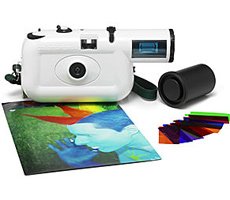
But there are more functions of the site that are interesting. Besides being able to create profiles, Lomography also has a series of incentives for its community. For one, there are many ways for any person to win prizes, including monthly “missions” (basically photo contests), having your profile highlighted as “home of the day,” and submitting useful tips for handling certain cameras. Rewards usually entail either Lomo products (usually cameras) or Lomo piggie points (coupons you can use to get rebates at the Lomo online shop). What’s notable is that the incentives are rather minimal, when you think about it, and yet, participation is quite sizeable. Plus, each incentive-based activity actually promotes the community. A “home of the day” generates thousands of views to your profile, and interest in your photos. Contest winners are always interviewed, again generating views to the victor’s page. It seems less about winning and more about seeing new photos and meeting the person who took them.

But what I really love are the microsites. Lomography manufactures and distributes many lo-fi cameras, and for most of these, there’s a microsite that reflects the camera’s “personality,” complete with a nifty photo gallery displaying the given camera’s range. When you consider how many cameras Lomography distributes, it’s actually a tall order. But there you have it: Lomography is as devoted to their cause as their customers. If you need further convincing, check out the microsites for the Supersampler, the Lomolitos, and the Minox. What’s more, each of these microsites is constantly being redesigned to include new photos, usually submitted by the community.
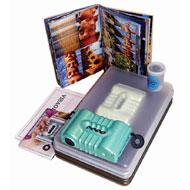
And then there’s the fun part: buying a Lomo camera. Why is it fun? It starts with the packaging. Every Lomo camera comes in a unique package that, once again, mirrors the camera’s idiosyncrasies. Plus, there are special editions to some of the more popular models, which means you’ll again find neat new “containers” for the content. As the proud owner of 6 Lomographic cameras, I distinctly recall the package each came in (to the point where I had trouble getting rid of them). My Holga came in a lovely box, with yellow and white rays, right out of 1940s communist propaganda posters, and a gorilla planted square in the middle. Why a gorilla? Because once you open the box, a leaflet explained that the Holga is a big, clumsy piece of plastic that somehow takes some of the most beautiful pictures imaginable. My Colorsplash came in a translucent, multicoloured plastic box. And my Diana came in an action-figure style container, with the camera wrapped in moulded plastic, surrounded by designed cardboard.
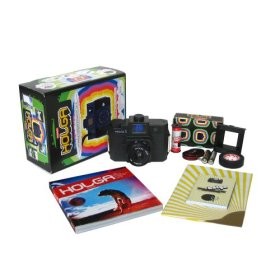
Then there’s what’s inside the package. Each camera I’ve had the pleasure to purchase comes with the usual warranty and instruction manual, with an important difference. The “how-to” is written by a bonafide copywriter, who really underscores what makes the product fun,  rendering the whole thing accessible. In one funny (and honest) example, the Holga instructions warned that the little wire that controls the “automatic vs. bulb” switch usually breaks after one year, but that this adds to the camera’s excitement. However, what really makes me want to buy Lomo cameras are the little picture books inside each box. These neat little books show off some lovely photos taken with the camera you just bought, providing enchantment, inspiration, and insight. I particularly like the photo book that comes with the Holga starter kit; it boasts eye-popping visuals while explaining the techniques behind them.

Recently, I got a Diana F+, which came with a little photo book, as well as a thicker, hardcover book, containing short stories and more pictures. In this hardcover book, Lomography states that the content will be ever-changing to include new stories and photos by fellow Lomographers. What a delightful way to engage the community…again!

Lessons from Lomography

  1. Don’t try to be everything to everybody: Know your audience, and embrace it.
  2. Spend time making your product rock: Urban Outfitters first started to distribute Lomo cameras because they tend to like all things retro, but Lomo’s success at Urban Outfitters is largely due to the cool and fetching packaging, and the repeat consumerism is due to satisfaction.
  3. Make your product the incentive: If your product is great, you won’t need to lower your price or host a contest. Apple/Mac provides the best example.
  4. If you host a contest, you don’t need to give everything away: People like to participate in contests for the chance to win, and regardless of whether or not they’ll win.
  5. Redesign and refresh to reflect the evolution of your community: And I’m not talking Facebook’s fear of Twitter, and changing its homepage to look more like it. I mean ways of making it easier for your community to find what it’s looking for.
  6. Never assume that your product is perfect: Be open to improving it as necessary. It tells your community that you’re listening.
  7. Be honest: While you can strive for perfection in your product, most things aren’t built that way. Rather than skirt the issue, why not admit to the flaws (like the Holga shutter wire), and remind people of the complementary benefits. There are many folks out there running around with non-automatic Holgas, and they don’t seem to mind. Barack Obama’s transparency also comes to mind.
  8. Reflect your product’s personality: That’s essentially what a brand is supposed to be. If your brand were a person, what would it say? How would it act? Lomography products are fun, and so is the brand. If your product isn’t fun, no biggie. That doesn’t mean it can’t be interesting, and it most certainly doesn’t mean it doesn’t have its own unique story.
  9. Don’t try to control your community: Just give it the proper means to propagate itself, and it’ll find a way to take care of the rest. Any interference on your part will be ill-received, not to mention futile.
  10. Build your community in a way that makes sense for that market: A photographic product should allow users to create their own photo galleries and view other people’s pictures easily. It’s not rocket science.
  11. Market your product in a way that makes sense for that product: Twitter isn’t the answer for everyone or everything. It’s a tool, like many other tools. Incidentally, Lomography doesn’t advertise anywhere, but it’s built such a solid word-of-mouth machine that it doesn’t need to. Still, we can’t forget that because its community thrives in and revolves around photo galleries, beefing up the website to support this function made sense for this product. This doesn’t work for every product, especially those that don’t have much to offer in terms of an online experience.

Parting thoughts

Traditional marketing methods still work like magic for certain products. TV advertising, for example, are still an effective way to get a message across about cars, since you can see the car in action, which, due to its mobile nature, makes sense. The fact is, each brand or product requires a customized solution. Each is different, and each is valuable. So to nay-say conventional marketing activities, at this point, is somewhat heretic.


Commercial appeal

Remember how reliably bad TV commercial music used to be? It’s hard to recall now because we’ve been blessed with years of iPod ads. The jingle would be a thing of the past if it weren’t an essential component of video-produced spots for local retailers (“Mel Farr to the rescue! Mel Farr to the re-e-es-cue”). This, of course, excludes the “lingle,” when an ad is punctuated by a choir singing the company’s logo and slogan. I don’t know if that thing will ever die.

Furniture depots and used car dealerships aside, ad music has mercifully evolved. I started to take note back in 2002, when one of my favourite bands, Ladytron, sold one of their little-noted instrumental tracks to a car commercial. Whether composed originally for the spot, or purchased from a musician, ad music just got better. I generally feel that the advent of the web gave way to a broader, more engaging musical landscape. It became easier for people to discover alternative bands and break away from the mainstream, especially with file sharing, iTunes, and eventually, Myspace. Right on cue, ad agencies picked up on the trend, and started to infuse their creative with what I can only assume were their own musical selections. The result is so effective that a query often found on Yahoo Answers is “what is that song in the new *** commercial?”

I think we really started to feel a shift with the iPod spots, like this one:

To me, it seems certain creatives had the sweetest job: scouring Myspace for the best background noise. It worked especially well when the music was incorporated into the concept.

Car commercials especially started to gain momentum. While people are still seeking power and performance, ads started to appeal to those of us who want a car to reflect style, dynamism, youth, and ourselves. In fact, a good friend of mine admitted that he bought his Volks as a result of this ad:

I think it’s especially effective when we’re taking about cars, of course, because that’s when we listen to music the most. You’ve got speed and mobility, set to the soundtrack of your life. And isn’t that what the idea of freedom really is? A selection of your preferences combined with movement.

I particularly like this recent spot. The build-up is executed flawlessly.

Right now, I’d like to give a shout-out to my buddy TS, who’s taken the time to read all of my blogs after noticing that he had 5 pages of catching up to do. TS admitted that he absolutely hates commercials. I think that’s a normal reaction to have. Truth be told, ad creatives also hate a lot of commercials. Thing is, agencies are often forced to comply with a client’s demands, which means that an entertaining concept quickly  turns into boring, indulgent guff. But every now and then, a client is willing to take a risk and allow creatives to have a bit of fun. The result is an ad you’ll likely remember for years and years. And yes, TS, even you have your favourites. Those entertaining ones have an impact on the choices we make, how we see ourselves, and how we perceive the world. Because it’s part of our daily routine, it’s actually quite inevitable.

And as much as we’d love to hate it, one company that allows agencies to take risks, a lot, is Coca-Cola. Based on this ad, the company is perfectly willing to sacrifice direct sales in favour of championing a particular lifestyle and demographic. Given its entertainment value, would you really switch to another channel, or would you wait until it was over? My guess is the latter.

Oh, and the song? Via the White Stripes.

***

On Selling Out

Shortly after seeing the Ladytron ad, I had the fortunate opportunity to interview Daniel Hunt, the band’s main songwriter. I asked him about selling “Mu-Tron” to the commercial, to which he aptly responded, “I think people would have be happier if we worked at Taco Bell and did music on the side. But the truth is, you’d have to be wealthy already to turn that down.”

There’s the rub. Ladytron, while they had a record contract, were still struggling. At the time, as now, they rely largely on shows as a source of revenue. To my understanding, they got a few thousand for the song, which they presumably shared between them, their manager, and whoever else. The investment was largely theirs, truth be told, and in its own way, the commercial became an ad for Ladytron.

Though we’d love to put artists in a category that’s holier than corporations, the fact is, they’ve got to eat too. Instruments are expensive, and with regular use, they require either replacement or maintenance. With file sharing and iTunes, a record contract just isn’t as viable as it once was. More than ever, musicians, even the really successful ones, go on tour and sell merchandise in the hopes of turning a profit, but mostly to generate an income. This is especially the case for alternative musicians, who, though they may be signed, aren’t benefitting from album sales in the same way as mainstream performers.

File sharing served a major blow to the music industry. While I’m certainly not expressing an opinion about file sharing specifically, I can support artists who agree to be part of an iPod ad. This is often the difference between insignificance and notoriety. And for an unsigned musician, that just makes business sense.

Although some of us got sick of hearing “1, 2, 3, 4” repeatedly during the 2007 holiday season, most of us are glad that Feist got the kudos she deserved.

The other nice outcome in all of this is that audiences seem aware of how much musicians have been struggling in recent years. So attendance at live performances is statistically higher, and people buy more merchandise in support of their favourite artist.

And isn’t that how it should work? Shouldn’t an artist’s success be measured by their audience, rather than the company that backs them?

Advertising Killed the Bulletin Star

Ever notice that when a brand does well, it’s advertising’s fault? It isn’t long before the same ad gets deconstructed in the academic world and chewed apart in laymenese by Naomi Klein. Sure, we’ll point fingers at the company behind the ad, but the agency gets a lot of flak too. And I have to wonder why.


When I was in university, we spent a whole week during one of my courses on advertising, and, to paraphrase, how evil it was. What made it evil? The fact that it summons specific imagery to speak to an elite market, or the fact that fashion photography favours a particular type of woman, and more importantly, how effectively advertising techniques work to sell a product or represent a brand.

Later, when life became about paying off the education debt (while I tried to see how my education payed off), it became clear that there was a divide among communications graduates. There were those writers who starved as journalists, and those who didn’t in advertising. As someone who’s been to both sides, I’ve observed that journalists tend to hate copywriters more. “Sell-out” is the usual accusation, and it’s a fairly easy one to throw around.

But here’s my problem with it. Never mind that the creative teams behind some of the ads we like most are genuinely nice people who often vote NDP. The question really should be, why does advertising work?

In my experience, many of the creatives I’ve worked with also have a hobby: art. I’m not saying this is the case for everyone, but they really are sensitive to this sort of thing because they put the same kind of energy into their work. Sure, they have to analyze a brief from a corporate angle, but the output is basically borne of an artistic process. And many of the art directors I’ve been paired with are more or less artists with jobs (and a bigger audience). As for the copywriters I’ve known: you should see what happens when they’re allowed to lock themselves up in a room and write a radio spot. Granted, clients rarely let these creatives express themselves the way they want to, but when they’re allowed to, you get “I’m a Mac.”

That aside, when we like an ad, we respond to it, and that’s what I’m getting at. It takes a certain kind of craft and skill to make us respond to it in the way that we do.

We all know that when we’re being advertised to by a company, with a laundry list of product benefits, we hate it. But when a company isn’t afraid to let creatives do their work in peace, you get something as timeless The Economist campaign.

Are ad creatives artists? It would be unfair to generalize, but kind of. And we’d never criticize artists, would we? Of course not! Art is sacred. Ads are business.

But you know what? Even the Mona Lisa was commissioned by a patron. Alphonse Mucha’s work involved a lot of  packaging, and many Art Nouveau relics are posters, magazine illustrations and ads. Whether or not it’s hanging in a museum now should be irrelevant. I like to marvel at the idea that it takes an artistic process to really reach out to the masses and impact culture.

Is all advertising art? Absolutely not. I’m really talking about the process of creating ads. Not everything turns to gold, especially if the client has anything to do with it (and they always do). But even those crappy Bell beavers came from the blood and sweat of many a creative who tried to make the frickin’ concept work (I know; I was one of them).

So it seems silly and short-sighted to belittle advertising without taking into account what goes into creating spots, and how effective they can be because we, the audience, aren’t indifferent. It’s worth mentioning, as well, that for every GM account, there are at least 5 non-profit organizations or disease research funds. Remember “this is your brain on drugs?” Yup. An ad agency was behind that one. And while it became dorm-room poster material, there was still a public service behind it.

Taking the critique to a more constructive level might involve looking at a system that allows corporations to use advertising to persuade the masses. But that’s not as easy to do, is it? Because that same system also makes room for thousands of clone magazines on newsstands, and narrowing the selection down is what we like to call censorship. It’s a shame that it’s almost as easy to throw around as “sell-out.” We really should only use “censorship” for special occasions.

Anyway, as an exercise, I’d like us to consider Naomi Klein’s point about Gap pioneering the branding movement, and to keep in mind that when the creatives worked on the Khakis series, it’s quite possible they were just having a little too much fun.

Woo-Ha! I wuz refrenst

My buddy (and contemporary) quoted me in his blog. He referred to something I said here only a few days ago. You rock, Deniger!

Naturally, I’m flattered. But more importantly, I’m glad we’ve started a dialogue about memes and viral marketing. There isn’t a magic, colour-by-numbers formula to these things, and it’s time people noticed.

Exhibit A: A couple of years ago, a client of mine developed a Digg-like website. The format was nearly identical, only their model was available in, like, 10 different languages. A more-of-same kind of web initiative that we saw so often in the late ’90s. They no longer exist now, of course.

Exhibit B: Recently, a friend of mine told me he’d been approached by an ad agency for a campaign that would turn bloggers into brand ambassadors. I don’t know anything about the context, so I can’t say what this campaign is really about or how strong the concept is. But I am fascinated at the ballsy move to exploit a highly democratized environment. So far, this hasn’t worked very well. On the web, more than any other medium, people know when they’re being advertised to, and when they find it off-putting, the ad gets panned publicly, and immediately. On Digg, if a user is suspected of prioritizing a corporation’s interests, they quickly get “buried,” seriously decreasing the value (and validity) of their contributions.

So really, it’s not enough to submit an article to Digg. You also have to be part of a community and contribute to it in a significant way…and even then…

It’s not enough to put your ad on YouTube. People have to find it interesting, relevant, funny, or all three…and even then…

It’s not enough to have a viral medium at your disposal. It has to be useful to the right  audience, who can engage with it in a flexible manner…and even then…

It’s surprising that we’re still getting the “let’s go viral” requests when it’s clearly so difficult to control and predict a campaign’s viral trajectory. If it weren’t, everyone would have done it successfully by now. And unfortunately, focusing on a campaign’s viral value takes focus away from creating a sucessful campaign.

Quoth my buddy:

“First and foremost, anything we do needs to serve the client and their goals first, and resonate enough with the target market that they follow through on the calls to action given to them. Anything beyond that, as far as mass-appeal popularity goes, is a lucky cherry on top.”

+++

Complimentary P.S. Here’s an ad I first spotted on College Humor. Millions saw it. Why did an ad about toilet technology do so well? You tell me. Does the same approach work just as well for a loofah sponge or Hamburger Helper? Probably not.

Viral marketing in Darwinian terms

A few days ago, I theorized that viral marketing is a result that’s always hoped for, but seldom within the advertiser’s control. I used the phenomenon of the “25 things” chain letter on Facebook to illustrate my point.

It turns out that only a day earlier, Slate Magazine’s Chris Wilson had similar thoughts. After conducting a survey on how the chain letter began and how it grew, he came to the following conclusion:

“Viral marketers might take note of the patterns that “25 Random Things About Me” obeyed. The best hope for someone looking to start a grass-roots craze is to introduce a wide variety of schemes into the wild and pray like hell that one of them evolves into a virulent meme. If evolution is any guide, however, there’s no predicting what succeeds and what doesn’t. Just look at the platypus.”

Couldn’t have put it better myself (unfortunately). Here is the full article.

Ooopsy: Democratized marketing for yuppies

When I worked in advertising, some of us were hardly left indifferent by this ad:

Then came the buzzword “viral.” And a new game began, and the leaders were Têtes à Claques, Digg, YouTube and company.

Then came the client requests. “We want a viral campaign,” or its fraternal twin, “Let’s go viral with this!”

In the advertising world, we struggled to comply, because while the kind folk at Ogilvy, who created the hugely successful Dove Evolution campaign, hoped that their ad would impact millions, the viral part of the equation was mostly an accident. The campaign was good, and that’s why people paid any attention to it. But there’s plenty of good stuff out there (I know; I send it all the time), and people don’t always respond to it. So really, it was a crapshoot, and it always is.

At the end of the day, it’s the people – we mere mortals – who decide what’s popular. And how that’s decided is based on an infinite number of variables that make it virtually impossible to predict how a campaign will fare. The other night, my sort of boss and I were at a fundraiser, and we talked about Twitter, Stumbleupon, Facebook and friends. All of them tools that can be used to spread the “virus” about a company or campaign. All of them left up to the user to exploit. My sort of boss said he liked how the Twitter people were honest about the fact that they don’t have a business model. I made the point that it’s probably smarter for them to think of a business model after someone uses Twitter in a clever way that nobody’s thought of, and subsequently makes tons of money from it. The viral potential of any site or its components hugely depends on what applications are available on a site, and how these allow people to express themselves (or simply take in information they’re interested in).

The fact is, even developers don’t fully realize the potential of their medium until a creative user does something that even the developers hadn’t factored into the experience. Take Myspace, the evolved Friendster and Facebook prototype. At this juncture, it’s become a hub for artists to gain support and market themselves, especially musicians. Yet when the music player was made available, the point was to share music you, the user, liked. By accident, musicians began to use the hub to promote themselves. Not a bad idea, once users thought of it. Then, it was only a matter of time (and not too much of it) before the Myspace guys were able to build a business model from it…and for ad agencies who create spots for iPod to select the next track for the next commercial.

Let’s use “25 Things” as another example, the chain letter that’s been widely circulated in the Facebook realm. What made this different from other similar chain letters where you answer questions that allow us to know more about you? In this particular format, users got to reveal the facts they wanted to reveal, and at the length of their choosing. No questions. Just answers. The fact that users had complete control over it made it hugely popular.

What can we glean from all this? Viral is unpredictable. But people are creatures of habit, and a conceited bunch at that. Give them the opportunity to  talk in more detail about themselves, and with the least amount of effort, and you’ve got a winning formula.

Maybe.

Magazines won’t die because the web is a pacifist

Lately, it seems everyone’s in a panic about the future of magazines. Well, everyone that’s around me, anyhow, since I happen to work at a magazine.

I work in the online division, and this, as many of my peers believe, is the future.

For the sake of my own survival, I can’t afford to think they’re wrong. The problem is they’re making this prediction to the detriment of the magazine, and I’m not sure it’s necessary. Just like Moogs and synthesizers didn’t completely replace folk music, magazines need not suffer a death by Internet.

When people talk about the web, they often remark that it’s a different experience from print, and this bit usually launches a spiel about the breadth of online media. Oddly enough, in that same conversation, they don’t often consider the possibilities of print.

The fact is, people still buy magazines and will continue to buy them because they enjoy the solitary and tactile experience far too much. When you’re on the web, you might be all alone with your computer, but you’re connected to the world. When you read a magazine, the world connects back, and just to you. And of course, there are those silky glossy pages. The web provides information quickly on any topic, but a magazine selects the best of those topics and explores them in depth, usually with pretty pictures. Ah yes! Fantastic photography: also missing from the web. Yes, you’ll find nice enough images on the Internet, but you won’t see them on a rich, contextualized layout, and that’s an important part of our magazine experience.

So the issue is really content. If we can ostensibly put everything that’s in a magazine online, why bother publishing? Fair enough. To me, information is the kind of thing that translates well onto the web. In online media, the common methodology keeps stories short and “web-friendly,” but it’s mostly hogwash (even though I tend to belong to common methodologist). People will click on page 2, 3, 4 and up to 82 if they’re interested in the material.

To me, all this means is that magazines will have to specialize and up the ante. Magazines are already good at engaging us in beautiful layouts, strong visual material and compelling writing. Now, they just have to do it better. While the web is good at catering to all the little micro-niches, magazines have the opportunity to exploit broader niches, things that don’t appeal to every taste, but that somehow connect us all.

The web says, “sure, put whatever you want here! I don’t mind.” Magazines go, “just the good stuff please.” It might seem snooty, but that’s the kind of material that provides an escape, where the web always keeps us mercilessly in the here and now. And there isn’t a person in the world who doesn’t want to escape just a little, once in a while.

Some magazines will probably have a longer life span than others. I predict that gossip rags will be rendered obsolete by sites like Perez and TMZ (who, incidentally, have also changed the landscape of gossip journalism by actually creating celebrities out of non-celebrities). I also foresee that specialty lifestyle publications known for their striking visuals (the Wallpapers, Vogues and enRoutes of the world) will fare well for some time, especially if they continue to excel at their art.

Other magazines made a much easier transition into the web, to the point where should their publication stop printing, they’ll still have a presence in our lives. I’m thinking of the Scientific American, Wired, the New York Times and The Economist. These publications have turned their websites into interactive news channels. But I think that’s because the nature of the information they provide allowed them to.

Some things, like art and a good story, just look and feel better on paper. If you don’t believe me, then answer this: what three magazines do you always take on a trip? My point is not what magazines you choose; it’s that you buy three.