The History of Montreal’s Eastern Bus Terminal

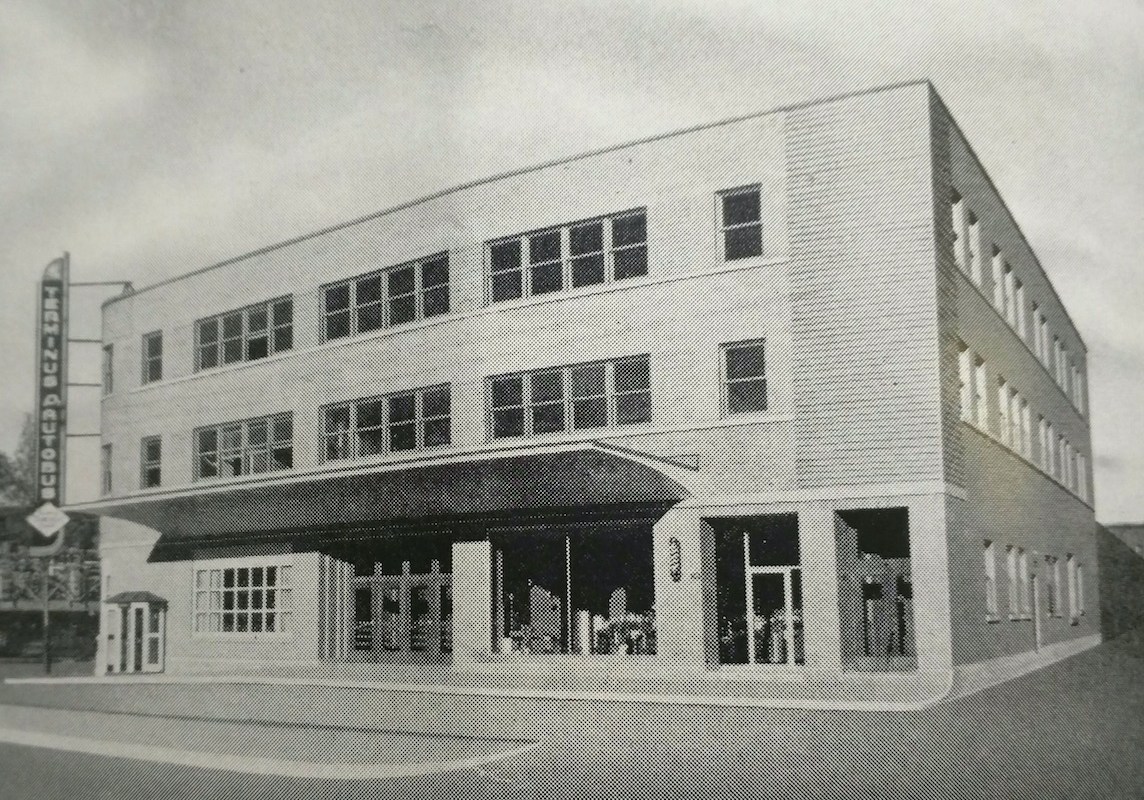
“When we think of the old bus terminal on Berri and Maisonneuve, it usually conjures up the image of a brown L-shaped building across the street from Place Émilie-Gamelin on one side, and the National Library (BaNQ) on the other. That’s certainly the case now, but those extensions along Berri and Maisonneuve were add-ons that came some time in the 1970s. When the bus terminal was built in the early 1950s, it was just that square. The building’s curved corner and vertical Googie-styled signage suggests Streamline Moderne architecture, somewhat echoing the other bus terminal in Montreal at the time.”

Read more

Exploring Montreal’s Lesser-Known Districts

Originally published in the Montreal Gazette on October 18, 2014. Photo by La Portraitiste.

“Montreal is an island, which is easy to forget as you’re rushing to grab lunch in Mile-End’s latest alterno-lumberjack joint that serves each course in a mason jar. Exploring the city’s lesser-known neighbourhoods reminded me that much of the island is verdant with a view of blue.”

Read more

Lighting design: Turn Up the House Lights

Originally published in the Montreal Gazette on July 26, 2014. Photo by Stéphane Racicot.

“If you can see your bulbs, you’re doing it wrong. Fixtures aren’t the main event; your space is. Bulbs should be hidden, either within details of a home’s architecture or because the fixture’s design conceals it. ‘Read the light; hide the source,’ says lighting designer Conor Sampson. ‘Our strategy is to make the lights disappear. The fixtures play a role, but they’re not what we want to emphasize. You want to emphasize the space, the furnishings and the general atmosphere.'”

Read more

Interior Design: Romancing the countertop stones

Originally published in the Montreal Gazette on August 23, 2014. Photo courtesy of Silestone.

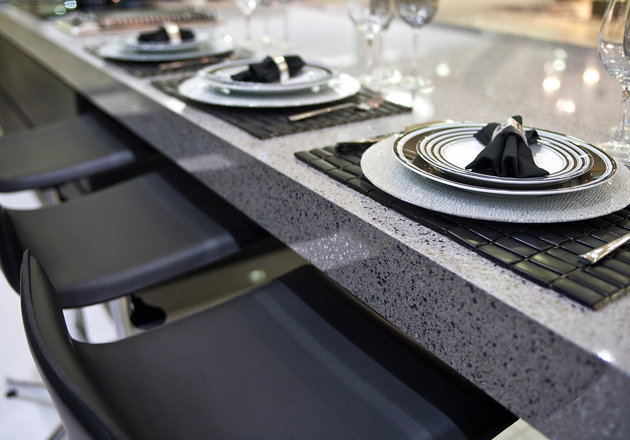
“The Royal is a pale onyx that’s translucent in parts, so, with the right technology and some clever illumination, you could produce some nifty lighting effects. It’s mesmerizing and just plain gorgeous, which is why it’s my favourite so far. For Bégin, this is a good start. If I were a client, his job would now be to help me narrow it down. He’d follow up with one very important question: How do I plan to use the stone?”

Read more

Architecture: The Happy Place

Originally published in the Montreal Gazette on July 5, 2014. Photo by Steve Montpetit.

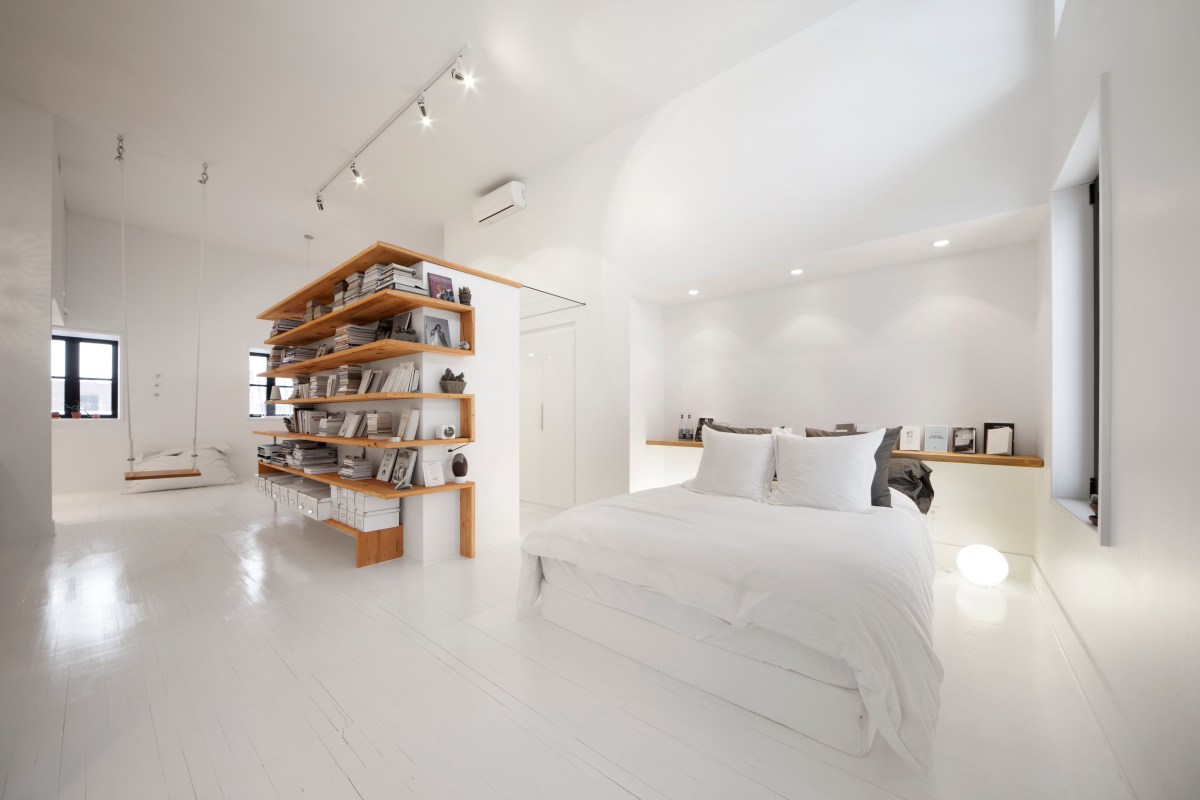
When I ask architect Laurent McComber to describe his pictured renovation project in a phrase, it gets us talking about how fascinating it is that some things just don’t translate.

In a phrase, he’d describe the project with the name it already has, “Juliette aux combles.” The word “comble” has two connotations — attic or happiness — both equally applicable. The wooden shelves at the centre of the space are built from the same wood that made up the small attic that was once here. Juliette, one of the owners, is quite happy about how it all turned out. But McComber and I agree that “Juliette in the attic” just doesn’t have the same panache.

The project is the third floor of a Plateau townhouse, originally built in 1885. The family of four had got the first two floors renovated previously, and called upon McComber to gut the attic and transform this space into something of a sanctuary for the parents.

Before these renovations, everything on the third floor was in terrible shape. The floors were damaged; the plaster was falling apart; the ceiling was poorly insulated and leaked when it rained; the attic, which was really more of a crawl space, was hardly used and took up way too much space, making the ceiling shorter.

The purpose of the project was to repair, restore and renovate the third floor so it could serve the multiple purposes of master bedroom, art studio, office, library and lounge.

“We wanted to put all those functions together on the third floor, so it would also give the parents their own private quarters,” McComber explains.

The concept centres on the stairway, which marks the entrance, and the central shelving, probably the most noticeable thing here, with its beige wood diverging from the ubiquitous whiteness. The stairs, railings and adjacent brick wall were restored and painted over to keep a hint of the house’s historic cachet.

The shelving wraps around three wall surfaces, providing storage for the many books and miscellany that had been crowding the second floor. One of the planks is also a little wider to create a work surface. All of the wood was sourced from the now-defunct attic, though McComber warns that working with reclaimed material has its challenges.

“There are often nails embedded into the planks, or even dust and sand, and that dulls saw blades, which are costly to replace,” he says. “Still, it makes for a nice story: we kept the existing wood and gave it a second life.”

The shelving unit cleverly conceals the linear walk-in closet that leads to the bathroom, an effect that’s better observed from the bordering master bedroom. The owners call this zone “the shell,” since the winding shelves, somewhat reminiscent of a conch’s shape, envelop a shiny and smooth interior (namely the marble mosaic tiles).

There is no door blocking the bathroom; it’s a straight path from the master bedroom. There are only the closet’s sliding doors, which, when closed, create a small hallway passage.

“When people build a walk-in closet,” McComber points out, “it’s usually closed up in its own space, so it’s darker. We tried not to do that.”

In general, this area, which is near the back of the house, benefits from new windows: two verticals and one panoramic. McComber also removed the balcony poles on which the large cantilevered roofing rested, blocking much of the sunlight; he replaced it with a smaller, pole-less version to keep that part of the house cool in the summer and warm during winter. The light bounces off the mostly white surfaces.

There’s a palpable flow to the third floor that wasn’t there before. Part of that was achieved by tearing down the walls that used to separate rooms, which opened everything up like a loft. Still, the owners didn’t want their space to look like a modern condo, so McComber worked to maintain some of its original elements. That meant preserving the flooring, which was repainted and evened out with self-levelling concrete.

It seems cliché to use the term “feng shui,” so we’ll use “circulation” instead, because that’s what Juliette aux combles ultimately achieves: unencumbered fluidity.

“Your perception of a room will change according to where you see it from,” McComber says. “We try to regroup those circulations, because if there are too many, it kills a room. You wouldn’t want the bed to be next to the staircase, for example.”

To that end, the shelving acts like a core, holding it all together. It’s the most obvious reference point from the stairway, it’s where most of the busy activities occur, and it lends privacy to the areas that need it.

It’s how an attic that was falling apart turned into a solid happy place.

+++

Tips from the architect:

• Renovating the top floor of a house can be challenging. Because we needed to open up the roof, there was a risk of flooding or other weather-related issues, so we were forced to work on only one half of the third floor at a time, and we had a drainage system set up.

• The moment you alter a load-bearing wall or the way the rooms are configured, it can have an impact on fire safety. So that’s the kind of thing that has to be carefully considered and intelligently designed around.

• With a historic house in a historic neighbourhood, expect to adhere to a coherent esthetic at street level. In this case, the new front windows we installed had to have central mullions, where we would rather have used uniform panels to get more light.

• Always think about where your door is going to land when you open it, especially in a small space. That’s why I used sliding doors or none at all in this project.

The 600-square-foot project was completed in 2013 with prefinished steel cladding for the facade. For the interiors, gypsum, brick, salvaged wood, marble mosaic and painted wood flooring were used. The woodworking was done by L’Arbre (larbre.ca), and the contractor was P.A. Construction, 514-951-1018.

Laurent McComber founded his firm L. McComber ltée (lmccomber.ca) in 2005, and eventually was joined by David Grenier and Olivier Lord. On top of several home renovations, L. McComber ltée is behind many residential designs, as well as commercial projects like the Crudessence restaurant and bar, Boulangerie Guillaume on St-Laurent Blvd. and the Via Capitale office on Mont-Royal Ave. and de la Roche St. L. McComber ltée received an award in 2009 from the Ordre des architectes du Québec for its Lignes aériennes project, and its work was presented at the 2007 Venice Biennale.
Architecture: The Lighthouse of Alexandra

Originally published in the Montreal Gazette on June 14, 2014. Photo by Adrien Williams.

We’ve come to equate the Mile-Ex/Marconi-Alexandra neighbourhood with architectural experimentation. A stroll in the area might lead to the assumption that anyone can waltz in there and do whatever they like, but it’s never that simple.

In many cases, it’s limitations that push architects to solve certain problems with cunning design.

Take the pictured Alexandra Residence.

Like many Montreal abodes, it was part of a row, so it had a house on each side. Any obvious opportunities for fenestration were from the front (south) and the back (north). So Stéphane Rasselet, architect and co-founder of _naturehumaine, created a five-foot-wide, 20-foot-long skylight that cuts through the house lengthwise, allowing daylight to stream in from above. It’s located over the entrance on the east side, between the first and second floors, creating a break in the roof.

“From there, all the light coming in from the south seeps in, lighting spaces that are at the centre of the house and on its second floor, like the bathroom and the bedrooms,” Rasselet points out. “The skylight also illuminates living spaces on the ground floor, like the dining room and kitchen.”

Most of the house benefits from the skylight, but it probably produces the most interesting effect on the upstairs bathroom, which is just next to and underneath it. Because this particular space is walled off with frosted glass, its discretion is secured while the bathroom reaps plenty of sunlight.

The homeowners are contractors who had collaborated with Rasselet before. They purchased the property in 2012 and decided to completely reconstruct it to better suit their needs. Maximum daylight may have been the leitmotif driving the design, but Rasselet also had dual functions to consider; the house was part family home and part office space.

To separate the entrance from the living spaces, a pivoting panel was installed near the kitchen, creating a more private vestibule. That said, when the owners want to take clients inside the house, the dining area and recessed living room are ideal for longer meetings.

Rasselet drew much inspiration from contemporary Japanese architecture.

“You’ll have closed spaces and open spaces,” he explains. “In Japan, neighbours can be very close, so certain zones require more intimacy, while others can be more communal.”

The more palpable Japanese influences are in the stark contrasts of the black and white surfaces, and the sleek lines. It’s meant to convey simplicity and cleanliness, even if there are many little details working together to make it look that way.

It’s in the ash cabinets in the kitchen and bathroom and occasional wood flooring, lending earth tones to interiors with a largely metallic palette. It’s the grey and white pattern created with the mosaic tiles in the bathroom, playing with a multitude of different textures. It’s the way the front windows don’t quite align with those of the neighbours. It’s the random bricks that were laid backward to display a lighter hue on the facade.

Then there’s the slightly protruding white box, floating as if it were its own entity. It’s this feature that truly defines the concept of the house. From the inside, it outlines the skylight and emphasizes the length of the house. It’s also where the master bedroom is located, with an office in the mezzanine just above it, leading to a rooftop patio that’s delineated by an asymmetrical balcony ledge.

“We went from the slot of the skylight, and it led to developing the white box,” Rasselet recalls, adding: “Compared to other neighbourhoods, Mile-Ex is eclectic, and the city knows it. It’s great for architects and clients who want to do something different.”

Originality is a good start, but what gives any residential project permanence is the way it interacts with its setting; what it takes and gives back.

“In an urban context,” Rasselet says, “you have to pay attention to the quality of light; you have to study the sun’s trajectory, and the impact of the volume of neighbouring houses. These things all have to be analyzed carefully before designing a project, because they’re often what will generate the concept of the home.”

Rasselet’s design acknowledges many intersecting realities. There’s life inside and outside this house. It’s a family home that’s distinctly urban, meshing effortlessly with Mile-Ex’s diverse built environment. It’s in and of the place.

+++

The house is 3,300 square feet, and was completed in 2013. Materials used for facade: brown brick; anodized aluminum panels (framing windows and awning at the entrance); galvanized industrial grate (balcony); black and white pre-painted AD-300 metal panels by Vicwest.

Materials used for interiors: large light grey tile flooring; ash flooring; ash cabinets (kitchen and bathroom); black steel plate steps (living room); white and grey mosaic tiles, Mano by Céragrès (bathroom)

Clients and contractors: Olivier Beaulieu & Gentiane Godin, Fob Construction, 514-829-9278, and Orbitat (orbitat.ca)

Tips from the architect:

• Never underestimate how much time a project will take, from the initial design to the last coat of paint.

• You also shouldn’t underestimate the surprises you’ll have along the way. In this case, we found out during the reconstruction that the foundation of one of the neighbouring houses was laid into the owners’ property. So, we had to change our plans around that.

• Before I even start working on a project, I like to invite clients to the office. It’s so important for clients and architects to click, and that first visit is when it happens.

_naturehumaine was founded in 2003 by Stéphane Rasselet and Marc-André Plasse, who has since moved to New York. Specializing in residential projects, _naturehumaine has created critically acclaimed homes. A multiplex it did on St-Zotique in Mile-Ex was awarded the “Prix d’excellence” by the Ordre des architectes du Québec in 2013. The company is working on multi-residential projects on Marquette and St-Ambroise Sts., a few renovations in Outremont, and lakeside homes in the Eastern Townships and the Laurentians. See some the firm’s projects at http://www.naturehumaine.com

Lighting design: The lantern of Ste-Catherine

Originally published in the Montreal Gazette on May 17, 2014. Photo by Lumenpulse.

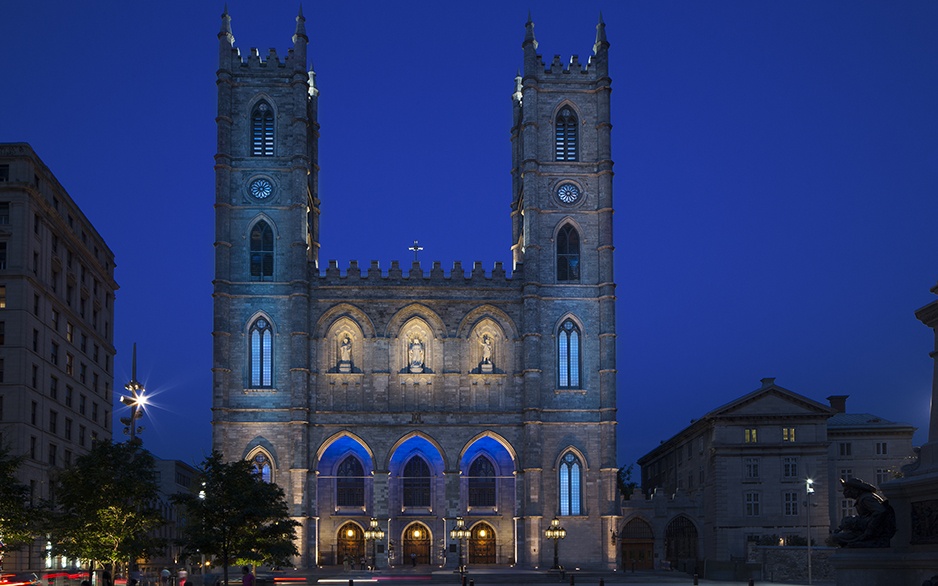
The lighting scheme gives the St. James more than mere visibility; it also gives volume and perspective. You can tell how high the church is, you can make out some of the details in the stonework, and the illumination avoids two-dimensionality by wrapping the towers along the sides.”

Read more

Architecture: Where the living is easy

Originally published in the Montreal Gazette on May 10, 2014. Photo by Marc Cramer.

It isn’t always easy to build something new in the older parts of this city. Heritage laws, zoning restrictions and mindful citizens all work together to keep Montreal looking like Montreal, and that’s not a bad thing. So when a contemporary project manages to blend into its environment, it’s worth a closer look.

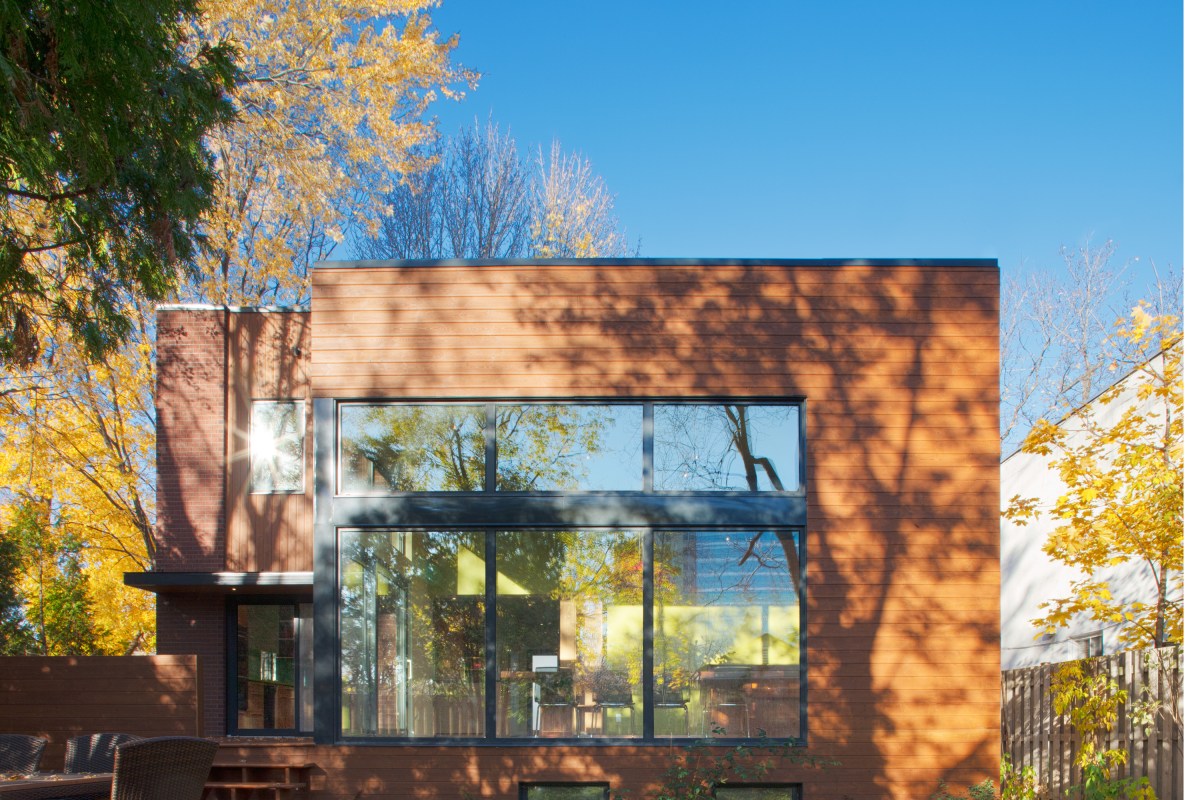
Box-shaped with a burgundy brick facade, the pictured Ahuntsic abode hardly clashes with its residential surroundings. If anything, it reflects the red-hued masonry that typifies so many of Montreal’s early-20th-century homes, partly because that’s exactly when this place was built.

It was initially used to house the Millen station master, who conducted the tramway line that transported hundreds of workers from Montreal North to the downtown core. By the 1970s, when the métro replaced most trams, the house became a regular home.

A family of five purchased it in 2001, and in 2009 they called upon architect Anik Péloquin to renovate and add an extension.

From the front, the only features suggesting newness are the vertical torrefied wood panels separating the windows and the perched entrance. It’s only when we get around to the rear that the house takes a more modern turn.

The expansive extension that juts out toward the yard has tall, nearly 13-foot windows wrapping its corner, meeting the patio and the original back of the house, which is now outfitted with sliding glass doors.

The owners host a lot, so they wanted a bigger kitchen and a large dining area. The extension gave them that, and it also connected their home to the neighbourhood park that outlines their entire backyard.

“I wanted to open up that space and create a very fluid kind of circulation,” Péloquin says, “and from every social space in the house, you have a view of the surrounding nature and greenery. It’s as if that wall doesn’t exist, and the space looks bigger because the windows almost reach the ceiling.”

The abundant natural light doesn’t just penetrate the social spaces; it also reaches the little office nook on the second floor that overlooks the dining area — which, like much of this part of the house, was previously smaller and a lot darker.

For a contemporary home, there’s more colour than we’re used to seeing. That was the owners’ wish, and Péloquin, who loves to play with colour, had no trouble pulling it off.

“Usually clients prefer neutral tones, but in this case, the owner had a passion for red,” she says. “If you use it everywhere, it can be too much, so you have to balance it out. To do that, I used many colours to control the doses and make the red an accent rather than redundant.”

In the kitchen, dining room and office, different shades of green recall the natural verdant scene on the other side of those huge windows. The woodworked furniture and kitchen add to the organic forest-like look of the place. It’s all a reminder and appreciation of the world outside.

Péloquin wanted the facade to be beautiful but sturdy. The borough’s bylaws required it to be redone in brick, but she didn’t mind. “I’m happy I found this particular brick because it’s textured, and it varies a lot with light,” she says. “It’s also a nice contrast to the contemporary lines.”

Besides the brick, she also wanted to mix it up with some wood. When it’s torrefied, the process cooks any harmful bugs or bacteria out so the wood can last up to 50 years.

“It lives a very long time and it doesn’t rot, like cedar,” says Péloquin. “Plus, with wood, if you get a mark or a stain, it doesn’t matter. But aluminum or vinyl siding ages badly, and you can’t really fix it if it gets damaged.”

The house was revamped around the habits of its inhabitants. It had to facilitate entertaining while also keeping in mind comfort, movement and the fact that three children call this place home.

When the renovations were completed in December 2010, the family reported back to Péloquin. “They told me the youngest one immediately went to the dining room and looked at the snow outside,” she recounts. “When windows are that tall, you can really appreciate a snowfall. That’s when I knew the family felt good in their home, and that they’d really enjoy it. It’s a pleasant place; it’s easy to live in.”

+++

Completed: 2010

Size: 2,225 square feet

Materials used for facade: Torrefied wood and brick, aluminum windows by Alumilex

Materials used for interiors: Gypsum, cherry hardwood floors, black slate tile flooring, bamboo kitchen cupboards, granite and quartz counters

Architect: Anik Péloquin Architecte, anikpeloquin.ca; woodworking: Claude Tourigny: 819-294-9840; contractor: Les entreprises G3F, 514-358-3585

Tips from the architect

  • It’s possible for a house to be both contemporary and warm.
  • A construction site is challenging even when everything is managed well, so it’s best to plan as much in advance as possible to make it comfortable for everyone involved.
  • Stay Zen. There will always be something that doesn’t quite work out as planned — in this case, the stone for the kitchen counter — so just work with it and move past it.
  • Find out about building and renovation restrictions at your borough office or city council before you even purchase the home.
  • For the whole thing to work, architects and homeowners have to completely trust one another. I’m proud to say that’s exactly how I’d describe this project.

About Anik Péloquin
Péloquin founded her eponymous architecture firm in 2000, after years of collaborating with Dupuis LeTourneux Architectes, Turcotte-Pilon and Cardinal Hardy. On top of many residential projects, Péloquin is behind the redesign of the Clinique Vétérinaire St-Denis, and her work on Les hauts et les bas boutique on Fabre St. earned her the top Commerce Design Montréal award.


Architecture: Eastern Townships home designed to a T

Originally published in the Montreal Gazette on April 12, 2014. Photo by Marc Cramer.

Ancient Roman politician Pliny the Younger owned many villas, and he enjoyed writing out them in great detail. It’s why architecture school students are sometimes assigned to design villas based on his descriptions.

Those very writings influenced the T House, designed by the eponymous founder of Natalie Dionne Architecture and her partner, Martin Laneuville. “It’s very creatively stimulating,” Dionne says of visualizing Pliny’s accounts. “The way people lived in places with views, the depiction of these spaces, the height, the proportions: it’s all so evocative.”

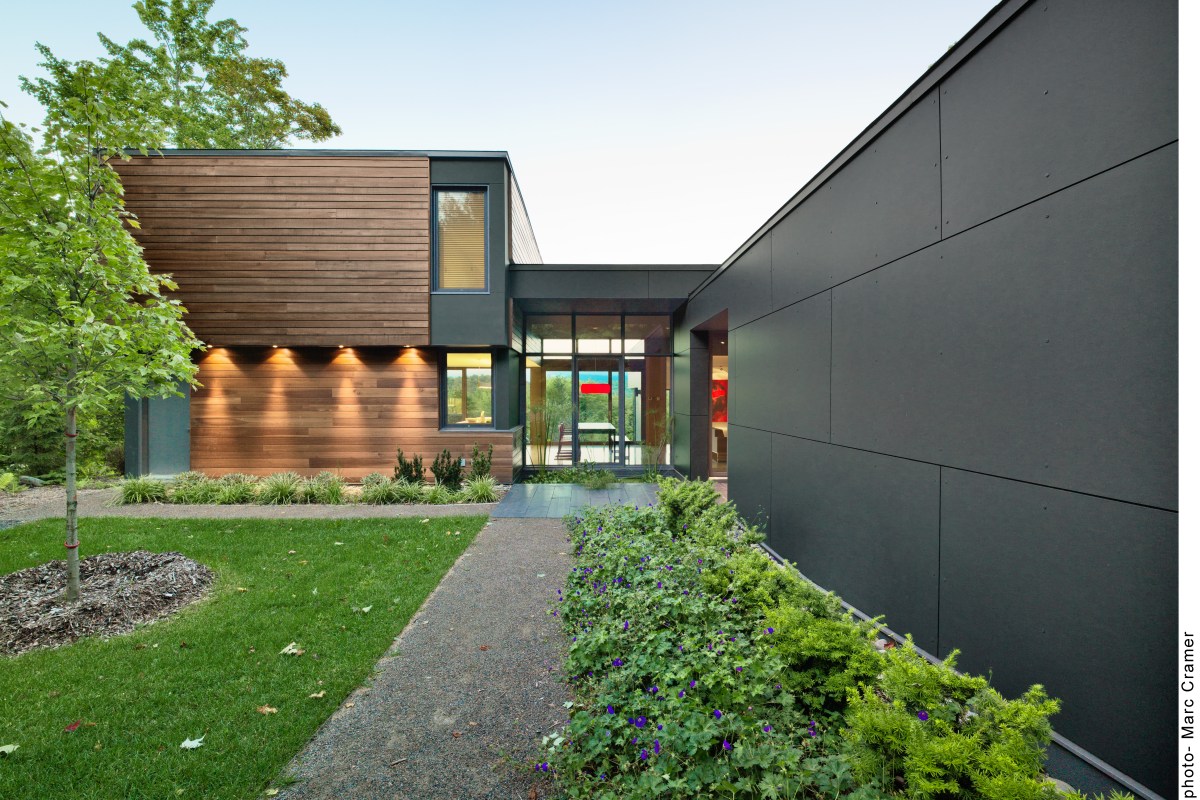
Nestled in the bush, the T House is a hillside home in the Eastern Townships with sweeping views of Mount Sutton. Its Pliny-inspired design does more than provide opportunities to contemplate nature; it’s symbiotic with it.

Starting with its T-shape, each side of the house faces the four cardinal directions. The cooler north side has the fewest windows. The wooden deck, master bedroom and living room are part of the heavily fenestrated east, which faces the mountain. On the warmer south side is the pool. The shaded west is where you’ll find the guest rooms, the entrance and a water garden built around a gently rustling creek that leads to a pond at the foot of the hill. From the dining room, located in the centre of the house, you can watch the sunrise or sunset.

The house’s positioning is quite deliberate. Using the 3D modelling software Google SketchUp, Dionne and Laneuville could assess optimal arrangements around natural light and even gauge how it would shift from one season to the next.

Showing me a 3D model of the T House in SketchUp, Laneuville demonstrates how the program helped them make design decisions. “Because of this,” he says, “we were able to see how much sunlight came in at, say, 12:30 pm during the summer solstice, so we made the roof jut out a bit more on the patio to prevent overheating.”

The home has a seamless indoor-outdoor flow. Materials used on the home’s exteriors – like Corten steel, wood siding or the slate patio covering – are also found in the interiors. The woodworked kitchen and living room recall the alcove of the entrance. The ample fenestration gives the impression of being in a sheltered outdoor space, especially when the windows are opened.

Artificial light also emphasizes this continuity at night. For example, recessed spot fixtures are lined up inside, next to the dining area, and continue outside towards the wooden deck. Spots are used to graze some of the exterior façades, evoking some of the interior motifs that can be seen from the windows at night.

“What’s important is not the fixture but the atmosphere it creates,” Dionne points out. That’s why spots are also directed at a painting in the living room, creating a dramatic reference point that can be seen from the other extremity of the T. In general, the night-time lighting in the living areas is subtle and sparse.

In addition to its bucolic composition, the T House is also Novoclimat-certified, so the home is energy-efficient. During winter, a hydronic system heats the concrete and natural stone flooring, which becomes cool and comfortable in the summer. The windows are positioned to allow cross-ventilation, requiring little to no air conditioning during summer, while letting in enough natural light in the winter to bathe the interiors in warmth.

On top of the Novoclimat features, the house is also heated by a geothermal system. “Geothermal energy has great long-term benefits, but you need the budget to invest in it initially,” Dionne admits. “Still, it’s a good thing because 25% of your energy ends up coming from the ground.”

What Dionne likes most about the T House is a little nook by the windows that are perpendicular to the entrance, and from which you can see the pool. “This spot plays with the indoor-outdoor movement, the elements of the landscape architecture and the flow-through of the little paths that guide you throughout the home.” she says.

For their part, the owners are most pleased with the views of Mount Sutton, which was their top priority when they approached Dionne to build this home.

Meantime, the judges of the Grands Prix du design liked the T House so much, they gave it an award in the category of Residential Space (1,600 to 3,200 square feet) in January 2014.

That’s what happens when an architect can see a project through. “Every last detail was of this house was designed,” Dionne says. “We also oversaw construction and designed all the built-in furniture, like the book shelf in the living room.”

Even though residential construction bylaws in the Eastern Townships are fairly flexible, our Nordic weather means we can’t expect some of the more extravagant Mediterranean or Californian homes we might see in architecture magazines. But that doesn’t have to limit the imagination.

“Here, you can still build a house with many windows and make it comfortable, as long as the spaces are well sealed and insulated, and the fenestration is well oriented,” Dionne concludes.

Best to work with the nature of our climate instead of repressing it.

***

Completed: 2012
Size: 3,200 square feet
Materials used for façade: Torrefied wood siding, fibre cement panelling and Corten steel
Materials used for interiors: Polished concrete, quarter-sawn white oak flooring and panelling, torrefied wood siding and Corten steel
Architect: Natalie Dionne Architecture, ndarchitecture.net
Landscape Architect: Topia Solutions Jardins, topia.ca
Green Building Consultant: synAIRgis, synairgis.com
Contractor: Roger Élie

Tips from the Architect

  • Take the time to find a good contractor and to properly plan the adventure you’re about to embark on together.
  • Designing and building a house from scratch with an architect is not the same as buying a ready-made home, but the cost can be comparable. Most of the investment goes towards the design and construction in the former scenario, while the latter is often priced to take a real estate agent into account.
  • Check residential bylaws because they can be tricky. In the case of the T House, Dionne had to rework the pool’s construction plans for safety. As a result, she managed to keep one side of the pool 4 feet off the ground to avoid using a fence, which would have limited the natural appeal of the house in its surrounding landscape.

About Natalie Dionne Architecture (NDA)
Natalie Dionne founded her business in 2000 and was joined by her life partner Martin Laneuville in 2008. Their award-winning U House in the Plateau-Mont-Royal serves as both their home and their architecture studio.

Architecture: A riff on the brick-box motif in NDG

Originally published in the Montreal Gazette‘s Homefront cover on March 13, 2014. Photo by Marc Cramer.

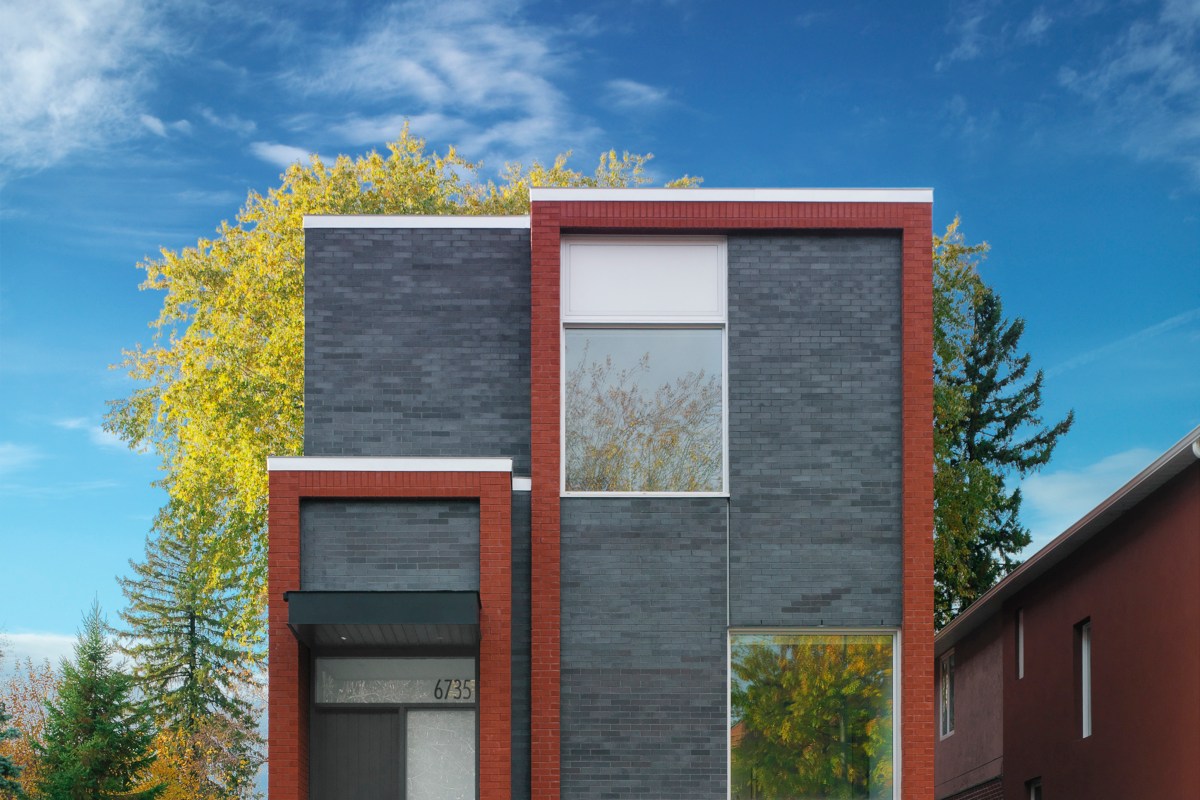
Red brick outlines two dominant rectangles on the house’s front façade, so your eye quite naturally wanders to those areas. Since one of these zones includes the doorway, it’s pragmatic. But there’s also a bit of artful misdirection, because the thing you don’t immediately notice is the slightly recessed garage door at the bottom of the ramp.

“Hide the garage; express the box,” says Gavin Affleck, co-founder with Richard de la Riva of the Affleck de la Riva architecture firm. That he describes this Notre-Dame-de-Grâce (NDG) house as a box might seem unglamorous, but it’s also appropriate.

“It’s a contemporary expression, but if you look at the neighbourhood and its historic buildings, it’s all there,” Affleck explains. “In NDG, there are brick boxes with large bay windows.”

When Affleck de la Riva presented their plans for this modern single-family home to the Côte-des-Neiges-Notre-Dame-de-Grâce borough, the firm met with little resistance. The one proviso was to use red brick instead of the beige-brown masonry the architects originally wanted for the exterior outlines, though they’re still happy with the results.

The project got started in 2010, when frequent collaborator Richard Dufour of Sienna Construction approached Affleck de la Riva to design a house for an empty residential lot the former purchased in NDG.

“These days, empty lots are rare in NDG,” de la Riva says. “The projects tend to be smaller, with single-family homes that are usually attached to other houses, or perhaps it’ll be a duplex. This was a notable project because it was the first time we had a completely detached house in NDG. ‘’

Affleck de la Riva designed as many windows into the façade as the borough’s zoning restrictions would allow. In most Montreal neighbourhoods, windows can occupy about 35 to 40 percent of a street façade, while it’s stricter for the sides of the house, and almost limitless at the back.

“We’re always trying to reach the by-law’s maximum, which sometimes requires some clever composition,” de la Riva comments.

Along the sides, closely spaced vertical windows provide a staggered rhythm of light onto the floor, and skylights beam down from above the stairway. Nearly 75 percent of the back is fenestrated.

Natural light doesn’t just brighten the interiors; it also creates a flow, guiding you to specific communal, or “living” areas of the home. From the narrow entrance, you’re immediately drawn to the amply lit rear of the house, where the kitchen, living, and dining rooms are located, with a door leading to the patio. The parlour, where the where people traditionally wait before being led to the living areas, is in the front, near the more dimly lit entrance.

The disposition of these spaces is part of what makes this house contemporary. It points to a shift in our lifestyles and in our ideas about how a house works.

“The entrance is more or less open, but the important social spaces are towards the back, where it’s roomier,” Affleck points out. “Before, big spaces like the living room were in the front, near the bay windows, and the smaller spaces like the kitchen were in the rear of the house. Today, the intimate parts of our lives are associated with the backyard, so the big spaces and the big windows are now both in the back.”

For de la Riva, the stairway is key to experiencing the house because it provides navigational cues. “There’s generous fenestration revolving around the stairs,” he says, referring to the lateral windows and skylights. “So when you’re walking around, you always have a view of the exterior.”

White walls and pale wooden floors make the natural light seem even more abundant, and also lend an elegant finish to the interiors. The home feels airy and uncluttered.

Affleck, who’s originally from the neighbourhood and still lives there, admits that the big challenge was to breathe new life into the concept of the NDG house. “Modern architecture doesn’t start from zero; it’s rooted in something,” he says. “To update the neighbourhood, you have to modernize it, but in its own traditions, while giving it a new expression.”

Both architects feel this residence represents a new form that’s got NDG in its DNA. “The bay windows might be square instead of curved, but they have NDG proportions,” de la Riva points out.

The real coup is the discreet garage door. Designing around cars is relatively new and wasn’t a concern when NDG was first built, so a stealthy garage is respectful of its historic setting.

Most importantly, like many older NDG homes, this place is comfortable. It’s spacious and pleasant, with many opportunities to find a nook and contemplate the outdoors. Warmed by copious sunlight, the house truly has a life of its own.

***

Completed: 2012
Size: 2,700 square feet
Materials used for façade: brick, aluminum, painted stucco
Materials used for interiors: painted plasterboard, hardwood floors
Architect: Affleck de la Riva Architects, affleckdelariva.com
Contractor: Sienna Construction, siennaconstruction.com

Tips from the Architects

  • Architecture is a process, and it’s important to take pleasure in it. It’s a bit like cuisine: you appreciate eating more when you enjoy cooking.
  • Building a house from scratch is not like buying a car. A house may be a product, but architecture is a service.
  • Celebrate the entrance, the interior stairway and natural light.
  • Check with your borough about zoning. Once you know what the restrictions are, adjust your expectations accordingly.
  • Don’t let the garage door steal the show.

About Affleck de la Riva
Founded in 1995 by Gavin Affleck and Richard de la Riva, the firm’s projects cover architecture, renovation, restoration and urban design. Among their many accomplishments, Affleck de la Riva refurbished Montreal’s City Hall and Victoria School on Maisonneuve Boulevard. They designed Square des Frères-Charon in Old Montreal and several residential complexes in the NDG area, as well as homes in and around Montreal. They are currently working on the revitalization of Cabot Square, across from the old Forum. Both partners are visiting lecturers at the schools of architecture of McGill University and the University of Montreal.


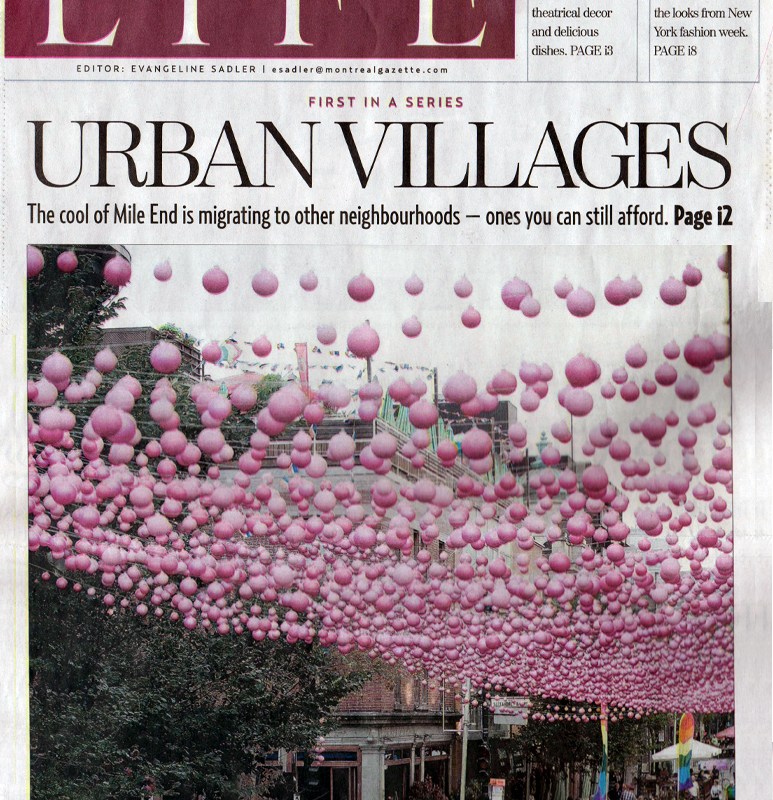
Urban Villages

The Urban Villages series for the Montreal Gazette studies the city’s emerging neighbourhoods and finds out why they’re burgeoning.

From “Mile-Ex’s Multiple Personalities”
“It’s hard to get a handle on Mile-Ex. This peculiar 1.5-square-kilometre enclave is both old and new, both industrial and residential, not quite Mile-End or Park-Extension. Even its name is debatable. To many people who have been here longer than five years, it’s still Marconi-Alexandra, so named for two streets that cut through the sector. Those who have lived here longer than 15 years might consider it part of Little Italy. Some even call it WeLIta, for West Little Italy. Mile-Ex is a recent moniker that sits better with newer crowds, or with people who don’t live or work here at all.” Read more

From “Made in Villeray”
“In the interviews I have done for the Urban Villages series, I make a point of asking this one question: Why did you choose this place instead of another place? In Villeray, the top five reasons are: the Jean-Talon market; Jarry Park; five métro stations; reasonably priced rent for well maintained, often large spaces (both commercial and residential); and a pleasant quality of life. The question I’ve tried to answer in every story in the series is: Why is this place emerging? In the case of Villeray, fashion is one of the elements propelling the area forward.” Read more

From “Snowdon Meets You Halfway”
“Though Snowdon’s tranquility might feel like a departure from the bustling city core, there’s still a lot of activity here because of commercial roads like Queen Mary, Décarie and Victoria, from St-Kevin Ave. on. Plus, the types of businesses are assorted; you’ll find grocers big and small, health food stores, many pharmacies, clothing boutiques and loads of restaurants, many of them serving up authentic ethnic flavours.” Read more

From “Hochelaga-Maisonneuve: Friendly with a Small-Town Feel”
“’HoMa,’ as some call it now, is slowly evolving past that image, but it’s not completely transformed. Some of its small businesses look a little worn, which happens when you’ve been around for 20 years or more. Still, they’re meeting a fairly high demand. Local fast-food joints like La Pataterie and cozy diner Gerry’s Delicatessen serve comfort classics like hamburgers, poutine and smoked meat sandwiches, and they’re as popular now as they were when they opened decades ago. A place like Bar Davidson, a dive bar known for inexpensive drinks, has been around since the 1930s. Back then, it was a tavern and wouldn’t serve women. Now it refuses no one. Not the student looking for cheap beer; not the leather-covered biker dude; not the scantily clad lady.” Read more

From “St-Henri: Eccentric, Artsy”
“St-Henri is the Un-Plateau. It’s quiet, it doesn’t have much of a nightlife, it borders the water, it has the Atwater Market. It does have a cachet that is Plateau-like in certain residential areas, but the neighbourhood tends to be more industrial thanks to its old factories, remnants of the many manufacturers once headquartered here.” Read more

From “Old Montreal: Chic & Central”
“Today, Old Montreal couldn’t be more different. There are almost too many restaurants to choose from, new bars and clubs are 5 à 7-ready, and quite a few designer boutiques have set up shop along ‘Gallery Alley,’ St. Paul’s nickname for the many art galleries that once dominated the street. More importantly, the area is attracting more Montrealers than visitors.” Read more

From “The Village: Beyond Partying”
“’There weren’t that many places in the Village where you could enjoy fine dining,’ says Bernard Beauchemin, a consultant for Bistro 1272, which focuses on progressive cuisine. Lallouz kebabery owner Zohar Bardai agrees, adding: ‘People in this neighbourhood … are willing to try new ethnic foods and appreciate it for what it is.’” Read more

Lighting design: Old City of Light

“The lighting of the Notre-Dame Basilica’s façade is part of a deliberate urban landscaping initiative called Plan lumière, which started in 1999. The goal was to breathe new life into historic Old Montreal using strategic lighting design.”

In this article for the Montreal Gazette, I report on how lighting design revived Old Montreal and its historic architecture.

Read more