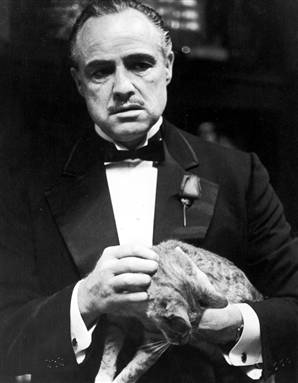
 On the day of his daughter’s wedding, Vito Corleone can’t refuse a single request, no matter how eccentric. Yes, of course he can help you pay for those restaurant renovations. That Hollywood producer is giving you a hard time? Don’t worry. He and Vito are going to have a chat. What’s that Fluffy? Sure, Vito’ll scratch your neck. You like that, don’t you, Fluffy. Yes you do. (Yes you do.) So does Vito. He’s always loved cats. And in just a few scenes, he’s going to do something to a horse that really sticks it to the Hollywood suit.
Vito Corleone may be a cruel monster, but his cat *loves* him. And as any cat owner will attest, that love is duly earned. Sure, they’ll brush up against your leg, maybe let you pet them a little. But the Corleone cat is rolling around on godpoppa’s lap, showing him the bellied goods. That means Fluffy and Vito have a history that Vito’s taken the time to nurture.
If anything, that’s what makes Vito Corleone so scary. Sure, he’s a ruthless murderer who wouldn’t give a second thought to pumping your torso full of holes. But he’s also a cat person, which is so…ordinary.
I’ve always been more freaked out by average folks who are capable of great evil than fantastical serial killers, like Freddy Krueger. Psychologist Dr. Deborah Serani says that makes perfect sense. “Any human being…is far more frightening than a distilled, flat-dimensional psychopathic character,” she explains. “The reason that it’s creepier is because we are all human and complex. And when we discover that someone just like us can do evil, terrifying things, it causes us to wonder how close we can be to doing such things.”
I’m not sure how close I am to doing any of the things the following movie villains did, but they left their mark because their brand of evil is seasoned with the uncannily mundane.
“Wait for the cream.” – Colonel Hans Landa, Inglourious Basterds
There’s a lot that’s unsettling about Colonel Hans Landa: his cool demeanour, his inexorable grin, his talent for capturing Jews, and especially his sharp mind. He’s a cultured fellow, having travelled plenty, learned many languages, and tasted a host of different foods. Yet there’s little he seems to enjoy more than a plain glass of milk. Dr. Serani thinks Landa uses it to assert his authority over the situations he’s in, from confronting the dairy farmer to that unnerving afternoon tea with Shoshanna. That’s certainly the larger subtext of those scenes. But his love of milk seems disconnected to hunting Jews. It’s more like one of life’s simple pleasures, like the icing on the cake, or the cream on the strudel. It does something to his palate, perhaps taps into a soothing childhood memory. So when he has a glass of the farmer’s milk, it feels more like a “don’t mind if I do” than a “what’s yours is mine.” According to Christoph Waltz’s own description of the character he portrayed, Landa is “realistic to the point of being inhuman.” Add that to Quentin Tarantino’s penchant for quiet terror and you’ve got one bone-chilling Nazi.
“A hobby should pass the time, not fill it.” – Norman Bates, Psycho
Though Alfred Hitchcock felt Psycho was his answer to the slasher genre, the picture is riddled with suspense. Unlike his other movies, you don’t find out who the killer is (well, not for sure, anyway) until the very end, and during that ride, you have to contend with a mild-mannered, gawky, shy momma’s boy. You know something isn’t right with Norman Bates, but you’re willing to give him the benefit of the doubt. Even though he spends a lot time stuffing dead animals and preserving them in lifelike poses. I honestly don’t know what’s more disconcerting: the fact that Norman Bates is a taxidermist, or that he has a hobby. It’s a painstakingly precise craft, and one that takes years to perfect. You have to wonder what kind of boredom and loneliness led him to taxidermy, and how all of those things led him to murder. When we find out that Norman Bates killed his mother and kept her corpse, we come to the eerie realization that what he really preserved was her personality.
“Forgive me for prattling away and making you feel all oogie.” – Annie Wilkes, Misery
I’ve always said that there’s a difference between being nice and being polite. Annie Wilkes is too polite from the start. From her disdain for profanity to her exaltation of Paul Sheldon, author of her favourite series of novels, Misery. It’s actually the fictional Misery Chastain that she loves, so Paul Sheldon, as her creator, is worshiped by association. It’s not altogether clear what kind of character Misery Chastain is, but we know she’s a romantic 18th century heroine. We also know that Annie Wilkes found comfort in reading when her husband divorced her. Since she’s bananas, she skirts over the fact that her husband left her because he got wise to the whole “my wife’s a nutty serial killer” business. Whatever the case, reading is what kept her cuckoo under control, and it’s when Paul kills off Misery that Annie loses it. Who knows what it is about Misery that kept her sanity in check, but Paul’s misery grows exponentially until he writes her back to life.
“I want to earn enough money that I can get away from everyone.” – Daniel Plainview, There Will Be Blood
Did your parents have a specific activity they didn’t want you to interrupt? My mother doesn’t like being bothered during Entertainment Tonight. Oprah’s okay, but don’t you cut into her Mary Hart time. Daniel Plainview feels the same way about bookkeeping. Don’t come a-knockin’ when Plainview’s on a date with the general ledger. It’s pretty much the only thing that matters to him. He relishes it so much he’s given to psychopathic behaviour if anyone intrudes. He’s crunching numbers when his adopted son tells him he wants to branch out on his own. Plainview goes into a blind rage, calling his son a “bastard from a basket.” Then that brat Eli Sunday comes around asking for money when Plainview is busy counting it. And without an ounce of sympathy, Eli gets some sense beaten into him with a bowling pin. Sure, Plainview’s hatred for the duplicitous Eli had been brewing for years, but the poor boy’s only sin, here, was bad timing.
“Call it.” – Anton Chigurh, No Country for Old Men
Anton Chigurh is more of a poltergeist than a person. You can feel his effect, but you don’t really get to know him. Yet there’s this thing he does after each murder. He checks his boots to make sure no blood got on them. And the thing is, he’s not worried about leaving evidence behind or getting caught. For whatever reason, he just wants to keep his boots clean. Maybe it’s OCD. Maybe he doesn’t like blood. Either way, he can’t seem to help himself. So he checks his feet to make sure all’s right with the world, and when it is, he carries on. Anton Chigurh doesn’t have too much dimension to him beyond this, but that little neat-freak detail makes me even more curious about him. That and the coin toss. I mean, Buddhist much?
Honourable mention: Kristina, Happiness
For no other reason than this quote: “Everyone uses baggies. That’s why we can all relate to the crime!”


 OLIVIA COLLETTE