5 things best left in the ‘90s

To cap off what’s been a surprisingly successful series on the ‘90s, I want to impart some wisdom that could very well save our culture. Not everything from the ‘90s is worth hanging on to. So when we plan our revival, let’s carefully curate the things we revisit and leave these duds behind.

1. The laugh track

No, it wasn’t invented in the ‘90s, but near the end of the ‘90s, good writing started to phase it out. Shows like Dream on, Ally McBeal and Sex and the City proved that people could laugh in all the right places without taking cues from a phantom audience. Sure, the ‘90s gave us Seinfeld and Frasier, but they were also responsible for Caroline in the City, Just Shoot Me and The Fresh Prince of Bel-Air. When you look back at some of these, it’s staggering how un-funny they are. Such punchline-driven cheap shots. Such meaningless catch phrases (or in the case of The Nanny, a series of grating groans). So will someone please send Two and a Half Men back to 1995 where it belongs? We’ve got 30 Rock and The Office now. We’ll just take it from here.

2. Dimestore spirituality

Though I’m not the biggest fan of self-help, some of it speaks on a tangible, grounded level. Unfortunately, the ‘90s wanted to balance that out with a new brand of New Age, and it was never very clear what doctrine a person was following. Oprah’s “Remembering your Spirit” segment invited guests to describe their calming rituals, like drawing a bath or, in the case of Martha Stewart, berating the help. Books like The Celestine Prophecy became hugely popular, and despite being a work of fiction, some still adhered to some of its proposed “insights.” And TV producers played fast and loose with Christian dogmas to make Touched by an Angel and Seventh Heaven more mainstream. The ensuing melting pot didn’t use the best ingredients, just the most popular.

3. Whiny pop that tried so, so hard to sound like alterno

Grunge did something to the music industry. It opened up a whole new market. But true-blue grunge artists cared a lot more about the music than their labels did. So labels started working with musicians who were willing to follow orders. That’s how we ended up with the radio-friendly, easy-listening drivel of the Goo Goo Dolls, the Gin Blossoms and that Friends band. There’s still some of that going around today. You have the Stereos, who are just enough emo to bellyache through each song, just enough rock to distort their guitars, and just enough hip-hop to sing every note on auto-tune. It’s just awful. And hopefully it’ll move back in with its mother Cher, circa “Believe.”

4. Khakis

Despite one very enticing Gap ad campaign, khakis just don’t look as good on people who aren’t professional dancers or models. They seem so promising because they’re classic, but that doesn’t translate into staying power when the trend resurfaces. So this time around, if the khaki comes back, let’s just act like we don’t know it.

5. Will Smith

He and I were cool until he became a Scientologist.

I actually liked the Fresh Prince in Six Degrees of Separation. Why didn't he go all Stockard Channing instead of Tom Cruise?

Advertising Killed the Bulletin Star

Ever notice that when a brand does well, it’s advertising’s fault? It isn’t long before the same ad gets deconstructed in the academic world and chewed apart in laymenese by Naomi Klein. Sure, we’ll point fingers at the company behind the ad, but the agency gets a lot of flak too. And I have to wonder why.
When I was in university, we spent a whole week during one of my courses on advertising, and, to paraphrase, how evil it was. What made it evil? The fact that it summons specific imagery to speak to an elite market, or the fact that fashion photography favours a particular type of woman, and more importantly, how effectively advertising techniques work to sell a product or represent a brand.

Later, when life became about paying off the education debt (while I tried to see how my education payed off), it became clear that there was a divide among communications graduates. There were those writers who starved as journalists, and those who didn’t in advertising. As someone who’s been to both sides, I’ve observed that journalists tend to hate copywriters more. “Sell-out” is the usual accusation, and it’s a fairly easy one to throw around.

But here’s my problem with it. Never mind that the creative teams behind some of the ads we like most are genuinely nice people who often vote NDP. The question really should be, why does advertising work?

In my experience, many of the creatives I’ve worked with also have a hobby: art. I’m not saying this is the case for everyone, but they really are sensitive to this sort of thing because they put the same kind of energy into their work. Sure, they have to analyze a brief from a corporate angle, but the output is basically borne of an artistic process. And many of the art directors I’ve been paired with are more or less artists with jobs (and a bigger audience). As for the copywriters I’ve known: you should see what happens when they’re allowed to lock themselves up in a room and write a radio spot. Granted, clients rarely let these creatives express themselves the way they want to, but when they’re allowed to, you get “I’m a Mac.”

That aside, when we like an ad, we respond to it, and that’s what I’m getting at. It takes a certain kind of craft and skill to make us respond to it in the way that we do.

We all know that when we’re being advertised to by a company, with a laundry list of product benefits, we hate it. But when a company isn’t afraid to let creatives do their work in peace, you get something as timeless The Economist campaign.

Are ad creatives artists? It would be unfair to generalize, but kind of. And we’d never criticize artists, would we? Of course not! Art is sacred. Ads are business.

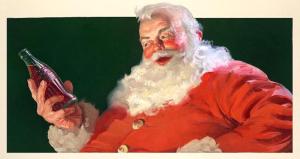
But you know what? Even the Mona Lisa was commissioned by a patron. Alphonse Mucha’s work involved a lot of  packaging, and many Art Nouveau relics are posters, magazine illustrations and ads. Whether or not it’s hanging in a museum now should be irrelevant. I like to marvel at the idea that it takes an artistic process to really reach out to the masses and impact culture.

Is all advertising art? Absolutely not. I’m really talking about the process of creating ads. Not everything turns to gold, especially if the client has anything to do with it (and they always do). But even those crappy Bell beavers came from the blood and sweat of many a creative who tried to make the frickin’ concept work (I know; I was one of them).

So it seems silly and short-sighted to belittle advertising without taking into account what goes into creating spots, and how effective they can be because we, the audience, aren’t indifferent. It’s worth mentioning, as well, that for every GM account, there are at least 5 non-profit organizations or disease research funds. Remember “this is your brain on drugs?” Yup. An ad agency was behind that one. And while it became dorm-room poster material, there was still a public service behind it.

Taking the critique to a more constructive level might involve looking at a system that allows corporations to use advertising to persuade the masses. But that’s not as easy to do, is it? Because that same system also makes room for thousands of clone magazines on newsstands, and narrowing the selection down is what we like to call censorship. It’s a shame that it’s almost as easy to throw around as “sell-out.” We really should only use “censorship” for special occasions.

Anyway, as an exercise, I’d like us to consider Naomi Klein’s point about Gap pioneering the branding movement, and to keep in mind that when the creatives worked on the Khakis series, it’s quite possible they were just having a little too much fun.