
If you have trouble getting back up on that horse, use a bigger ladder

A few months ago, I started a new job and people have often asked me how it’s going. Here’s the answer.

It’s the hardest thing I’ve ever done. The learning curve is huge. I took a break from journalism for three years, struggled in advertising, and now I’m struggling with something I wanted to do to begin with. It’s anything but easy, and part of the reason is that for the first time – ever – I’m surrounded by a bunch of people who are really good at what they do. Actually, that’s a lie. I was surrounded by the same kind of people at Cossette, but once I got there, I realized I didn’t really want to work in advertising, so it didn’t seem to count. It really should have. These are not the kinds of things we should only realize in retrospect.

Anyhow, despite the difficulty, I’ve decided that only arrogance would prevent me from giving this my bestest shot. So I’m just swallowing it, learning, working harder than I ever have, and turning the other cheek to all manner of criticism. After all, this is exactly what studying music is like: laborious, unforgiving, but so satisfying when you nail that crazy-ass cadenza.

Along the way, I’ve made mental notes on how to maintain stability. Here’s how I’m keeping afloat.

  1. It’s incredibly important to remember what you’re good at. Find as many opportunities as you can to make it surface. It’s a wonderful exercise to do something confidently.
  2. If someone else notices your strength and praises you for it, that’s gravy, but don’t seek praise and don’t dwell on it. Focus on the work.
  3. It’s incredibly important to know what you’re not so good at. If you don’t know and someone else tells you, and you trust the source, take it seriously. The truth is, there are only a handful of people who revel in putting others down. The rest are actually trying to help.
  4. Get better at everything. Get better at what you’re good at and what you’re not. Being great doesn’t last. You always have to do one better.
  5. Practice, practice, practice. If you can, spend more time practicing than you do working. Practicing will inform your work, and it’ll show.
  6. Give yourself a day or two to not worry about any of this. During that time, be lazy. Relish in recupe time.
  7. Don’t take your frustrations out on other people. If you have to criticize someone else’s work while yours is going through the ringer, remember the awesome responsibility of helping them grow. It’s so easy to be driven by bitterness, but it’s much more effective when you’re not. Also, people can always smell bitterness, and it’ll cut your credibility in half if you don’t stow it somewhere where it can’t emerge.
  8. When things get tough, find a figure who seems to have it together, and ask yourself what they would do. For me, it’s Scarlett O’Hara. I’m not sure Scarlett would do any of the things I’ve asked her to do so far, but projection is a good exercise. It takes you out of yourself for a moment and makes the difficulty seem feasible.
  9. There’s no way to medicate the problem. Like physio, it’s hard, it’s rough, it’s painful, but it’s the only way to get well. So savour the small victories.
  10. Remember, jockeys are about a quarter of the size of the horse, but ultimately it’s the rider that wins the race.

Maybe it sounds like I’m not happy, but it’s actually quite the contrary. This has been the most satisfying period of my life. Then again, I love a challenge.

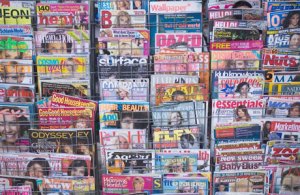
Magazines won’t die because the web is a pacifist

Lately, it seems everyone’s in a panic about the future of magazines. Well, everyone that’s around me, anyhow, since I happen to work at a magazine.
I work in the online division, and this, as many of my peers believe, is the future.

For the sake of my own survival, I can’t afford to think they’re wrong. The problem is they’re making this prediction to the detriment of the magazine, and I’m not sure it’s necessary. Just like Moogs and synthesizers didn’t completely replace folk music, magazines need not suffer a death by Internet.

When people talk about the web, they often remark that it’s a different experience from print, and this bit usually launches a spiel about the breadth of online media. Oddly enough, in that same conversation, they don’t often consider the possibilities of print.

The fact is, people still buy magazines and will continue to buy them because they enjoy the solitary and tactile experience far too much. When you’re on the web, you might be all alone with your computer, but you’re connected to the world. When you read a magazine, the world connects back, and just to you. And of course, there are those silky glossy pages. The web provides information quickly on any topic, but a magazine selects the best of those topics and explores them in depth, usually with pretty pictures. Ah yes! Fantastic photography: also missing from the web. Yes, you’ll find nice enough images on the Internet, but you won’t see them on a rich, contextualized layout, and that’s an important part of our magazine experience.

So the issue is really content. If we can ostensibly put everything that’s in a magazine online, why bother publishing? Fair enough. To me, information is the kind of thing that translates well onto the web. In online media, the common methodology keeps stories short and “web-friendly,” but it’s mostly hogwash (even though I tend to belong to common methodologist). People will click on page 2, 3, 4 and up to 82 if they’re interested in the material.

To me, all this means is that magazines will have to specialize and up the ante. Magazines are already good at engaging us in beautiful layouts, strong visual material and compelling writing. Now, they just have to do it better. While the web is good at catering to all the little micro-niches, magazines have the opportunity to exploit broader niches, things that don’t appeal to every taste, but that somehow connect us all.

The web says, “sure, put whatever you want here! I don’t mind.” Magazines go, “just the good stuff please.” It might seem snooty, but that’s the kind of material that provides an escape, where the web always keeps us mercilessly in the here and now. And there isn’t a person in the world who doesn’t want to escape just a little, once in a while.

Some magazines will probably have a longer life span than others. I predict that gossip rags will be rendered obsolete by sites like Perez and TMZ (who, incidentally, have also changed the landscape of gossip journalism by actually creating celebrities out of non-celebrities). I also foresee that specialty lifestyle publications known for their striking visuals (the Wallpapers, Vogues and enRoutes of the world) will fare well for some time, especially if they continue to excel at their art.

Other magazines made a much easier transition into the web, to the point where should their publication stop printing, they’ll still have a presence in our lives. I’m thinking of the Scientific American, Wired, the New York Times and The Economist. These publications have turned their websites into interactive news channels. But I think that’s because the nature of the information they provide allowed them to.

Some things, like art and a good story, just look and feel better on paper. If you don’t believe me, then answer this: what three magazines do you always take on a trip? My point is not what magazines you choose; it’s that you buy three.

Write like you

The odd thing about the “jack of all trades, master of none” clause is that it only works for certain professions. Supermodels, for example, are encouraged to “diversify,” because they won’t be in demand forever. Makes sense, and many, like Christy Turlington and Cindy Crawford, have been quite successful. But what if you diversify first, then try to specialize. If you‘re a writer, it’s hard.

I’ve always said that I was lucky to have had jobs that involved writing in one capacity or another. The problem is there have been so many capacities. I’ve written articles, captions, headlines, brochures, flyers, press releases, ad heads, ad sub-heads, body copy, web sites, concepts, short stories, Q&As, scripts, poems and so forth. For a while, I preferred journalism, but advertising paid more, so I went into it through a series of fortunate encounters. Then, last May, the big-ass agency where I worked as a junior copywriter lost their biggest clients, and I was one of the casualties. When it happened, I figured it was time to make a move back to journalism after a 3-year hiatus.

I got lucky. A job opened up at this prestigious magazine and it seemed to be a right fit. Plus, I’d get to work at a prestigious magazine to boot. Granted, I’d be working for the web site, but the magazine’s name is still attached to everything I do, and it feels great!

But the thing is, not only have I not been writing articles for three years, I also haven’t been corrupted by the magazine’s style.

Today, I handed in a piece to the magazine’s editor-in-chief, just to get her feedback. She told me there were some cute bits, but mostly I was “too PR.”

“You try to hard to get it right,” she says. “Don’t write right. Write like you. Write what you like.”

I don’t think I’ve ever done that, and it’s bloody hard! I don’t always know what I write like. I just write, and I’ve never asked if I was in there.

Still, what an exciting challenge. Maybe I haven’t been me in my texts before, at least, not when describing a hotel or restaurant. But I’m sure I’m in there somewhere.