
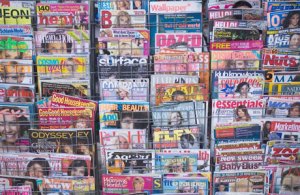
 Lately, it seems everyone’s in a panic about the future of magazines. Well, everyone that’s around me, anyhow, since I happen to work at a magazine.
I work in the online division, and this, as many of my peers believe, is the future.
For the sake of my own survival, I can’t afford to think they’re wrong. The problem is they’re making this prediction to the detriment of the magazine, and I’m not sure it’s necessary. Just like Moogs and synthesizers didn’t completely replace folk music, magazines need not suffer a death by Internet.
When people talk about the web, they often remark that it’s a different experience from print, and this bit usually launches a spiel about the breadth of online media. Oddly enough, in that same conversation, they don’t often consider the possibilities of print.
The fact is, people still buy magazines and will continue to buy them because they enjoy the solitary and tactile experience far too much. When you’re on the web, you might be all alone with your computer, but you’re connected to the world. When you read a magazine, the world connects back, and just to you. And of course, there are those silky glossy pages. The web provides information quickly on any topic, but a magazine selects the best of those topics and explores them in depth, usually with pretty pictures. Ah yes! Fantastic photography: also missing from the web. Yes, you’ll find nice enough images on the Internet, but you won’t see them on a rich, contextualized layout, and that’s an important part of our magazine experience.
So the issue is really content. If we can ostensibly put everything that’s in a magazine online, why bother publishing? Fair enough. To me, information is the kind of thing that translates well onto the web. In online media, the common methodology keeps stories short and “web-friendly,” but it’s mostly hogwash (even though I tend to belong to common methodologist). People will click on page 2, 3, 4 and up to 82 if they’re interested in the material.
To me, all this means is that magazines will have to specialize and up the ante. Magazines are already good at engaging us in beautiful layouts, strong visual material and compelling writing. Now, they just have to do it better. While the web is good at catering to all the little micro-niches, magazines have the opportunity to exploit broader niches, things that don’t appeal to every taste, but that somehow connect us all.
The web says, “sure, put whatever you want here! I don’t mind.” Magazines go, “just the good stuff please.” It might seem snooty, but that’s the kind of material that provides an escape, where the web always keeps us mercilessly in the here and now. And there isn’t a person in the world who doesn’t want to escape just a little, once in a while.
Some magazines will probably have a longer life span than others. I predict that gossip rags will be rendered obsolete by sites like Perez and TMZ (who, incidentally, have also changed the landscape of gossip journalism by actually creating celebrities out of non-celebrities). I also foresee that specialty lifestyle publications known for their striking visuals (the Wallpapers, Vogues and enRoutes of the world) will fare well for some time, especially if they continue to excel at their art.
Other magazines made a much easier transition into the web, to the point where should their publication stop printing, they’ll still have a presence in our lives. I’m thinking of the Scientific American, Wired, the New York Times and The Economist. These publications have turned their websites into interactive news channels. But I think that’s because the nature of the information they provide allowed them to.
Some things, like art and a good story, just look and feel better on paper. If you don’t believe me, then answer this: what three magazines do you always take on a trip? My point is not what magazines you choose; it’s that you buy three.





 OLIVIA COLLETTE