
If you have trouble getting back up on that horse, use a bigger ladder

A few months ago, I started a new job and people have often asked me how it’s going. Here’s the answer.

It’s the hardest thing I’ve ever done. The learning curve is huge. I took a break from journalism for three years, struggled in advertising, and now I’m struggling with something I wanted to do to begin with. It’s anything but easy, and part of the reason is that for the first time – ever – I’m surrounded by a bunch of people who are really good at what they do. Actually, that’s a lie. I was surrounded by the same kind of people at Cossette, but once I got there, I realized I didn’t really want to work in advertising, so it didn’t seem to count. It really should have. These are not the kinds of things we should only realize in retrospect.

Anyhow, despite the difficulty, I’ve decided that only arrogance would prevent me from giving this my bestest shot. So I’m just swallowing it, learning, working harder than I ever have, and turning the other cheek to all manner of criticism. After all, this is exactly what studying music is like: laborious, unforgiving, but so satisfying when you nail that crazy-ass cadenza.

Along the way, I’ve made mental notes on how to maintain stability. Here’s how I’m keeping afloat.

  1. It’s incredibly important to remember what you’re good at. Find as many opportunities as you can to make it surface. It’s a wonderful exercise to do something confidently.
  2. If someone else notices your strength and praises you for it, that’s gravy, but don’t seek praise and don’t dwell on it. Focus on the work.
  3. It’s incredibly important to know what you’re not so good at. If you don’t know and someone else tells you, and you trust the source, take it seriously. The truth is, there are only a handful of people who revel in putting others down. The rest are actually trying to help.
  4. Get better at everything. Get better at what you’re good at and what you’re not. Being great doesn’t last. You always have to do one better.
  5. Practice, practice, practice. If you can, spend more time practicing than you do working. Practicing will inform your work, and it’ll show.
  6. Give yourself a day or two to not worry about any of this. During that time, be lazy. Relish in recupe time.
  7. Don’t take your frustrations out on other people. If you have to criticize someone else’s work while yours is going through the ringer, remember the awesome responsibility of helping them grow. It’s so easy to be driven by bitterness, but it’s much more effective when you’re not. Also, people can always smell bitterness, and it’ll cut your credibility in half if you don’t stow it somewhere where it can’t emerge.
  8. When things get tough, find a figure who seems to have it together, and ask yourself what they would do. For me, it’s Scarlett O’Hara. I’m not sure Scarlett would do any of the things I’ve asked her to do so far, but projection is a good exercise. It takes you out of yourself for a moment and makes the difficulty seem feasible.
  9. There’s no way to medicate the problem. Like physio, it’s hard, it’s rough, it’s painful, but it’s the only way to get well. So savour the small victories.
  10. Remember, jockeys are about a quarter of the size of the horse, but ultimately it’s the rider that wins the race.

Maybe it sounds like I’m not happy, but it’s actually quite the contrary. This has been the most satisfying period of my life. Then again, I love a challenge.

Advertising Killed the Bulletin Star

Ever notice that when a brand does well, it’s advertising’s fault? It isn’t long before the same ad gets deconstructed in the academic world and chewed apart in laymenese by Naomi Klein. Sure, we’ll point fingers at the company behind the ad, but the agency gets a lot of flak too. And I have to wonder why.
When I was in university, we spent a whole week during one of my courses on advertising, and, to paraphrase, how evil it was. What made it evil? The fact that it summons specific imagery to speak to an elite market, or the fact that fashion photography favours a particular type of woman, and more importantly, how effectively advertising techniques work to sell a product or represent a brand.

Later, when life became about paying off the education debt (while I tried to see how my education payed off), it became clear that there was a divide among communications graduates. There were those writers who starved as journalists, and those who didn’t in advertising. As someone who’s been to both sides, I’ve observed that journalists tend to hate copywriters more. “Sell-out” is the usual accusation, and it’s a fairly easy one to throw around.

But here’s my problem with it. Never mind that the creative teams behind some of the ads we like most are genuinely nice people who often vote NDP. The question really should be, why does advertising work?

In my experience, many of the creatives I’ve worked with also have a hobby: art. I’m not saying this is the case for everyone, but they really are sensitive to this sort of thing because they put the same kind of energy into their work. Sure, they have to analyze a brief from a corporate angle, but the output is basically borne of an artistic process. And many of the art directors I’ve been paired with are more or less artists with jobs (and a bigger audience). As for the copywriters I’ve known: you should see what happens when they’re allowed to lock themselves up in a room and write a radio spot. Granted, clients rarely let these creatives express themselves the way they want to, but when they’re allowed to, you get “I’m a Mac.”

That aside, when we like an ad, we respond to it, and that’s what I’m getting at. It takes a certain kind of craft and skill to make us respond to it in the way that we do.

We all know that when we’re being advertised to by a company, with a laundry list of product benefits, we hate it. But when a company isn’t afraid to let creatives do their work in peace, you get something as timeless The Economist campaign.

Are ad creatives artists? It would be unfair to generalize, but kind of. And we’d never criticize artists, would we? Of course not! Art is sacred. Ads are business.

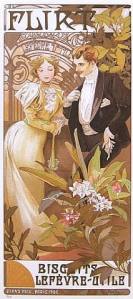
But you know what? Even the Mona Lisa was commissioned by a patron. Alphonse Mucha’s work involved a lot of  packaging, and many Art Nouveau relics are posters, magazine illustrations and ads. Whether or not it’s hanging in a museum now should be irrelevant. I like to marvel at the idea that it takes an artistic process to really reach out to the masses and impact culture.

Is all advertising art? Absolutely not. I’m really talking about the process of creating ads. Not everything turns to gold, especially if the client has anything to do with it (and they always do). But even those crappy Bell beavers came from the blood and sweat of many a creative who tried to make the frickin’ concept work (I know; I was one of them).

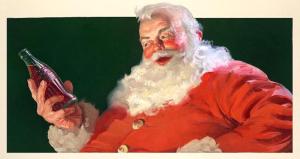
So it seems silly and short-sighted to belittle advertising without taking into account what goes into creating spots, and how effective they can be because we, the audience, aren’t indifferent. It’s worth mentioning, as well, that for every GM account, there are at least 5 non-profit organizations or disease research funds. Remember “this is your brain on drugs?” Yup. An ad agency was behind that one. And while it became dorm-room poster material, there was still a public service behind it.

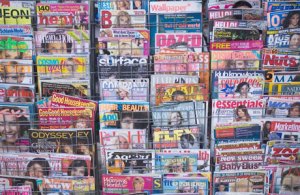
Taking the critique to a more constructive level might involve looking at a system that allows corporations to use advertising to persuade the masses. But that’s not as easy to do, is it? Because that same system also makes room for thousands of clone magazines on newsstands, and narrowing the selection down is what we like to call censorship. It’s a shame that it’s almost as easy to throw around as “sell-out.” We really should only use “censorship” for special occasions.

Anyway, as an exercise, I’d like us to consider Naomi Klein’s point about Gap pioneering the branding movement, and to keep in mind that when the creatives worked on the Khakis series, it’s quite possible they were just having a little too much fun.

Magazines won’t die because the web is a pacifist

Lately, it seems everyone’s in a panic about the future of magazines. Well, everyone that’s around me, anyhow, since I happen to work at a magazine.

I work in the online division, and this, as many of my peers believe, is the future.

For the sake of my own survival, I can’t afford to think they’re wrong. The problem is they’re making this prediction to the detriment of the magazine, and I’m not sure it’s necessary. Just like Moogs and synthesizers didn’t completely replace folk music, magazines need not suffer a death by Internet.

When people talk about the web, they often remark that it’s a different experience from print, and this bit usually launches a spiel about the breadth of online media. Oddly enough, in that same conversation, they don’t often consider the possibilities of print.

The fact is, people still buy magazines and will continue to buy them because they enjoy the solitary and tactile experience far too much. When you’re on the web, you might be all alone with your computer, but you’re connected to the world. When you read a magazine, the world connects back, and just to you. And of course, there are those silky glossy pages. The web provides information quickly on any topic, but a magazine selects the best of those topics and explores them in depth, usually with pretty pictures. Ah yes! Fantastic photography: also missing from the web. Yes, you’ll find nice enough images on the Internet, but you won’t see them on a rich, contextualized layout, and that’s an important part of our magazine experience.

So the issue is really content. If we can ostensibly put everything that’s in a magazine online, why bother publishing? Fair enough. To me, information is the kind of thing that translates well onto the web. In online media, the common methodology keeps stories short and “web-friendly,” but it’s mostly hogwash (even though I tend to belong to common methodologist). People will click on page 2, 3, 4 and up to 82 if they’re interested in the material.

To me, all this means is that magazines will have to specialize and up the ante. Magazines are already good at engaging us in beautiful layouts, strong visual material and compelling writing. Now, they just have to do it better. While the web is good at catering to all the little micro-niches, magazines have the opportunity to exploit broader niches, things that don’t appeal to every taste, but that somehow connect us all.

The web says, “sure, put whatever you want here! I don’t mind.” Magazines go, “just the good stuff please.” It might seem snooty, but that’s the kind of material that provides an escape, where the web always keeps us mercilessly in the here and now. And there isn’t a person in the world who doesn’t want to escape just a little, once in a while.

Some magazines will probably have a longer life span than others. I predict that gossip rags will be rendered obsolete by sites like Perez and TMZ (who, incidentally, have also changed the landscape of gossip journalism by actually creating celebrities out of non-celebrities). I also foresee that specialty lifestyle publications known for their striking visuals (the Wallpapers, Vogues and enRoutes of the world) will fare well for some time, especially if they continue to excel at their art.

Other magazines made a much easier transition into the web, to the point where should their publication stop printing, they’ll still have a presence in our lives. I’m thinking of the Scientific American, Wired, the New York Times and The Economist. These publications have turned their websites into interactive news channels. But I think that’s because the nature of the information they provide allowed them to.

Some things, like art and a good story, just look and feel better on paper. If you don’t believe me, then answer this: what three magazines do you always take on a trip? My point is not what magazines you choose; it’s that you buy three.