Not that I’ve ever gone to any trouble to deny it, but I can’t, for the life of me, sit through even 5 minutes of a zombie movie. Hell: I even put off watching Zombieland, a comedy. It’s never the zombie film itself that scares me. It’s more about what happens after. Each time I see a zombie on screen, I dream of zombies that night. And that’s the part I try to avoid.
My zombie dreams are terrifying and rather difficult to get out of. The set-up tends to be the same. Whether I’m in the city or country, it’s down to me and maybe 1 or 2 other living people. We know the world’s been taken over by zombies, and we simply wait for them to close in on us. I’m either lucky enough to wake up just as they’re about to get us, or I have to endure becoming one of them. Just to be sure, in my dreams, there’s never a way out. No heroic Woody Harrelson figure bursts through my door wielding a bazooka. I usually don’t scream much either, not because I’m paralyzed but because what’s happening is inevitable and the only thing to do is wait. I’m trapped. End of.
If I’m transformed into a zombie, I don’t suddenly scour the neighbourhood for non-dead brains. I just stop…being. I don’t do anything, really. I don’t move around or think things or want things. I am nothing. For a very long dream-time minute, until I wake up, my existence is nothing.
Save the brain-chasing, that pretty much sums up your average zombie reality. They seldom, if ever, get characterized in movies, because you can’t give “nothing” a personality. Vampires? Werewolves? Man-eating monsters? They sometimes get the artistic treatment. But zombie stories tend to focus on the experience of the living rather than the thing that’s challenging their living experience.
For many years, I’ve tried to figure out why I have a zombie phobia. Then recently, it dawned on me. I believe what scares me about zombie dreams is what’s scary about zombies in general: they are death itself.
Zombies force us to deal with death. They even force us to look death square in the face: warts, decomposed flesh and all. Zombies differ from vampires, monsters and aliens in that we can’t assign them any sort of “otherness”: they’re us. Not now, but soon enough.
And it’s a bleak future. They weren’t rescued by a forgiving god or a noble scientific process. They just laid there rotting in the ground until some unknown source animated their bodies. But they’re not sentient. They’re not really beings. They’re just piles of worthless flesh that we don’t even pity once they’re shot dead(er).
If zombies took epidemic proportions, we probably wouldn’t have much of a chance against them. We’d all die, but not just because zombies would kill us or turn us into them. Zombies’ food supply would eventually run out and they’d just starve to death. In other words: Buh-bye human race!
Death is already an idea most of us aren’t comfortable discussing. It’s the usual things: the lack of control, what the afterlife has in store, the possibility that there is no afterlife.
Extinction is far worse. It confirms our vulnerability as a species. It’s death with no legacy. It’s as if we were never there, which invites us to wonder if it even mattered that we were. This, of course, suggests that we believe we matter only if we are.
Meaninglessness is something people have never been very good at reconciling. Nihilism comes close, but it’s just no fun. And that’s the problem. Maybe life means nothing at all, but that’s hardly a reason to not have fun doing it. If anything, it’s an incentive to have a massive party.
So while people are hosting Walking Dead parties, I’m still working up the courage to watch the pilot. Some of you might egg me on, telling me to face my fear. And sometimes, facing fears can be fun. But I understand this phobia. I think I’ve been working it out in this post pretty efficiently. What scares me now is the prospect that having figured out the wherefore of this thing won’t prevent me from having more zombie dreams.
So, you’re sending your army to fight for something they might not completely understand, and many of them will meet certain death in the process? They’re going to need a little pick-me-up, a reason for doing it. Add a touch of glory to the message: it’ll be the caffeine boost of the initial attack. Try to work in words like “honour,” “courage,” “heroes” and “for centuries.” They’re motivational gold, proven to produce fewer deserters than other pre-battle keywords.
What’s that? You’ve got an army of hundreds? A couple thousand? All on horseback? You’re from 5th-century Middle-Earth? You don’t know what a megaphone is? Listen, I’m not being funny, but I’d be surprised if anyone hears you past the first couple of rows.
Whyn’t you do everyone a favour and make sure there’s enough beer.
There’s no way to dress it up: I didn’t meet my father until I was 16 years old. Circumstances, more than anything else, had a hand in it. For most of my short life at that time, my father lived on Canada’s west coast while I lived in Germany. When I returned to Canada – on the east coast, mind – I was still too young to travel on my own. So when I was 16, I finally made the cross-country trek.
Until then, I only really knew snippets about my father, mostly from my mother’s glowing reviews. He and I had also spoken on the phone a few times, but this was before phone cards, cheap long-distance plans and Skype. Otherwise, we’d gotten to know each other through correspondence.
My mother had pictures of him, but they all dated back to 1975, a little before I was born. He looked like Cat Stevens, especially with a guitar in his hands. It struck me because it provided a clue about my own musical inclination. Back then, we were all so sure that I’d turn my years of classical piano training into a career in music.
When my father and I finally met in person at the airport, he embraced me urgently, saying, “god, you look like me.” He was right. The rest of our 2-week vacation was largely spent pointing out our similarities and our uncanny body language (we seem to unwittingly cross our arms at the same time).
But it was still a little awkward for me. Being in a household with no female presence felt uncomfortable. My father was no longer a legend. He’d become a real person, with all the flaws that being human entails. He started to look less like Cat Stevens and more like himself. And in all the important ways, he was a stranger. My father picked up on it and told me it was okay for me to feel weirdness or even resentment. I couldn’t really classify any of the emotions, so I swallowed it and told him it was nothing. So he swallowed it too.
One thing I learned about him was that he loves jazz. He even had a show at the University of Victoria’s radio station. He called it Joe’s Garage (a playful cross between my father’s name and the Frank Zappa album). His show featured guitar jazz exclusively. Lots of Steve Vai, Chet Atkins, some Django Reinhardt and Béla Fleck. When I told him there were similarities between baroque music and jazz in that they’re both improvisational, my father turned it into a show, with me as the guest. I remember that he played Lenny Breau’s jazzy rendition of Bach’s Bourrée in E minor to draw the connection for listeners.
Right after the show, we stopped by UVic’s repertory theatre, which was in the same building. This was exciting for me. We didn’t have that sort of thing in Moncton yet. And when I saw that they were playing Tous les matins du monde, with Gérard Depardieu and his swoonworthy son Guillaume, I begged my father to humour me.
The next day, we attended the early show. I didn’t know much about the movie, but I’d heard about it, and Gérard Depardieu’s fame had somewhat trickled down to North America on the heels of Green Card and Cyrano de Bergerac. I knew it was a period piece, but I had no idea it would revolve around baroque music. The discovery delighted us both.
Marin Marais faces his inadequacies in the last few moments his life lets him have.
Tous les matins du monde is a fictional account of the lives of composers who actually existed. (Biopic filmmakers take note: themes are infinitely more engaging than “milestone moments.”) Gérard Depardieu plays Versailles court composer Marin Marais, and his son Guillaume plays the same character at a younger age.
The movie has an exquisite opening shot, with the action happening off-camera. Knowing that death is closing in, Marais confides in his orchestra. He admits he’s an imposter, and segues into the tale of his aloof and temperamental music teacher, Monsieur de Sainte Colombe, played to pitch by Jean-Pierre Marielle.
Sainte Colombe outranks Marais in talent, awareness and proportion. Marais knows this and spends his life trying to understand what Sainte Colombe has that he doesn’t. The set-up is similar to Amadeus, but unlike Salieri, Marais is clueless about his inability, in part because he’s in a hurry to get famous. “You’ll wear lovely robes, you’ll dance for the king’s circus. It might impress some but it’ll never move them,” Sainte Colombe predicts. “You’ll make music, but you’ll never be a musician.” Sainte Colombe isn’t trying to condemn Marais, but he knows that ambition stunts growth.
If only Madeleine had listened to her father.
To complicate things, young Marais has an affair with Sainte Colombe’s daughter, Madeleine, only to leave her for a woman more fit for the court. Madeleine, who had taught Marais for months after her father dropped him in a violent fit, retreats into a resolute sombreness that eventually leads to her suicide.
Matins is also about mourning. Sainte Colombe owes much of his rage to unwavering grief over the death of his wife. It’s why he composes “Le Tombeau,” an opus of viol pieces. Himself a muted man, Sainte Colombe spends most of the movie trying to teach Marais that music replaces the words we can’t say, and says the things there are no words for. Of course, it isn’t until the end that Marais gathers all of his sorrows and weeps, with viol in hand, for his betrayal of Madeleine, for his decades-long ignorance, for the swanky court position he doesn’t deserve. He’s redeemed, just in time to die.
The film’s title comes from a line in Marais’s narration. “Tous les matins du monde sont sans retour.” It translates to, “all the mornings of the world never return,” which is as poetic in both languages, and possibly the most apt description of regret.
When the movie ended, there was a heavy silence in the theatre. I looked around and most people were teary, including my father. “I wasn’t expecting that,” he said. He and I spent the rest of the evening discussing the movie: its perfect soundtrack (mostly rendered by violist Jordi Savall), the way the cinematography mirrored baroque paintings, the fact that there really isn’t much dialogue, and the truth about music.
I thought of the movie’s relationships, most of them entrenched in disappointment. Is it so different from how a teenaged girl feels about her parents? As an adult, I’m going to be pleased to put all that behind me. I’ll want to have a friendship with my parents. But at 16, I’m not there yet, least of all with my father.
Later, I would learn that Guillaume and Gérard Depardieu had a tense father-son relationship, wrought with anger and envy, not unlike Marais and Sainte Colombe. When 37-year-old Guillaume Depardieu died of pneumonia in 2008, people disparaged Gérard for reading a passage from Le Petit Prince as his eulogy. They felt it was further proof of Poppa Depardieu’s rumoured heartlessness, without considering that it might have been too painful for him to speak frankly at his own son’s funeral. I suppose they would have preferred him to give the performance of his life.
Gérard never denied his difficult relationship with the troubled Guillaume, but any criticism always came with a sliver of admiration. “He’s a great man,” he once said of Guillaume, “and especially a great actor.” After Guillaume’s death, in an interview with Paris Match, Gérard said, “He had his excesses, and I had my foolishness, but there was no conflict between us. He didn’t have issues with drugs. His real problem was life.”
Family ties are complicated. Children go from needing their parents to wanting them overthrown, and that transition takes almost no time to occur. Naturally, it’s worse when children actually have a reason to begrudge their parents. It’s messy stuff, and I can’t imagine having to live it out in public.
I didn’t want my father and I to have a resentful subtext between us. So eventually, I came clean with emotions I couldn’t comprehend or name. He was my father, but we didn’t know each other yet, and it would take some time. There was bitterness and confusion and love all at once. He graciously understood. He didn’t ask questions. He didn’t try to explain his side of the story. He just made himself available for whatever I might need.
And I embraced it because I thought it would be a shame to root our relationship in regret. We had music in common. Isn’t that a good start?
Daddy-O and I singing Karaoke to "California Dreamin'" at the reception.
Roger Ebert published a rather fascinating piece arguing that video games cannot be art. Not surprisingly, there’s been a lot of backlash. Video gamers are a loyal bunch, but it’s not that they need to justify what they love by calling it art. They honestly feel that video game creators are artists. That’s why they let Blizzard take years to release any game, because like the developers, gamers want them to get it right. There’s an intricate creative process that goes into developing a video game (even a bad one). And it’s no different than spending a decade on a sculpture (even an ugly one).
Ebert was compelled to broach the topic when he saw a TED presentation by Kellee Santiago, a game designer and president of thatgamecompany. In it, she attempts to prove that video games are, in fact, an art form. I enjoyed Santiago’s spiel, but I felt she didn’t tackle the artistic elements of videogames. While she focused on engagement and emotional involvement, she didn’t deal with design or conception and how these create engagement in the first place. This seems like the most obvious argument for a game designer. She also kept bringing up critical acclaim as though it were synonymous with artistic street cred, which it isn’t. Taste doesn’t art make, as Ebert admits. Anyhow, I don’t feel she makes much of a case for the art of video games. So I’m going to try.
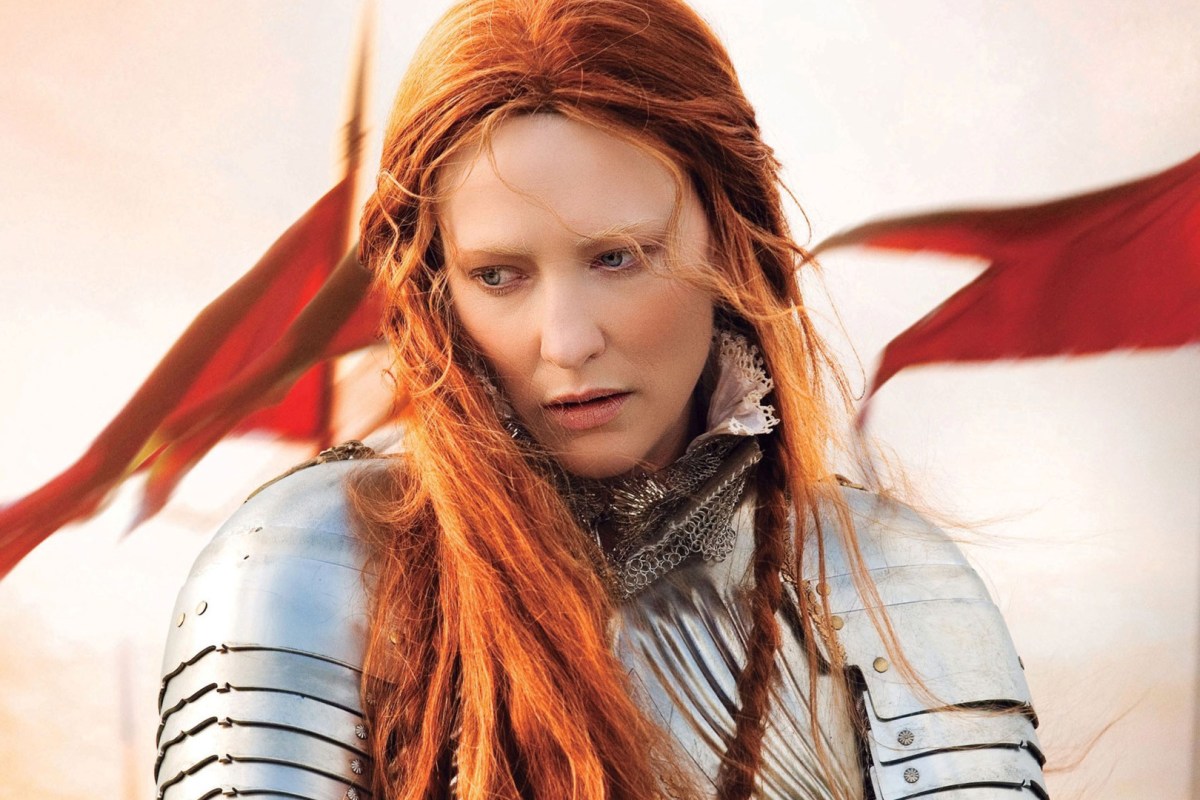
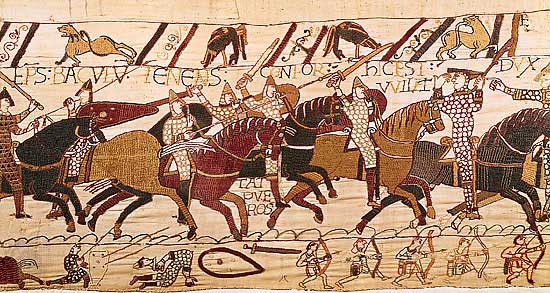
Medievalism: the root of most RPGs.
I want to preface this by mentioning that in the earlier part of my career, I was a journalist for a video game news website. Here, reviews are one of the major draws. Otherwise, what’s considered news is the announcement of a new game in development, and as many bits and pieces of that game as the studio behind it is willing to reveal. Those bits and pieces usually constitute concept art, in-game screenshots, and trailers. Why are these things important to gamers? Because it helps them assess what the gaming environment is going to be like, and that’s integral to their experience of the game. Sure, you could argue that most games have an objective; some sort of MacGuffin that has to be won or conquered. But to paraphrase Ebert: it’s not what the game is about, it’s how it is about it. The people responsible for the “how” of any game are the designers, the writers, and the many creators involved in taking you on a journey through the game. Really, the process of creating a game is no less artistic than what went into weaving the Bayeux Tapestry.
So what is art, then? Santiago cites the Wikipedia definition, which says that “Art is the process or product of deliberately arranging elements in a way to affect the senses or emotions.” Like Ebert, I’m not convinced this encompasses the totality or complexity of art; the description feels inadequate. But I find it touches on an important part of the experience of art. It’s about engagement, and video games engage people; that much is easily recognizable.
That’s one way to get people’s attention.
Do video games engage people in the same way as art? It depends on the medium we’re talking about. It’s only fair to compare video games to other media that lend themselves to similar experiences. Is playing a video game the same as looking at a sculpture? Not in the least. Is it a bit like reading a book? Certainly, if we’re talking about fiction. It requires the same process of suspending one’s disbelief to accept an alternate universe that’s different from the reality we know. The absorption of a book is similar to playing a video game in that it’s immersive, even if the adventure isn’t yours in the strictest sense. Otherwise, the visual dimension of video games can be compared to watching animation or a film: there’s a moving picture, and the construction of it is as deliberate as anything Stanley Kubrick might have done. I’m not comparing video game designers to Stanley Kubrick, but I’m sure many of them are inspired by his work and have used it to feed the vision of their output. And like Kubrick, game creators work hard to elicit a specific response from their audience. Which brings me to my next point.
Art requires an audience. Without an audience, there is no art. Art is one half of a relationship and a dialogue. It has to be presented to someone else as art, and, whether good or bad, it has to be acknowledged as such. Art doesn’t require taste, just one crucial social transaction.
While those who play World of Warcraft may or may not attend the next Picasso exhibit, they belong to an enormous demographic and are hugely devoted to the work of their favourite artists. This also means that they give video game creators jobs. And this addresses a strange cultural paradox: we seem to have a bone to pick with artists who make money. Game designers, much like art directors in an ad agency, are artists with jobs. They’re not struggling financially. They impact culture in an important way. They have a widespread audience, and it’s incredibly, immediately receptive to their work. Dissenters call it “selling out,” but video game creators prefer “raison d’être.”
Can any game be art? I’m not sure about that. People have brought up chess a lot, and my problem here is with the mathematics of the game. It’s functional and objective-driven. This doesn’t take away the enjoyment of it, but there’s no engagement with the imaginary, which is what’s so distinct about video games. There’s no “what if” fancy in chess. It doesn’t make it a lesser game, just an inappropriate comparison.
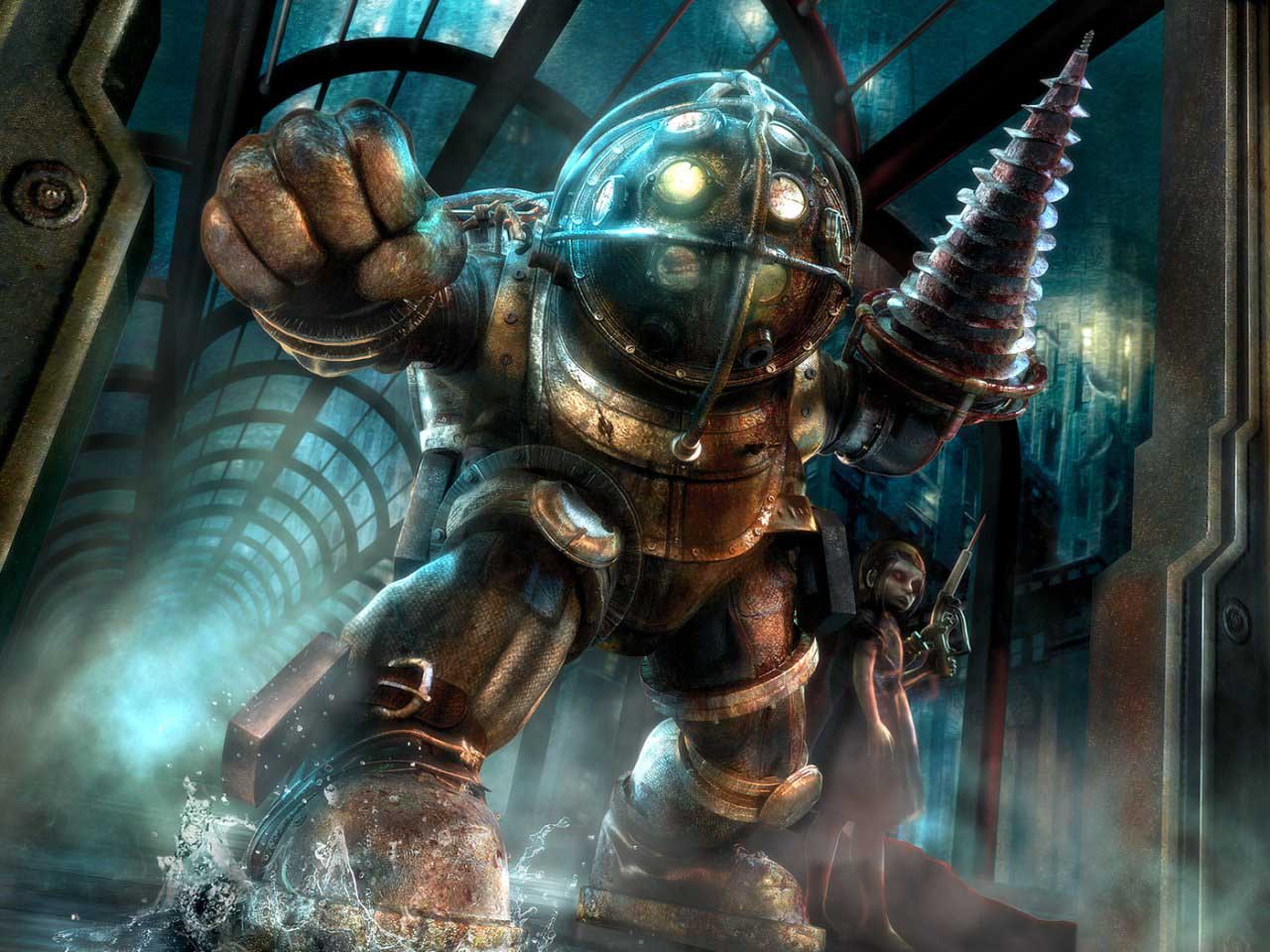
One of the terrifying BioShock bad dudes.
Art isn’t just a component of video games. It’s necessary to enhance the gameplay. An example that’s commonly brought up to negate this is the first-person shooter (FPS). They’re often touted as mindless and one-dimensional, which is fair enough if you consider that the genre mostly involves one repeated action. But the “first-person” aspect is what gives the genre substance. Players need the art to believe the first-person gameplay. They also need a unique reason to choose one FPS over another (enter the Quake vs. Unreal debate). Games like BioShock demonstrate that it’s infinitely more interesting to shoot things in a setting that’s entirely alien, where surprise is just around corner. What impressed fans and critics about this game wasn’t just the graphics; it was also its Randian underwater environment and dystopian story. This means a lot of effort when into conceiving this world, and that’s not the work of marketers or project managers. These are storytellers at play in an interactive digital medium.
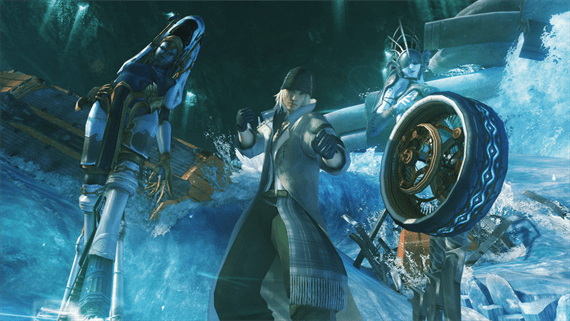
One of the many Final Fantasy landscapes. Someone was hired just to design the trees in this forest.
Immersion is even more important in role-playing games, and it can’t happen without a bewildering universe. Just the other day, the husband unit finally bought his copy of Final Fantasy XIII. I’ve never played games from this franchise myself (I prefer straightforward adventure games), but if you’ve followed the series, it’s perhaps the best testament to the genre’s evolution. When you consider its 8-bit beginnings, it’s all the more astonishing that the gameplay graphics are now on par with the in-game movie sequences. FFXIII also boasts a whole ecosystem that makes me wonder how the developers came up with their flora, fauna and technology. Their world is both plausible and impossible, at least for now. And isn’t that good science fiction?
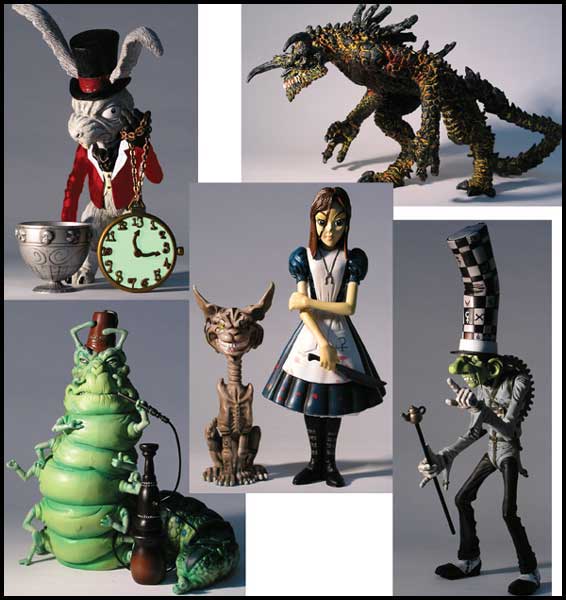
Though it’s a little dated now, my favourite game is American McGee’s Alice. Most of its reviews were the same: awesome universe, great gameplay, but the end boss sucked. In other words, the journey was greater than the destination. Since the game’s release, American McGee and his work have garnered something of a cult following, starting with toy models from Alice, including the sickly Cheshire cat and the sadistic White Rabbit. McGee, for his part, knew the Wonderland and Looking Glass mythologies so intricately that his reconstruction was solid. And the characters? Flawlessly designed.
American McGee’s Alice merch, sold at a geek store near you.
Since Alice’s release in 2000, McGee relocated to Shanghai and set up a new studio, Spicy Horse. When asked to list the advantages of working overseas, he said the biggest bonus was a “blue sky mentality. Game development [in Shanghai] is a relatively new industry, and there’s less of a ‘history burden’ in terms of conceptualizing games, studio structure, and development process. People are more open to radical ideas.” Among other things, his answer alludes to the multidisciplinary nature of game development, which, in this respect, is not unlike moviemaking.
I’m also a fan of time-management games, and while these don’t make use of mind-boggling graphics, an art team is still involved. Sally’s Salon doesn’t look realistic, but it doesn’t have to, and that’s part of the fun. We accept that in animation, so surely we can make a concession for time-killers. There are also games that take no time whatsoever to go to market (the TV franchises, the board game simulators, etc.). But that exists in the movie industry as well. It’s the part of the business that’s just business, and that can’t be helped.
In terms of the craft itself, a meticulous creative process has often been directly linked to a game’s success. And why shouldn’t it? It takes time to create a world, especially one that works. I might argue that it takes more effort than penning the next Nic Cage action flick. But I don’t think this has to be about choosing film, poetry or painting over video games. I don’t think you can only prefer one if you discredit the other. Video game creators use different tools and speak to a different audience, but there’s room for that too in the art world. Or rather, there should be.
Is playing a game an art? No more and no less than watching a movie. But as long as we rely on art to enhance the gaming experience, we simply can’t separate the video game itself from the art that’s involved in making it. To deny the artistic process that goes into creating games is, I believe, short-sighted, if a little snooty.
***
My buddy Roger has gotten a lot of flak for his piece, and while it was to be expected, I think it’s undeserved. He hasn’t discouraged dissent, he’s taken the more scathing comments in stride, and he’s even linked to this Cracked article and this academic paper on the art of video games. It’s fine to disagree with someone, but it’s important to recognize when you get to do it in the context of a discussion. On that front, Ebert’s been a real good sport.
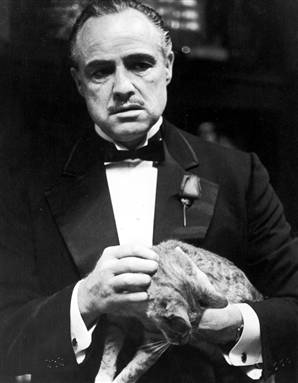
On the day of his daughter’s wedding, Vito Corleone can’t refuse a single request, no matter how eccentric. Yes, of course he can help you pay for those restaurant renovations. That Hollywood producer is giving you a hard time? Don’t worry. He and Vito are going to have a chat. What’s that Fluffy? Sure, Vito’ll scratch your neck. You like that, don’t you, Fluffy. Yes you do. (Yes you do.) So does Vito. He’s always loved cats. And in just a few scenes, he’s going to do something to a horse that really sticks it to the Hollywood suit.
Vito Corleone may be a cruel monster, but his cat *loves* him. And as any cat owner will attest, that love is duly earned. Sure, they’ll brush up against your leg, maybe let you pet them a little. But the Corleone cat is rolling around on godpoppa’s lap, showing him the bellied goods. That means Fluffy and Vito have a history that Vito’s taken the time to nurture.
If anything, that’s what makes Vito Corleone so scary. Sure, he’s a ruthless murderer who wouldn’t give a second thought to pumping your torso full of holes. But he’s also a cat person, which is so…ordinary.
I’ve always been more freaked out by average folks who are capable of great evil than fantastical serial killers, like Freddy Krueger. Psychologist Dr. Deborah Serani says that makes perfect sense. “Any human being…is far more frightening than a distilled, flat-dimensional psychopathic character,” she explains. “The reason that it’s creepier is because we are all human and complex. And when we discover that someone just like us can do evil, terrifying things, it causes us to wonder how close we can be to doing such things.”
I’m not sure how close I am to doing any of the things the following movie villains did, but they left their mark because their brand of evil is seasoned with the uncannily mundane.
“Wait for the cream.” – Colonel Hans Landa, Inglourious Basterds
There’s a lot that’s unsettling about Colonel Hans Landa: his cool demeanour, his inexorable grin, his talent for capturing Jews, and especially his sharp mind. He’s a cultured fellow, having travelled plenty, learned many languages, and tasted a host of different foods. Yet there’s little he seems to enjoy more than a plain glass of milk. Dr. Serani thinks Landa uses it to assert his authority over the situations he’s in, from confronting the dairy farmer to that unnerving afternoon tea with Shoshanna. That’s certainly the larger subtext of those scenes. But his love of milk seems disconnected to hunting Jews. It’s more like one of life’s simple pleasures, like the icing on the cake, or the cream on the strudel. It does something to his palate, perhaps taps into a soothing childhood memory. So when he has a glass of the farmer’s milk, it feels more like a “don’t mind if I do” than a “what’s yours is mine.” According to Christoph Waltz’s own description of the character he portrayed, Landa is “realistic to the point of being inhuman.” Add that to Quentin Tarantino’s penchant for quiet terror and you’ve got one bone-chilling Nazi.
“A hobby should pass the time, not fill it.” – Norman Bates, Psycho
Though Alfred Hitchcock felt Psycho was his answer to the slasher genre, the picture is riddled with suspense. Unlike his other movies, you don’t find out who the killer is (well, not for sure, anyway) until the very end, and during that ride, you have to contend with a mild-mannered, gawky, shy momma’s boy. You know something isn’t right with Norman Bates, but you’re willing to give him the benefit of the doubt. Even though he spends a lot time stuffing dead animals and preserving them in lifelike poses. I honestly don’t know what’s more disconcerting: the fact that Norman Bates is a taxidermist, or that he has a hobby. It’s a painstakingly precise craft, and one that takes years to perfect. You have to wonder what kind of boredom and loneliness led him to taxidermy, and how all of those things led him to murder. When we find out that Norman Bates killed his mother and kept her corpse, we come to the eerie realization that what he really preserved was her personality.
“Forgive me for prattling away and making you feel all oogie.” – Annie Wilkes, Misery
I’ve always said that there’s a difference between being nice and being polite. Annie Wilkes is too polite from the start. From her disdain for profanity to her exaltation of Paul Sheldon, author of her favourite series of novels, Misery. It’s actually the fictional Misery Chastain that she loves, so Paul Sheldon, as her creator, is worshiped by association. It’s not altogether clear what kind of character Misery Chastain is, but we know she’s a romantic 18th century heroine. We also know that Annie Wilkes found comfort in reading when her husband divorced her. Since she’s bananas, she skirts over the fact that her husband left her because he got wise to the whole “my wife’s a nutty serial killer” business. Whatever the case, reading is what kept her cuckoo under control, and it’s when Paul kills off Misery that Annie loses it. Who knows what it is about Misery that kept her sanity in check, but Paul’s misery grows exponentially until he writes her back to life.
“I want to earn enough money that I can get away from everyone.” – Daniel Plainview, There Will Be Blood
Did your parents have a specific activity they didn’t want you to interrupt? My mother doesn’t like being bothered during Entertainment Tonight. Oprah’s okay, but don’t you cut into her Mary Hart time. Daniel Plainview feels the same way about bookkeeping. Don’t come a-knockin’ when Plainview’s on a date with the general ledger. It’s pretty much the only thing that matters to him. He relishes it so much he’s given to psychopathic behaviour if anyone intrudes. He’s crunching numbers when his adopted son tells him he wants to branch out on his own. Plainview goes into a blind rage, calling his son a “bastard from a basket.” Then that brat Eli Sunday comes around asking for money when Plainview is busy counting it. And without an ounce of sympathy, Eli gets some sense beaten into him with a bowling pin. Sure, Plainview’s hatred for the duplicitous Eli had been brewing for years, but the poor boy’s only sin, here, was bad timing.
“Call it.” – Anton Chigurh, No Country for Old Men
Anton Chigurh is more of a poltergeist than a person. You can feel his effect, but you don’t really get to know him. Yet there’s this thing he does after each murder. He checks his boots to make sure no blood got on them. And the thing is, he’s not worried about leaving evidence behind or getting caught. For whatever reason, he just wants to keep his boots clean. Maybe it’s OCD. Maybe he doesn’t like blood. Either way, he can’t seem to help himself. So he checks his feet to make sure all’s right with the world, and when it is, he carries on. Anton Chigurh doesn’t have too much dimension to him beyond this, but that little neat-freak detail makes me even more curious about him. That and the coin toss. I mean, Buddhist much?
Honourable mention: Kristina, Happiness
For no other reason than this quote: “Everyone uses baggies. That’s why we can all relate to the crime!”
To cap off what’s been a surprisingly successful series on the ‘90s, I want to impart some wisdom that could very well save our culture. Not everything from the ‘90s is worth hanging on to. So when we plan our revival, let’s carefully curate the things we revisit and leave these duds behind.
1. The laugh track
No, it wasn’t invented in the ‘90s, but near the end of the ‘90s, good writing started to phase it out. Shows like Dream on, Ally McBeal and Sex and the City proved that people could laugh in all the right places without taking cues from a phantom audience. Sure, the ‘90s gave us Seinfeld and Frasier, but they were also responsible for Caroline in the City, Just Shoot Me and The Fresh Prince of Bel-Air. When you look back at some of these, it’s staggering how un-funny they are. Such punchline-driven cheap shots. Such meaningless catch phrases (or in the case of The Nanny, a series of grating groans). So will someone please send Two and a Half Men back to 1995 where it belongs? We’ve got 30 Rock and The Office now. We’ll just take it from here.
2. Dimestore spirituality
Though I’m not the biggest fan of self-help, some of it speaks on a tangible, grounded level. Unfortunately, the ‘90s wanted to balance that out with a new brand of New Age, and it was never very clear what doctrine a person was following. Oprah’s “Remembering your Spirit” segment invited guests to describe their calming rituals, like drawing a bath or, in the case of Martha Stewart, berating the help. Books like The Celestine Prophecy became hugely popular, and despite being a work of fiction, some still adhered to some of its proposed “insights.” And TV producers played fast and loose with Christian dogmas to make Touched by an Angel and Seventh Heaven more mainstream. The ensuing melting pot didn’t use the best ingredients, just the most popular.
3. Whiny pop that tried so, so hard to sound like alterno
Grunge did something to the music industry. It opened up a whole new market. But true-blue grunge artists cared a lot more about the music than their labels did. So labels started working with musicians who were willing to follow orders. That’s how we ended up with the radio-friendly, easy-listening drivel of the Goo Goo Dolls, the Gin Blossoms and that Friends band. There’s still some of that going around today. You have the Stereos, who are just enough emo to bellyache through each song, just enough rock to distort their guitars, and just enough hip-hop to sing every note on auto-tune. It’s just awful. And hopefully it’ll move back in with its mother Cher, circa “Believe.”
4. Khakis
Despite one very enticing Gap ad campaign, khakis just don’t look as good on people who aren’t professional dancers or models. They seem so promising because they’re classic, but that doesn’t translate into staying power when the trend resurfaces. So this time around, if the khaki comes back, let’s just act like we don’t know it.
5. Will Smith
He and I were cool until he became a Scientologist.
I actually liked the Fresh Prince in Six Degrees of Separation. Why didn't he go all Stockard Channing instead of Tom Cruise?
Oh, how we loved poking fun at the ‘80s! But when the things we hated most about them were brought back by American Apparel and possibly Marc Jacobs, old was new again. So I’m convinced that we’ll come to a similar conclusion about the ‘90s because they really weren’t so bad, and, if we want to get all sentimental about it, they helped us build the new millennium. Plus, good or bad, we actually held on to some ‘90s stuff. Here’s proof.
1. The a-ha! ending
What do TheUsual Suspects, Fight Club and The Sixth Sense have in common? An unexpected, what the?, second-viewing-required ending. If anything, these movies improved the suspense genre. Alfred Hitchcock was a strong enough storyteller to tell you who the killer was right away and make you itch in discomfort until they got caught. But replicating that experience has been a challenge. And then writers realized they just had to be more clever to build a better mystery. The best example is probably Memento, but the tradition carries on with pictures like The Machinist and Shutter Island.
"The greatest trick the devil ever pulled was convincing the world he didn't exist."
2. Here, queer & (getting) used to it
There’s nothing pretty about it: right up until the ’90s, gay and lesbian characters in movies or novels were often crazy, obsessed with the object of their affection, and/or just plain evil. AIDS gave people one more thing to blame on homosexuality, but when hetero women started contracting the disease, we couldn’t generalize these things any longer. That’s when we had to acknowledge the LGBT community, its budding voice and its rights. Then, on the heels of pop artist Keith Haring’s death, Madonna went into public service. She commented on religiously-backed bigotry and sexism in “Like a Prayer,” encouraged women to demand an orgasm in “Express Yourself,” celebrated/stole a gay club dance trend with “Vogue,” and hired mostly queer dancers for her Blond Ambition tour, as documented in Truth or Dare. That’s how the ‘90s started, and those sensibilities about the LGBT community remained in our consciousness. Though homophobia is still present and marring equality to the tune of Proposition 8, it didn’t quell Ellen’s eventual coming-out or the popularity of Will & Grace and The L Word. Today, we’ve replaced the term “lifestyle choice” with “orientation” (but we could still do better), and more people accept that sexuality, in all its forms, is biologically assigned. Maybe it’s because we dealt with so many LGBT issues in the ‘90s and part of the 2Ks that Lady Gaga’s butch-on-girl kiss in “Telephone” is a relative non-issue now. Certainly compared to how people reacted to “Justify my Love” in 1991. There’s still a whole lot of progress to be made. But we’re lightyears away from 1989, thank goodness.
3. Political correctness
Having hoorayed for gays, it must be said that the ‘90s also introduced a whole slew of new terms to replace old words that were borne of racism, chauvinism and general power structures that no longer reflected our new equal & empowered reality. I’m not saying it was a bad thing, and I couldn’t because I’m a woman. I personally benefitted from these changes. Still, the double-edged sword of political correctness is that it essentially masks old views instead of replacing them. A word can alter your language about an issue, and that’s certainly important. But it takes conviction – not just vocabulary – to create a revolution. That’s why words like “tolerance” have always irked me. It means putting up with something you don’t like, when, especially in the case of discrimination, it’s the dislike that needs to change.
4. “I’ve never been to me”
This is probably one of my least favourite ‘90s hangers-on, but it’s so popular that I have to address it. From John Gray to Alanis Morissette, if there’s one thing the ‘90s taught us, it’s that people in the westernized world have the luxury of spending a lot of time on their own problems. Enter Self-Help, which has its own bookstore section, right in between “Psychology” and “Cooking.” It taught us phrases like “scarred for life” and “you can’t love others until you love yourself.” Since the ‘90s, this trend has gotten bigger and, I would argue, more dangerous. Case in point: The Secret is still riding high on Oprah’s endorsement, and it teaches little more than you will get rich just by sitting on your ass and thinking positive thoughts. Why? Because the universe owes you. Which is exactly like saying that children toiling in sweat shops could change their fate if only they thought of bunnies and flowers instead of, you know, eating.
5. The Internet
Okay, so the Internet, as a technology, has actually been around since the ‘60s, but it wasn’t used by the public until 1991, and it only became commercialized and widespread in the mid-‘90s. If Twitter’s taught us anything, it’s that the way people interact with your invention is often more important than the invention itself. Although the Internet has all but replaced the library, abbreviated your TV and usurped the Associated Press, its most considerable achievement, I believe, was to make Playboy kind of soft core.
Laugh if you will, but back in the day, this machine was the shizzle.
Coming up: things the ‘90s can bloody well keep to themselves!
Remember the ‘80s? Or rather, our once-collective hatred of the ‘80s? Then American Apparel came along and used that washed-out Polaroid aesthetic to sexify Flashdance shirts, and we bought it, along with some leggings and legwarmers. We thought, “okay, so long as mullets don’t come back.” Then the faux-hawk went emo and everything from the Ziggy Stardust to the Farrah got an asymmetrical, jagged-edged revamp. And we thought, “that’s alright, so long as big shoulder pads are gone for good.” Then Lady Gaga…well…Lady Gaga.
I’m not incensed by any of this. What I find odd is that since the ‘80s went retro, the ‘90s have taken a beating. Thing is, I liked the ‘90s. Possibly because that’s when I was a teenager and life seemed simpler, if disproportionately more dramatic. But I really did have fun then. The grunge scene. Mosh pits. Pop psychology. I miss that whole era, and I’d bet if any of you think long and hard on it, you’ll get a bit nostalgic. So before you go treating the ‘90s like your dweeby kid sister, I want to point out which parts of that decade are worthy of a revisit.
p.s. I’m going to follow this up with a list of things that should have stayed in the ‘90s, and things we mercifully kept.
1. The Sixties
The first thing to mark the ‘90s was a ‘60s revival. It started with the big fat headband, made popular by Lady Miss Kier, followed by flower-power t-shirts, babydoll dresses and chunky heels. Hippy trends eventually ensued, from the long hair to the surprising return of bellbottoms and peace signs, which somehow got intermingled with grunge. Still, I’ll romanticize the ‘60s any day, and if Amy Winehouse and Mad Men are any indication, we can look forward to one swinging déjà vu.
Lady Miss Kier, from Deee-Lite. Is groove in your heart?
2. Beige and burgundy lipstick
In the 2Ks, makeup went the way of the fallacious “let’s look like we’re not wearing any” trend. Not so in the ‘90s. I can even date a ‘90s flick based purely on the shade of lipstick. Back then, wearing makeup meant observing the rite with the dutiful application of noticeable colours. I’m not sure why nobody committed to all-out red, but burgundy was the shade you wore to work, to dinner, or to the club if you wanted your style to say, “I’m a lipstick kind of woman.” For a more “natural” look, women wore beige. A very thick, opaque, heavily lip-lined beige. Resist it if you will, but remember that we long thought blue eye shadow was reserved for theme parties and John Waters drag.
Before, when you knew where the lips were.After, with invisible mouths.
3. Contrasting colours and geometry
When I think of ‘90s fashions, I’m in the early years, when guys tucked silk dress shirts into a pair of baggy Edwins. There were different patterns on the shirts, and I even remember a Mondrian-inspired trend. It was all about very bright colours against white and black. Bold, wacko type came with it too. Before the ‘90s got all grungy, they were really clean-cut. I’m not sure how this could work again, so I’m looking forward to seeing how designers pull it off. And they will, because the revised ‘80s are on the brink of exhaustion.
Yes, it's who you think it is. Before he became the punchline of every joke about the '90s, he had the swoon-factor.
It's funny. I don't remember there being less copy on the cover. But come to think of it, that's not a bad idea.
4. Supermodels who aren’t identical to one another
Gemma Ward isn’t modelling anymore, but who can tell? Today’s models look like porcelain dolls: long, strawberry blond hair with widely set-apart eyes, small, round lips and a heart-shaped face. That’s the mould, and the ‘90s would have had none of it. Supermodels had to have a distinct look that almost suggested a personality. They had real bodies, too, even if they were still impossible thinner than you or I will ever be. They were also asked to speak on occasion, which meant we could associate them with opinions and views (vacuous though they were). You even know who I mean when I refer to them using their nicknames: the Chameleon, the Body and the Heroin Addict.Today, people are still frettingabout how skinny models are, but I’m more miffed that they all look the same.
Remember when we were on a first-name basis with these ladies? Also note the lipstick.
5. Susan Powter
Fad diets are still around, but where’s the entertainment? Where’s the housewife who starved herself to get into her wedding dress, ballooned to over 200 lbs after popping out a couple of kids, then shaved her head and went all nutty when her husband cheated on her. Many moguls tried to sell their new-fangled weightloss technologies on shopping channels and infomercials, but only Susan Powter thrust dieting into the theatrical realm; rants, raves and all. And if you’ve ever been on a diet, your body will confirm that that’s about right. Sue’s still kicking about, but she’s quieted down, and her vlogs are downright boring. Where’s the anger, Powter? The low-carb trend is insanity! Make it stop it.
6. The electric piano riff
You know the one. It was in “Freedom,” “I’m too sexy,” “Good Vibrations,” and even EMF’s “Unbelievable.” I don’t know why recording studios chose this instrument to compel us to dance, but there it is. I’d love for it to replace the god-forsaken vocoder that’s become the conceal-my-terrible-voice device of choice for will.i.am, Kanye and co. In the meantime, here’s a video that combines a few of my favourite ‘90s things.
7. Masculine dance moves
Before grunge, many guys got all preppy. They dressed well, were more or less groomed, and really dug rap and soul. This usually meant they had a few cool dance moves to show off. There was the Running Man, the Hammer Dance, and that thing Kid ‘n’ Play did where they’d kick each others’ feet. But then grunge came, and suddenly your shirt was tied around the waist, your jeans were (sometimes intentionally) ripped, and each sentence expressed some form of disdain. And the dancing? The idea was to sway your body incoherently back and forth, keep your head down, make sure your hair was long enough to cover your face, and whatever else made you look stoned, if you already weren’t. Guys dance now, but only if they wear skinny jeans. Otherwise, they’re a little awkward, and it’s not right! We need decent moves for non-ironic non-hipsters. Now.
8. Raves
In Montreal, every Sunday afternoon means the Tam-Tams. Here, a bunch of people bring their djembes to Mount Royal park and jam it out while Montrealers dance, lie on the grass, have a picnic and/or smoke pot. When I moved to the city in 1997, the tam-tams were split into two parts: the tribal drums, and the drum ‘n’ bass. They’d found a way to work techno into the thing, and it wasn’t altogether inappropriate. I knew a lot of ravers when I came to Montreal, but I didn’t join in the fun. Now I wish I had, at least once. Sure, I’ve been to afterhours clubs since then, but it’s not the same. Lots of raves were about bringing the party out of the club. The spirit of the thing is gone, and so are the cargo pants. But I’d still love for a group of people to decide on a secret location, find a couple of DJs who are willing to spin it out in some abandoned field on the South Shore, and dance until tomorrow afternoon.
Trippy.
9. Movie or TV shows about a bunch of friends just, y’know, hangin’ out, talkin’ and stuff
When Aaron Spelling created 90210, he actually wanted to create another Degrassi, minus the ugly, acne-covered kids, of course. But we liked our people unattractive and riddled with angst. Maybe that’s why we craved entertainment that reflected what we thought our lives were like. Gone was the comedy of errors à la Three’s Company, and in were conversational classics like Seinfeld, Friends and Reality Bites. Today, authenticity comes in the form of reality shows. And the only thing that’s real about them is the writers. A weird shift.
10. The unbranded coffee shop
Remember those smoky, wooden, disorganized cafés with mismatched furniture, vegetarian menus and bohemian staff? Yeah. Neither do I.
Inside the old Café Calactus in Moncton, NB. I love their new restaurant and menu (and especially its popularity), but I kinda miss the vibe of the old digs.
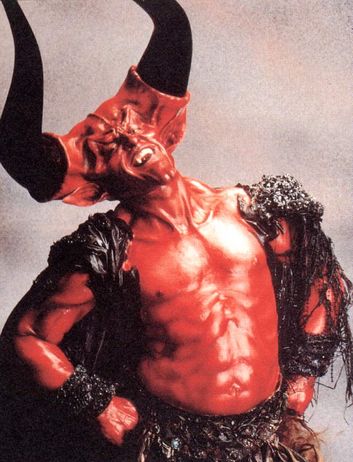
This guy isn’t one of my faves, but I’m going to give him a nod on account of Tim Curry played him.
Ask any actor what roles are the most fun, and they’ll inevitably tell you they like to play the villain. As someone who once portrayed the Wicked Witch of the West in our high school production of The Wizard of Oz, I admit that I auditioned for that role specifically. I had my reasons. Among them was the fact that the part of Dorothy was almost guaranteed to the girl who reminded us all of a young Judy Garland (big voice, sweet face and all). I also wanted a chance to be intimidating, volatile and powerful. In other words, a whole lot of things that I’m not on a daily basis.
So imagine what happens when an agent tells their actor, “Hey, the Wachowski brothers want you to play the Devil!” It’s the artist’s ka-ching, is what.
Since writing has replaced acting for me, I get my kicks watching how these cinematic Satans are characterized. There are so many different interpretations out there. There’s the malevolent, sociopathic, purely evil Lucifer. There’s the Miltonian rebel. And then there’s the Devil that’s a composite of all these moving mythologies.
For your entertainment, I’ve narrowed it down to my top 3, if for no other reason than a good Devil is hard to find. Before I go on, I want to apologize to those who expected to see Al Pacino on the list. I like The Devil’s Advocate as much as the next guy, but if I’m honest, Pacino’s John Milton (real subtle) is too…conventional. He’s exactly the Devil you’ve always heard about. And I’ll be the first to agree that it works in the context of the movie. But me, I’m looking for compelling characterization. So here’s the countdown.
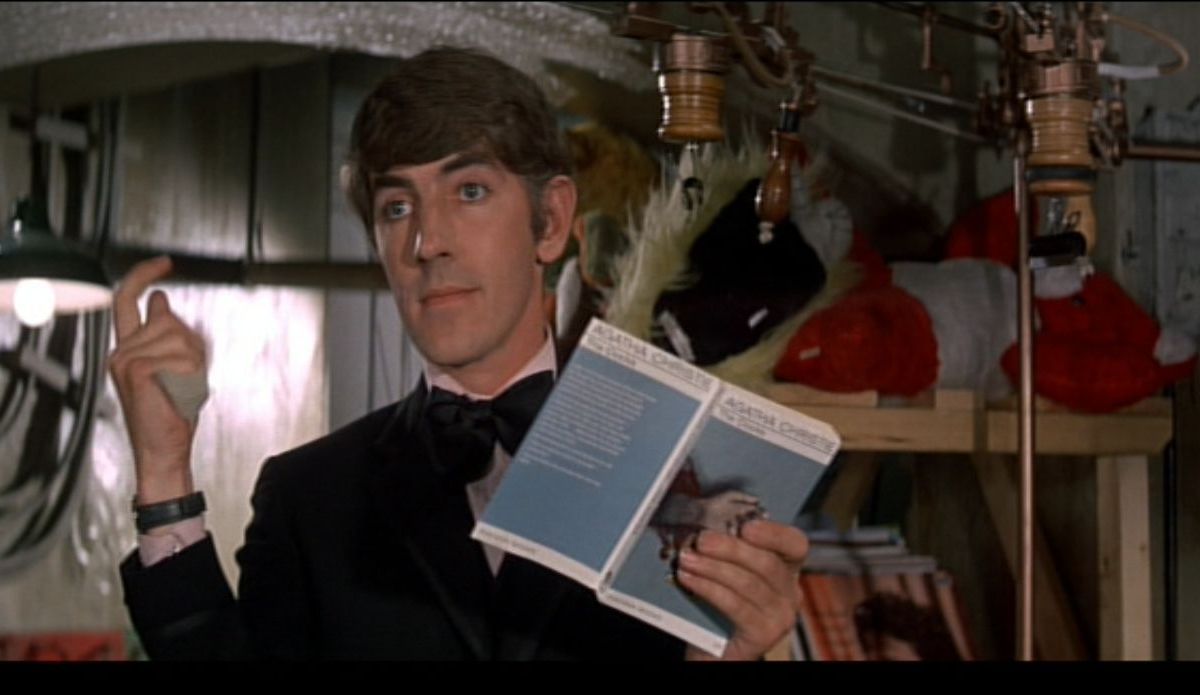
#3. Bedazzled – Peter Cook as “George Spiggott/The Devil”
What’s not to like about old George? He’s cool-headed, not judgemental in the least, and gives you exactly what you want, exactly how you asked for it. He’s handsome, has a great sense of humour, and enjoys long walks along London streets doling out generous quantities of daily mischief. He may be a fallen angel, but he has a good reason: he got tired of his glorification duties. As punishment, he’s now the world’s greatest trickster. But don’t blame him. As he judiciously points out, he’s just doing his job; aka, God’s will.
#2. Angel Heart – Robert De Niro as “Louis Cyphre/Lucifer”
I’m a little ashamed that I didn’t pick up on the name clue at first. I guess I got distracted by the detective story and the voodoo subplot. What I like most about Louis Cyphre is best summed up by my friend, who said, “I love a Devil who plays by the rules.” And how does he do that? For one, he never actually tells Harry Angel that he’s the one they’re looking for. Instead, Louis leads the private investigator down a path that will make him draw that conclusion himself. Kind of passive-aggressive, you’ll say, but them’s the rules in the Job story, right? You can’t beat him up directly, but you can destroy everything that has meaning in his life. In Angel Heart, Louis Cyphre strips Harry Angel of his perceived identity, and helps him remember that he’s actually Johnny Favorite, a ruthless murderer who made a deal with the Devil. And now the Devil’s collecting. Interestingly enough, this Devil doesn’t do any evil. None, in fact. The best part, though, is how deliciously creepy Robert De Niro is in this role.
#1. Faraway, So Close! – Willem Dafoe as “Emit Flesti/Time Itself”
There’s some debate about whether or not this guy is actually the Devil. But in the trailer, that’s how they ID him. So I’m going to go with that simply because he is the best, most complex representation of this character that I’ve seen. Besides the fact that Willem Dafoe was most righteously cast in this role, there’s also everything that the character is about. His name, spelled backwards, is “Time Itself.” And that’s what he does: he controls time. What’s evil about that? Nothing, except that it’s just another one of those pesky, limiting human inventions. And like all devils, Emit Flesti uses human weakness – an ingredient found in the silly things we dream up – to mix his brew. Does he do any evil? You might say so. He tempts the angel-turned-human Cassiel with gambling and alcohol, but only because these are things the latter was so drawn to anyhow. If anything, Emit seems to lead Cassiel straight to his destiny, which is to sacrifice himself for those he loves. Without Emit’s intervention, these things can’t happen. And because Emit is time, it’s his job to get you to your destination. Perhaps what’s most devil-like about him is the reign he seems to have over all things not-heaven, or rather, all things earth. But none of this makes him a bad guy, just a little liminal. Right at the edge of heaven, since he doesn’t like to hang out with the other angels. And just on the periphery of human existence, where he mostly goes unnoticed. But really, isn’t limbo just another word for “hell?”
Honourable mention: Beat the Devil – Gary Oldman as “The Devil”
Most people remember the short BMW movie directed by Guy Ritchie and starring Madonna. Beat the Devil was another instalment in that series. Also starring Clive Owen as the driver, the story follows James Brown as he tries to renegotiate his contract with the Devil, who gave him fame and fortune in exchange for his soul. Gary Oldman’s turn as the Prince of Darkness is part Jean-Baptiste Emanuel Zorg, part Ziggy Stardust, and pure Oldman. The movie’s a bit jerky but the style is flawless.
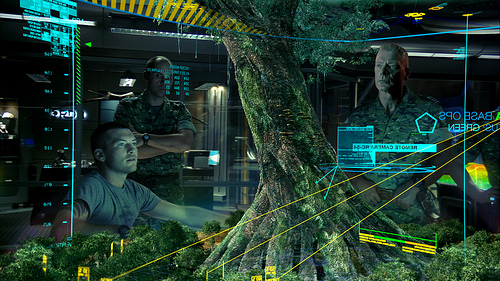
There's a reason why this works, and the creators of Avatar know what it is.
You know, I’ve heard a lot of Avatar-bashing in the past few days, and if anyone else was at the helm of this project, I have to wonder if it would be the same. Sure, James Cameron oozes a little too much self-worth, and given the stilted screenplay (and, as a friend justly pointed out, its poorly chosen font), it’s almost too easy to hurl the cheap shots. But I’ll say this about Avatar: its creators – from the writers to the person who designed every individual leaf on Big Momma Tree – know absolutely everything about the Avatar universe and how it works.
And this is something we can’t scoff at. It’s difficult to pull off, especially when the universe in question doesn’t actually exist, except in parallel analogies.
Every Pandoran beast has a function, a behaviour that’s unique to its species, and an intricate psychology to justify each motive. The Na’vi have a history that stretches beyond the borders of the tale we’re told. There’s also a whole ecosystem that wills the flora into fluorescence.
Even Big Momma Tree has a past.
By Cameron’s own admission, it took years just to develop the world and its mythology before they even started working on the movie, and it shows. The story feels more like an intrusion on what’s otherwise a pretty routine lifestyle, even if it’s in that extravagant wilderness.
Though Avatar primarily belongs in the science fiction realm, what if we applied this meticulous exercise to all fiction? From chick lit to indie films and action flicks: all of it. What if creators always went to the same amount of trouble to get intimate with the cosmos outside the narrative, even if the action takes place in the modern-day “real” world?
Our storytelling relies so heavily on characters that we sometimes lose sight of the fact that they exist somewhere. That this place has its own personality, idiosyncrasies, danger and splendour. That it affects the characters’ choices, or sometimes makes those choices for them.
When artists, writers or designers ignore the circumstances of the worlds they create, audiences notice. Case in point: The Phantom Menace. When your fans understand your universe better than you do, it’s a sure-fire death knell.
None of this means I wasn’t rooting for The Hurt Locker. I was. It’s a fascinating story, with a tight focus and a flawlessly treated subject. It deserved its awards for the same reasons I’m praising Avatar.
Like many Montrealers, I take Halloween seriously. It’s not just an excuse to get dressed up; it’s an opportunity to express that latent part of your personality. Ah yes, and get sloshed with a few of your favourite friends. In due form, I spent one evening preparing my costume with my buddy G, who, incidentally, is a horror movie filmmaker. To entertain us as we worked on our Halloween creations, G asked me to pick something to watch from his extensive slasher collection. His eye lit up when I brought out Night of the Demons.
Before judging us, you have to appreciate that I selected it only because it’s so much worse than you think. From Linnea Quigley‘s b-movie training to that disembodied demon head, whose superimposed appearances are clearly being played on a loop. But then there are classic moments: the “lipstick-nipple,” Angela’s grotesque transformation from human to second-hand demon to lead monster, and the razorblade apple pie. True to the genre, those clueless teenagers get viciously massacred one by one, until nobody is left but the Vestian blonde. At least, that’s how I remembered it.
It wasn’t until I saw it again that I realized none of the characters actually die. Except for the two survivors, Angela and gang are merely turned into demons, whether by attempted murder or serious injury (one guy gets his arm chopped off; don’t know how that makes a demon, but that’s for another blog post). Naturally, one of the characters who gets away is poor, virginal, I-just-wanna-cuddle Helen, played by flaxen-haired Allison Barron. The brunettes, sexual deviants, and brown-haired sexual deviants all get it in the end, if not at first.
Today, there was some back-and-forth between Adam Lambert and Out magazine’s editorial staff over the singer’s “handlers” asking the publication to make sure their client didn’t appear too “gay” in their cover story about him. This all reminded me that big gay Glambert only ranked runner-up to squeaky-clean Kris Allen (so immaculate, in fact, that he married his junior high school sweetheart when he was just 23). Will Kris Allen sell more records than Adam Lambert? Of course not. His role will be that of American Idol victor, not successful recording artist. Don’t get me wrong, it’s not that I don’t like Krissypooh! But this is a publicity contest, and Adam Lambert doesn’t need a dull press release to make headlines.
In much the same vein, who did they bring back for the Night of the Demons sequels? That’s right: Angela.
It’s a bit like the Quebec referendum, isn’t it? Quebecers say they want something fresh and revolutionary, but when push comes to shove, the devil you know always wins. On a day-to-day basis, many francophone Quebecers still want that sexy, dirty, dreamy sovereignty, so long as they don’t have to vote for it.
What’s getting tiresome for me is the long, overdrawn process of attrition. In a slasher flick, this describes when (sexually active) characters drop like flies at the hands of a masked murderer/monster. In singing competitions like American Idol and X Factor, it describes those painful weekly eliminations that ultimately betray the audience’s hypocrisy.
Often, the chasm that divides who should have won and who actually won is wide and deep. Why don’t we just own up to our desires and vote for the Adam Lamberts and Rhydian Robertses of the world? Who cares if they’re gay or worship David Caruso. Shouldn’t our loyalties lie with the people who interest us most? This isn’t like separating a country; it’s about performance! I don’t remember a single thing that Kris Allen sang, but I recall specific Glambert hairdos. And most people agree the latter was the better singer.
Do we really need more disappointing post-competition careers from our safe choices? Let’s have some fun! Let’s give ourselves what we want!
Does this mean that Jedward are growing on me? Goodness no! They’re really terrible. But like Angela, no matter what happens to them, they’ll come back. The good news is, they’re both blonde, and they’re very likely virgins.
Look, I studied at the school of smartypants. I know the difference between male (biological attribute) and masculine (social attribute). I read feminist theory, became acquainted with Laura Mulvey, friends with Susan Sontag, and intimate with bell hooks. I picked apart Paradise Lost, “Four Quartets” and Shakespeare’s female characters. I can speak, read and interpret French, Italian, German, and medieval English. In the last course of my last university term, I wrote my final paper on Gnostic elements in Aeon Flux (the original animated series). I have a brain, and I love to stimulate it with…stuff.
But every now and then, I just want to turn the ol’ noggin off. That’s when the outer Betty Friedan summons the inner Barbie, and I just indulge in a bunch of girly things for one blessed girly night.
It all begins with shopping. There’s no structure here, just a budget. Once I go over it by about $100, it’s time to get myself some girly reading material, namely Vogue (which I buy every month, regardless of whether or not I’ve made time for the girly show), and probably a nice, posh-looking food mag. Then it’s off to the video store to rent a couple of infallible girly movies. Sex and the City and Absolutely Fabulous used to be great companions, until I got the DVDs (I had to, you see). Next, it’s a booze run (either cans of Wurzburger beer or a fruity rosé), followed by take-out (I can’t resist Chinese broccoli soaked in oyster sauce, with a side of General Tao).
Then I get home, and the bliss begins. I crack open the alcohol, put the first movie on, spread the shopping bags all over the floor, wolf down the Chinese, and in between movies, hop in the bathtub for a richly deserved bubble bath. By movie 2, I’ve giving myself a facial and moisturizing every limb. At the end of the night, I pull out some no-strings-attached chick lit and wooze myself into a beautifully mindless slumber.
Don’t judge me! Smart girls need a little dumb time too. It’s a shame that “stupid” adds up to “girly,” but I take comfort in knowing that “dick flicks” include car chases, explosions and guns. Nothing terribly profound here.
So here are a few recommendations I’d like to make for your next girly night. And feel free to make suggestions of your own. I always welcome new additions to my little ritual.
Valley of the Dolls – This delicious novel is not unlike eating cotton candy: you’re getting bloodsugar nausea, but you won’t stop until there’s none left. The movie is full-on camp and stars the late Sharon Tate, so you’ll probably be a little curious. But I implore you to read the novel first. It’s infinitely better, with a touch more sex (full disclosure: this is what chicks really dig in a trash novel).
4 Blondes – Candace Bushnell is a surprisingly bad writer, but she somehow manages to tell a story. This book not-so-cleverly separates each chapter into a shade of blonde hair dye (e.g. platinum), and follows the girl who presumably flaunts it. Each character lives a life we couldn’t possibly imagine, and moves in New York’s finest circles. But sadly, each isn’t entirely fulfilled and pursues her heart’s content, for a fleeting New York minute. I don’t know how, but it’s engrossing.
Chantilly Lace – This bonafide chick flick features the improvisations of Ally Sheedy, Martha Plimpton, JoBeth Williams, Talia Shire, Lindsay Crouse, Jill Eikenberry and that Supergirl lady. They play 7 women vacationing in a gigantic cabin in the woods for the sole purpose of having one long, uninterrupted gabfest. Popcorn please!
All About My Mother – I’d hardly call any Pedro Almodovar film mindless, but he can entertain you without asking too much effort on your part. What I love most about this particular movie are the fabulous, wonderful women who express, so fervently, what it really feels like for a girl. From being gutted by tragedy to picking yourself up and moving forward like a train. For the same reasons, I also recommend Volver.
Like Water for Chocolate – Based on the Mexican novel by Laura Esquivel, this tasty movie tells the magical tale of Tita, a girl who’s forbidden to marry her boyfriend Pedro, and decides to show him her love through her cooking. It’s a simple escapade to turn-of-the-century Mexico with loads of exotic food scenes. Combine grub and romance and you’ve got a winning girly formula. Read the book while you’re at it. It’s available in something like 30 languages.
Moonstruck– I’ll admit, I prefer viewing this gem in the fall or winter. Maybe because it’s best accompanied by a bit of red wine, cheese and crackers, which I prefer during our nippy seasons. Anyhow, you probably won’t see a better performance by Cher or Nicholas Cage. Every character has a memorable line in this classy comedy, set against Puccini’s La Bohème. The Cher makeover scene is also yummy.
Pédale douce – This funky French flick about an unregenerate hag and her homo entourage uses humour to counterbalance a laundry list of gay issues (homophobia, living in the closet, STDs). Okay, so the latter is a bit condescending (not to mention dated), but the comedy is really, really funny. I especially love the woman who thinks her husband is gay and goes to great lengths to, first, discover his alternative lifestyle by going to raves, and second, embrace his homosexuality by throwing him a flamboyant “coming out” birthday party, where she gives him a lovely set of earrings to bring out his gorgeous green eyes. If you haven’t met her, get acquainted with Michèle Larocque, who makes her way into most of France’s funniest comedies.
J’ai faim!!! – Another hilarious French comedy. This one’s about a woman who tries to win her lover back by losing weight, because she thinks he left her for his new, super-skinny coworker. She’s egged on by her bestie (Michèle Larocque again!), who’s on a ridiculous diet that only lets you eat one food item per week, but as much of it as you want (starting with all-you-can-eat cucumber). Yes, many lessons are learned in the end. But this movie’s really about the journey and the girlfriends you take with you.













 Look, I studied at the school of smartypants. I know the difference between male (biological attribute) and masculine (social attribute). I read feminist theory, became acquainted with Laura Mulvey, friends with Susan Sontag, and intimate with bell hooks. I picked apart
  Valley of the Dolls – This delicious novel is not unlike eating cotton candy: you’re getting bloodsugar nausea, but you won’t stop until there’s none left. The movie is full-on camp and stars the late Sharon Tate, so you’ll probably be a little curious. But I implore you to read the novel first. It’s infinitely better, with a touch more sex (full disclosure: this is what chicks really dig in a trash novel).
 4 Blondes – Candace Bushnell is a surprisingly bad writer, but she somehow manages to tell a story. This book not-so-cleverly separates each chapter into a shade of blonde hair dye (e.g. platinum), and follows the girl who presumably flaunts it. Each character lives a life we couldn’t possibly imagine, and moves in New York’s finest circles. But sadly, each isn’t entirely fulfilled and pursues her heart’s content, for a fleeting New York minute. I don’t know how, but it’s engrossing.


 OLIVIA COLLETTE
