A couple of weeks ago, I came across this nifty video, which I feel compelled to share.
In this panic-stricken economy, many companies are looking to new media for a solution to their branding problems. Some people found it: Twitter. I’ll admit that I have a Twitter account, and I’m not nay-saying the tool. However, like the above video argues, I’m reticent to latch on to this platform while it’s still in its “escalation” phase. This means that the buzz is greater than the quality of the content, and use of the platform is still largely experimental.
Still, certain marketing luminaries believe this is the answer, and I haven’t experienced many discussions about where Twitter, in particular, is headed. To wit, when I asked Scott Monty, head of Social Media at Ford, to share insights about how he feels Twitter will evolve once the buzz has passed, he had this to say: “No one knew how the telephone or email would grow, but look at them now.” When as I asked him if he could be more specific, trying to come across as not a skeptic, but rather an interested party (in his defense, probably inadequately, since this back-and-forth was via Twitter), he replied: “As I implied – akin to the phone & email. It’ll be a part of daily life.” [ed. note: Scott Monty has since personally responded to this blog entry and provided helpful feedback to the discussion. Please take the time to read below.]
Meanwhile, marketing speaker David Meerman Scott feels that social media is the best way for brands to merit their customers’ loyalty. In one of his blogs, he argues that you can “buy” attention through advertising, “beg” for it through PR, “buy” it with sales, and “earn” it with social media. While he’s not explicitly saying that conventional marketing methods should disappear, his rhetoric appears to be in favour of social media. [ed. note: David Meerman Scott has clarified his stance on marketing methods in a comment below. Please take the time to read it, and by all means, visit his blog. We might not agree on all things, but he’s pretty gosh-darned brilliant.]
Maybe I’m too cautious, which is why I’m reluctant to experiment with something that’s still, in my opinion, an infant. Though some might think me a scoffer, I’m actually looking forward to seeing how Twitter will grow, and especially what it’ll mean to use it intelligently. For now, I feel that David Meerman Scott’s theory seems to apply rather suitably to individuals (e.g. celebrities), but to what extent does it help products and services (e.g. cars)? There’s also something desperate about a beach ball manufacturer creating a Twitter account to tell anyone who’s listening what’s playing on their iPod, in an attempt to humanize themselves. During a recent speaking engagement for airline companies, Satisfly CEO and founder Sergio Mello questioned the effectiveness of social media when a company or brand has over 500,000 followers. How do you keep that many people on message? How do you maintain an intimate connection with them?
And really, how do you keep customers satisfied and engaged in your brand? It used to be about uniqueness, quality. Now, it seems to be more about consistency. Delivering on the promise, rather than promising to deliver. While I’m still unconvinced about Twitter, I can’t deny that customers’ proximity to a company has largely increased, and that really informs one’s experience of a brand. Personally, I’m all about the Mom ‘n’ Pop shops because they know who I am and can customize their services accordingly. Isn’t Twitter just providing a macrocosm of the very same idea?
So all this got me thinking about a company with a marketing and business model I’ve long admired: Lomography.
Why Lomography rocks
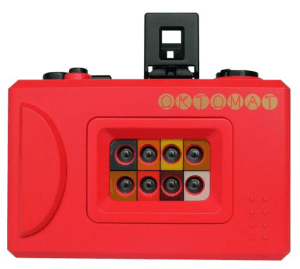 There are many things that I love about Lomography. First, and most importantly, they’re talking to a very specific market: lo-fi photography lovers (amateurs and pros alike). They know who they are, they know who their market is, and they don’t try to please the masses. They’re quite content to deliver a quality product and service to their niche.
Long before Myspace, Facebook, and now Twitter, Lomography’s website existed primarily to support the Lomo community. When you get any Lomo product, you’re encouraged to create a personal profile on lomography.com for free and upload photos regularly, sharing them with like-minded folk who can add you as friends and become part of your international, photographic network. In fact, the website served this purpose even back in 2002, ages before we’d even started to identify “community-building” as a 2.0 activity (which, incidentally, was more like a 1.0 idea).
What’s on the homepage? Though it’s undergone a recent redesign, the basic principles are still there. New and exciting products (which, as a Lomographer, you’ll be excited about; it’s a simple preacher-choir equation), photos taken by fellow Lomographers, a Lomo profile of the day (inciting visits to someone you might like to include in your network), and the latest “magazine” (which is really a blog) article. What I like about this set-up, so far, is that Lomography doesn’t waste any time with boring introductions. You’re just thrown into the fire, with no precursor, and they figure you have the wherewithal to know how to find what you’re looking for. If you’re not a newbie to the Lomo world, you know exactly what’s in front of you, and you’re already salivating.
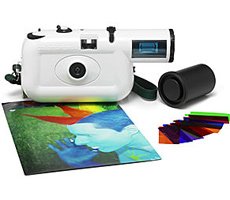 But there are more functions of the site that are interesting. Besides being able to create profiles, Lomography also has a series of incentives for its community. For one, there are many ways for any person to win prizes, including monthly “missions” (basically photo contests), having your profile highlighted as “home of the day,” and submitting useful tips for handling certain cameras. Rewards usually entail either Lomo products (usually cameras) or Lomo piggie points (coupons you can use to get rebates at the Lomo online shop). What’s notable is that the incentives are rather minimal, when you think about it, and yet, participation is quite sizeable. Plus, each incentive-based activity actually promotes the community. A “home of the day” generates thousands of views to your profile, and interest in your photos. Contest winners are always interviewed, again generating views to the victor’s page. It seems less about winning and more about seeing new photos and meeting the person who took them.
But what I really love are the microsites. Lomography manufactures and distributes many lo-fi cameras, and for most of these, there’s a microsite that reflects the camera’s “personality,” complete with a nifty photo gallery displaying the given camera’s range. When you consider how many cameras Lomography distributes, it’s actually a tall order. But there you have it: Lomography is as devoted to their cause as their customers. If you need further convincing, check out the microsites for the Supersampler, the Lomolitos, and the Minox. What’s more, each of these microsites is constantly being redesigned to include new photos, usually submitted by the community.
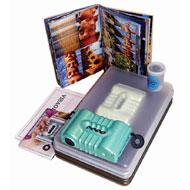 And then there’s the fun part: buying a Lomo camera. Why is it fun? It starts with the packaging. Every Lomo camera comes in a unique package that, once again, mirrors the camera’s idiosyncrasies. Plus, there are special editions to some of the more popular models, which means you’ll again find neat new “containers” for the content. As the proud owner of 6 Lomographic cameras, I distinctly recall the package each came in (to the point where I had trouble getting rid of them). My Holga came in a lovely box, with yellow and white rays, right out of 1940s communist propaganda posters, and a gorilla planted square in the middle. Why a gorilla? Because once you open the box, a leaflet explained that the Holga is a big, clumsy piece of plastic that somehow takes some of the most beautiful pictures imaginable. My Colorsplash came in a translucent, multicoloured plastic box. And my Diana came in an action-figure style container, with the camera wrapped in moulded plastic, surrounded by designed cardboard.
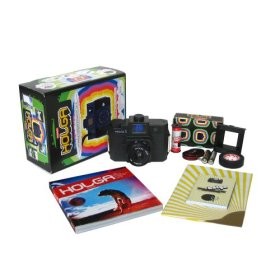 Then there’s what’s inside the package. Each camera I’ve had the pleasure to purchase comes with the usual warranty and instruction manual, with an important difference. The “how-to” is written by a bonafide copywriter, who really underscores what makes the product fun, rendering the whole thing accessible. In one funny (and honest) example, the Holga instructions warned that the little wire that controls the “automatic vs. bulb” switch usually breaks after one year, but that this adds to the camera’s excitement. However, what really makes me want to buy Lomo cameras are the little picture books inside each box. These neat little books show off some lovely photos taken with the camera you just bought, providing enchantment, inspiration, and insight. I particularly like the photo book that comes with the Holga starter kit; it boasts eye-popping visuals while explaining the techniques behind them.
Recently, I got a Diana F+, which came with a little photo book, as well as a thicker, hardcover book, containing short stories and more pictures. In this hardcover book, Lomography states that the content will be ever-changing to include new stories and photos by fellow Lomographers. What a delightful way to engage the community…again!
Lessons from Lomography
- Don’t try to be everything to everybody: Know your audience, and embrace it.
- Spend time making your product rock: Urban Outfitters first started to distribute Lomo cameras because they tend to like all things retro, but Lomo’s success at Urban Outfitters is largely due to the cool and fetching packaging, and the repeat consumerism is due to satisfaction.
- Make your product the incentive: If your product is great, you won’t need to lower your price or host a contest. Apple/Mac provides the best example.
- If you host a contest, you don’t need to give everything away: People like to participate in contests for the chance to win, and regardless of whether or not they’ll win.
- Redesign and refresh to reflect the evolution of your community: And I’m not talking Facebook’s fear of Twitter, and changing its homepage to look more like it. I mean ways of making it easier for your community to find what it’s looking for.
- Never assume that your product is perfect: Be open to improving it as necessary. It tells your community that you’re listening.
- Be honest: While you can strive for perfection in your product, most things aren’t built that way. Rather than skirt the issue, why not admit to the flaws (like the Holga shutter wire), and remind people of the complementary benefits. There are many folks out there running around with non-automatic Holgas, and they don’t seem to mind. Barack Obama’s transparency also comes to mind.
- Reflect your product’s personality: That’s essentially what a brand is supposed to be. If your brand were a person, what would it say? How would it act? Lomography products are fun, and so is the brand. If your product isn’t fun, no biggie. That doesn’t mean it can’t be interesting, and it most certainly doesn’t mean it doesn’t have its own unique story.
- Don’t try to control your community: Just give it the proper means to propagate itself, and it’ll find a way to take care of the rest. Any interference on your part will be ill-received, not to mention futile.
- Build your community in a way that makes sense for that market: A photographic product should allow users to create their own photo galleries and view other people’s pictures easily. It’s not rocket science.
- Market your product in a way that makes sense for that product: Twitter isn’t the answer for everyone or everything. It’s a tool, like many other tools. Incidentally, Lomography doesn’t advertise anywhere, but it’s built such a solid word-of-mouth machine that it doesn’t need to. Still, we can’t forget that because its community thrives in and revolves around photo galleries, beefing up the website to support this function made sense for this product. This doesn’t work for every product, especially those that don’t have much to offer in terms of an online experience.
Parting thoughts
Traditional marketing methods still work like magic for certain products. TV advertising, for example, are still an effective way to get a message across about cars, since you can see the car in action, which, due to its mobile nature, makes sense. The fact is, each brand or product requires a customized solution. Each is different, and each is valuable. So to nay-say conventional marketing activities, at this point, is somewhat heretic.




 OLIVIA COLLETTE