A flock of Eberties, part 3: Jewison Superstar

During my last year of university, I wrote an essay on the visual theme of chess in Jesus Christ Superstar. Think I’m stretching it? Then let me direct your attention to Exhibit A: Hats.

This is the first clue that got me looking for other chess…stuff. It almost seemed like a perfect set-up: Caiaphas and his priestly gang are all dressed in black (a classic chess colour) and each wears a hat that, in some cases, could be likened to chess pieces. Caiaphas’s headwear is shaped like the top of a pawn piece, and his sidekick Annas’s conical hat is a bit reminiscent of the bishop. I would have left well enough alone if it weren’t for Exhibit B: Scaffolding.

I found it interesting that Caiaphas and his pals of the cloth discuss the outcome of other people’s lives on a structure not unlike a chess board. Okay, it’s not identical to a chess board, but the scaffolding is criss-crossed, and from various angles, the crossings are shaped like squares. This is where they strategize and discuss what their next move should be (“So like John before him/This Jesus must die”). Uncanny though this is, I knew I had to explore this idea further because of Exhibit C: White Jesus.

I’m not referring to Jesus’s ethnicity (although…). I’m referring to what he’s wearing: a white tunic. It’s not new to visually contrast opposing forces in a movie. But when you’re building a case for a visual theme of chess, and you consider that white is the other common chess colour, something like this can be seen as compelling evidence. It’s even more convincing when you see that an effort is made to block Jesus in such a way so as to emphasize the difference between him and the priesthood, like when he’s arrested (or literally check-mated, being “King of Jews” and all):

 White also distinguishes him from, well, everyone:

Nobody else in the movie gets to wear that particularly beaming shade of white . Some of his followers don beige or dark ivory, but only Jesus is as bright. That is, until Judas fulfills his duties as official betrayer, offs himself, and appears to Jesus in a post-mortem vision:


 Until he dies, Judas wears a hot pink outfit. And once he’s done what he was (presumably) preordained to do, he reaches the same level of heavenly holiness as Jesus. At least, that’s what the movie suggests. In some ways, it reminds me of reaching the eighth square, where you can turn a sacrificial pawn into a powerful queen.

This all fits in rather beautifully in a biblical narrative because, if you take it at face value, it seems God controls everything. Every move is calculated and predetermined by the Guy Upstairs, each event bearing proof of God’s omniscience. And in some form, isn’t that what chess attempts to mimic? Instead of one god, there are two, and each predicts the game based on a set of mathematical possibilities and tactical advantages. It only takes one move to impact the rest of the game.

Maybe I’m reading too much into it, but that’s inherent to critiquing movies. So when I found out that Norman Jewison would be at Ebertfest, I figured the time had come to stop guessing and ask the higher power behind Jesus Christ Superstar if the visual theme of chess was something he’d intended.

I thought I might have to go through a publicist or agent to get to ask Norman that question, but the only person he brought with him was his wife. This aptly demonstrates a sentiment that was repeated throughout Ebertfest: it’s not about the movie business; it’s for the love of movies.

I’d hoped for a proper sit-down interview, but in the frenzy of the festival, it never happened. Still, I was fortunate enough to get to ask him that very question during a discussion panel on choices filmmakers make. Here’s what he said:

“Every film that you make, you see the film in your mind’s eye. So that’s why the director can explain to actors and set designers and cameramen what they see, what film they’re making. Because it’s in your mind, in your imagination, it sometimes conjures up images that you get locked into. In Jesus Christ Superstar, I was making a rock opera. There’s only one line of dialogue in the film: ‘forgive them for they know not what they do.’ That’s the only line of dialogue, unlike everything else, which are songs and lyrics. So it’s about the good, the bad and the beautiful. It’s a rock opera. That’s all it is. It’s not a treatise that I was making. So, I was making this musical, and therefore, when it came to costuming and style and period, what period are you dealing with? Well, we’re dealing with today. That’s why I put tanks and planes and guns into the film. Because they’re contemporary. The work itself is contemporary, written by two young Englishmen. So, when it came to costuming, I was trying to do a mixture of biblical and contemporary. That’s the only thing I can say, because when the time came to make the film, I started to walk around the Holy Land, where the story originates, I guess that’s what affected me more than anything. And I was just listening to a walkman, singing to myself, and trying to visualize [it]. And I didn’t want to build big temples and places. I wanted to find them organically, because I felt this is what’s left of the Holy Land. These are the rocks and earth that people walked on. So I think that was it. I tried to give the Romans always a look, [with] the helmets. With the other characters, I tried to give them indications of period, but on top of that, it was all contemporary. It was a t-shirt and things. It was a mixture…it’s hard for me to describe it because it was many years ago, and I was much younger, and I was out in the desert in [inaudible] degrees. I was a little out of it, I guess…[laughing]..But yeah, it’s an interesting look. The picture does have an interesting look, and I like the look very much. I really think it works.”

Later, when the resplendent Chaz Ebert found out that I had not been scheduled to appear on a post-movie panel like other Far-Flung Correspondents, she asked if I had a preference. That’s how I got to co-interview Norman (with the lovely Anath White) on a panel after the showing of a film dear to his heart, Only You.

In retrospect, I wish I’d had more time to prepare questions. I’m good at ad-libbing jokes, but as a journalist, I like to blueprint my interviews. It didn’t matter much since Roger wanted us to ask him about specific things which, all told, made for great stories. That’s one thing I learned about Norman Jewison: the man sure knows how to tell a tale.

That’s why it’s difficult to pin him down to a style or genre. He cares more about the story than anything else, and he wants it to be told with as much compassion and humanity as possible.

One question I’m glad I asked him (and it was ad-libbed to boot) was about how he managed to get such iconic performances from actors. Case in point: Sidney Poitier, Steve McQueen, Cher and Ted Neeley, who’s still playing Jesus, if that’s any indication. In Norman’s response, which led some people to think he was flirting with me (I don’t see it), he said this:

“The relationship between a director and an actor is one of trust. That’s what it’s really about. It’s about the fact that the actor knows that the director trusts the actor, or the actor wouldn’t even be there. So you keep reminding the actor, ‘of all the people in the world, you are the one, you are the one to play this role, because I chose you.’…[Sidney] Poitier was always very concerned about Rod Steiger [while filming In the Heat of the Night]. He would say, ‘he can go over the top, you know. He can get too big.’ And I said, ‘I’ll watch him.’ When Rod Steiger won the Academy Award for his performance, I think it was recognized that he had given a performance in that picture from his heart that was very honest and deep and true. So I think it’s all about believability, isn’t it? And the end result is, do you believe that scene? Do you believe that person on the screen. That’s what the audience is asking themselves every moment they’re watching a picture.”

There are different types of directors out there. There’s the visual director, the actor’s director, and then there are those who, like Norman Jewison, are consistently mindful of the audience’s experience.

I’ve often said that art necessitates an audience. Without it, there is no art. There is no one for the art to matter to. And art has to matter to someone other than the artist to exist at all.

After I asked Norman my question on chess and Jesus Christ Superstar, a lady from the audience came up to me and said, “You know, I never looked at it that way before, but when I think back, you’re right! Those hats. The costumes. I’m going to have to watch it again now.”

I still think there’s a visual theme of chess in Jesus Christ Superstar, but Norman doesn’t see it. He doesn’t have to. I think it was Salvador Dali who said something along the lines of, the artist is not the best authority on their own work.

A flock of Eberties, Part 1: Screening calls

I know some people might expect a blow-by-blow Ebertfest diary. But that’s just not my way. There’s a chronology to the bit that’s in the present tense, but once it’s in the past, it all gets jumbled into an impressionist memory with blurred beginnings and ends. It’s left to interpretative liberties. It’s five minutes ago and five seconds right now and five weeks later all at once. My narrative bounces around to accommodate fluid living. I need to relate to something before I can tell the story properly.

Like when Omer Mozaffar asked those of us on the Far-Flung Correspondents panel how we prefer to screen movies. Most panelists said they preferred the large cinema screen. Others said they enjoy big-screen TVs. Some admitted that they don’t mind watching a movie on a computer (which warranted a small but perceptible gasp in the audience). When it came to me, I couldn’t give a straight answer. “It depends on what I’m doing,” I said. “I love seeing special effects on a big screen, but if I’m writing about a movie, I like to toggle between my Word document and media player on the laptop. It lets me pause the movie in specific places more easily.”

I was happy with that answer because it was the truth. But then it occurred to me that the night before, I had a very unique and privileged experience. I got to watch the latest version of Metropolis, and while I did, the Alloy Orchestra played the movie’s score in the pit.

I asked Roger about the Alloy Orchestra the next day, and he said he found them at Telluride. They only perform to silent movies, it seems. Their industrial vibe could have something to do with the fact that their guitarist/keyboardist Roger Miller was once in the post-punk band Mission of Burma.

I’m already a fan of Metropolis, and though a days’ worth of travel made it impossible for me to sit through more than an hour of the movie, I was mesmerized for the full 60 minutes.

A lot of it has to do with the Virginia Theater, where we were fortunate enough to watch all Ebertfest movie selections. Having been restored to its original 1920s resplendence, the Virginia Theater lends itself seamlessly to a silent movie viewing. The details on the gilded mouldings hurl the audience to an era when interiors were carved out of sweat and fancy. Most attendees observed that the ornate balcony had some of the best seats in the house.

I’d never given the cinema space much thought. I can certainly tell the difference between a smaller screen and a bigger one. I owned the Koyaanisqatsi DVD for ages and had watched it several times on a cheap 12-inch TV that was handed down to me by a friend. Like most people who take years to stop living like a college student, I never upgraded until I was in my 30s, when I inherited my friend’s 27-inch telly after he got himself a flat-screen. For the short time that I owned it, I never watched important movies. I was busy. And it seemed to stretch and round out the images. It looked strange. Shortly after, however, the soon-to-be husband unit moved in and upgraded our living arrangements to better suit the 21st century, and just like that, it was our turn to get a large flat-screen TV. So I immediately tested out Koyaanisqatsi.

It was a game-changer.

The movie became so much more than the lesson in non-fiction that had initially introduced me to it. The Philip Glass score started to feel a little less gratuitous and made more sense. The film took on a new rhythm. Ron Fricke’s imagery was graceful despite its weighted largess.

So yeah, a nice big screen makes a difference. It’s not that I didn’t know that; it’s just that it was a given that I’ve come to take for granted. But every now and then, it literally smacks me in the face.

My favourite scene in Metropolis is near the beginning, when the workers toil away at the heart machine. Their movements are choreographed to make it seem like they’re one with the mechanism, like organic extensions of the levers and wheels. The machine itself looks like a pyramid, built to sacrifice humans to nameless, faceless, fickle gods (and the movie will tell us just that a few moments later).

But upon watching it on the Virginia Theater’s massive screen, with the Alloy gentlemen pounding on bedpans and squeezing accordions, a few more things take prevalence. Details I’d noticed before but that are more voluptuous now: the grandiose cityscape that just kind of popped out of Fritz Lang’s head; how Brigitte Helm was possibly the first true film actress that ever was; the subtle prowess of Joh Fredersen, who can disarm subconscious defenses with a raised eyebrow; the flamboyant depths of depravity. And I think, “I can’t believe anyone in the 1920s had the wherewithal to conceive of all this.”

This is the most ideal way to watch Metropolis: at the Virginia Theater, to the beat of the Alloy’s drummers, surrounded by people who are sharing exactly what I’m going through.

Of course, none of this will make me a screen snob. If I can, I’m going to want to refer to a movie I’m critiquing immediately. I’ll want to go Word-AVI-Word at will. I like watching some movies alone in the comfort of my own home. That’ll never change. So really, my answer to Omer is still true. Only now, I’ll think twice before underestimating the benefit of a large screen. I’d seen Metropolis before, at home, on my wee little 12-incher. And now it’s clear just how much I was settling.

Video games *can so* be art, so gnah!

Concept art for American McGee’s Alice.

Roger Ebert published a rather fascinating piece arguing that video games cannot be art. Not surprisingly, there’s been a lot of backlash. Video gamers are a loyal bunch, but it’s not that they need to justify what they love by calling it art. They honestly feel that video game creators are artists. That’s why they let Blizzard take years to release any game, because like the developers, gamers want them to get it right. There’s an intricate creative process that goes into developing a video game (even a bad one). And it’s no different than spending a decade on a sculpture (even an ugly one).

Ebert was compelled to broach the topic when he saw a TED presentation by Kellee Santiago, a game designer and president of thatgamecompany. In it, she attempts to prove that video games are, in fact, an art form. I enjoyed Santiago’s spiel, but I felt she didn’t tackle the artistic elements of videogames. While she focused on engagement and emotional involvement, she didn’t deal with design or conception and how these create engagement in the first place. This seems like the most obvious argument for a game designer. She also kept bringing up critical acclaim as though it were synonymous with artistic street cred, which it isn’t. Taste doesn’t art make, as Ebert admits. Anyhow, I don’t feel she makes much of a case for the art of video games. So I’m going to try.

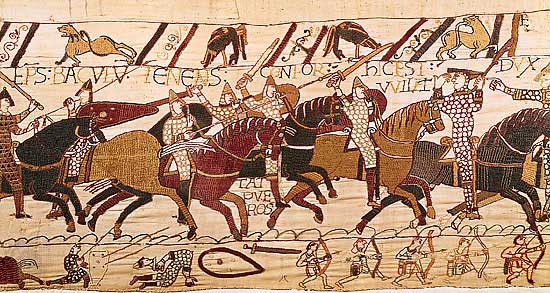
Medievalism: the root of most RPGs.

I want to preface this by mentioning that in the earlier part of my career, I was a journalist for a video game news website. Here, reviews are one of the major draws. Otherwise, what’s considered news is the announcement of a new game in development, and as many bits and pieces of that game as the studio behind it is willing to reveal. Those bits and pieces usually constitute concept art, in-game screenshots, and trailers. Why are these things important to gamers? Because it helps them assess what the gaming environment is going to be like, and that’s integral to their experience of the game. Sure, you could argue that most games have an objective; some sort of MacGuffin that has to be won or conquered. But to paraphrase Ebert: it’s not what the game is about, it’s how it is about it. The people responsible for the “how” of any game are the designers, the writers, and the many creators involved in taking you on a journey through the game. Really, the process of creating a game is no less artistic than what went into weaving the Bayeux Tapestry.

So what is art, then? Santiago cites the Wikipedia definition, which says that “Art is the process or product of deliberately arranging elements in a way to affect the senses or emotions.” Like Ebert, I’m not convinced this encompasses the totality or complexity of art; the description feels inadequate. But I find it touches on an important part of the experience of art. It’s about engagement, and video games engage people; that much is easily recognizable.

That’s one way to get people’s attention.

Do video games engage people in the same way as art? It depends on the medium we’re talking about. It’s only fair to compare video games to other media that lend themselves to similar experiences. Is playing a video game the same as looking at a sculpture? Not in the least. Is it a bit like reading a book? Certainly, if we’re talking about fiction. It requires the same process of suspending one’s disbelief to accept an alternate universe that’s different from the reality we know. The absorption of a book is similar to playing a video game in that it’s immersive, even if the adventure isn’t yours in the strictest sense. Otherwise, the visual dimension of video games can be compared to watching animation or a film: there’s a moving picture, and the construction of it is as deliberate as anything Stanley Kubrick might have done. I’m not comparing video game designers to Stanley Kubrick, but I’m sure many of them are inspired by his work and have used it to feed the vision of their output. And like Kubrick, game creators work hard to elicit a specific response from their audience. Which brings me to my next point.

Art requires an audience. Without an audience, there is no art. Art is one half of a relationship and a dialogue. It has to be presented to someone else as art, and, whether good or bad, it has to be acknowledged as such. Art doesn’t require taste, just one crucial social transaction.

While those who play World of Warcraft may or may not attend the next Picasso exhibit, they belong to an enormous demographic and are hugely devoted to the work of their favourite artists. This also means that they give video game creators jobs. And this addresses a strange cultural paradox: we seem to have a bone to pick with artists who make money. Game designers, much like art directors in an ad agency, are artists with jobs. They’re not struggling financially. They impact culture in an important way. They have a widespread audience, and it’s incredibly, immediately receptive to their work. Dissenters call it “selling out,” but video game creators prefer “raison d’être.”

Can any game be art? I’m not sure about that. People have brought up chess a lot, and my problem here is with the mathematics of the game. It’s functional and objective-driven. This doesn’t take away the enjoyment of it, but there’s no engagement with the imaginary, which is what’s so distinct about video games. There’s no “what if” fancy in chess. It doesn’t make it a lesser game, just an inappropriate comparison.

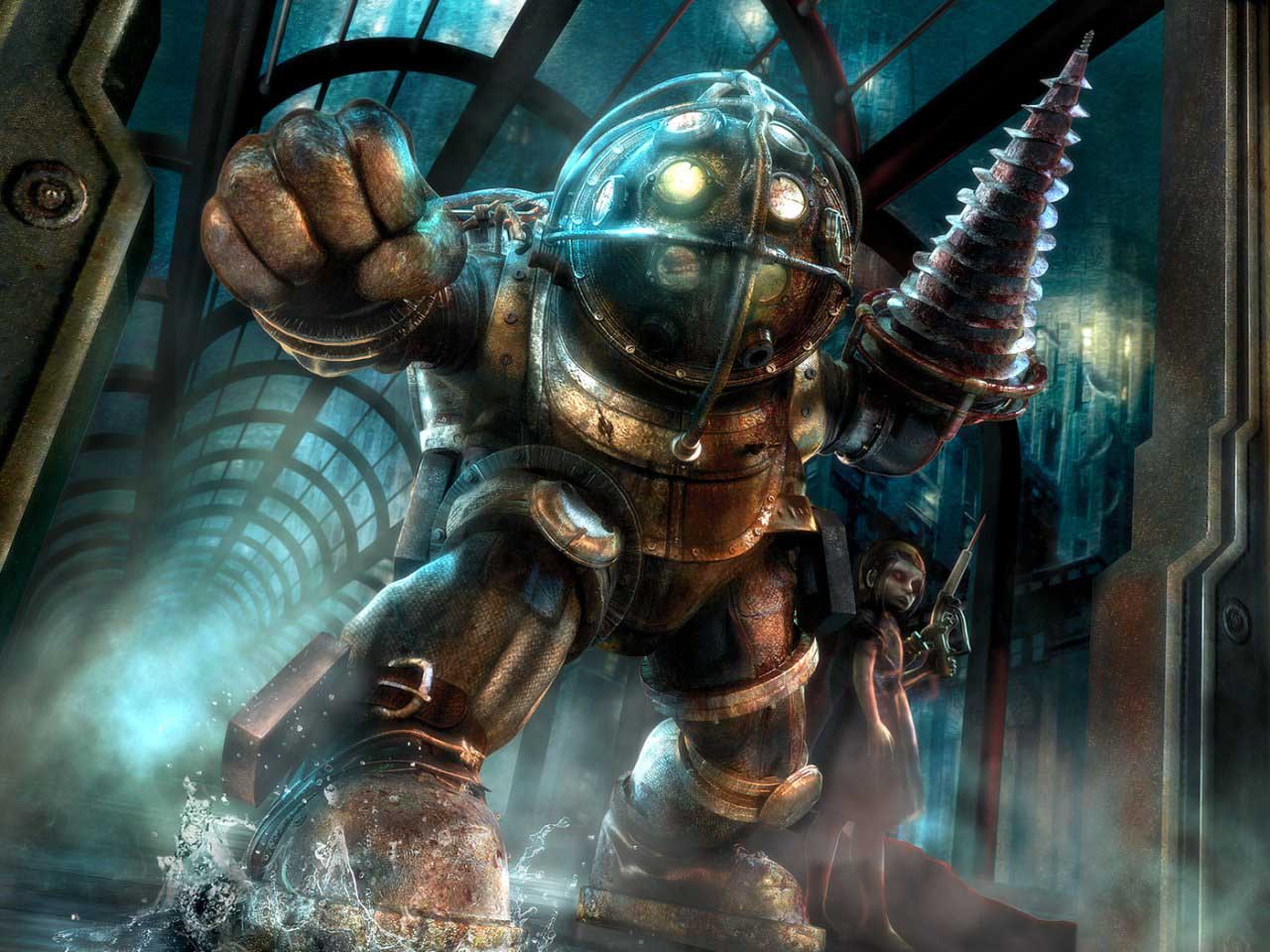
One of the terrifying BioShock bad dudes.

Art isn’t just a component of video games. It’s necessary to enhance the gameplay.  An example that’s commonly brought up to negate this is the first-person shooter (FPS). They’re often touted as mindless and one-dimensional, which is fair enough if you consider that the genre mostly involves one repeated action. But the “first-person” aspect is what gives the genre substance. Players need the art to believe the first-person gameplay. They also need a unique reason to choose one FPS over another (enter the Quake vs. Unreal debate). Games like BioShock demonstrate that it’s infinitely more interesting to shoot things in a setting that’s entirely alien, where surprise is just around corner. What impressed fans and critics about this game wasn’t just the graphics; it was also its Randian underwater environment and dystopian story.  This means a lot of effort when into conceiving this world, and that’s not the work of marketers or project managers. These are storytellers at play in an interactive digital medium.

One of the many Final Fantasy landscapes. Someone was hired just to design the trees in this forest.

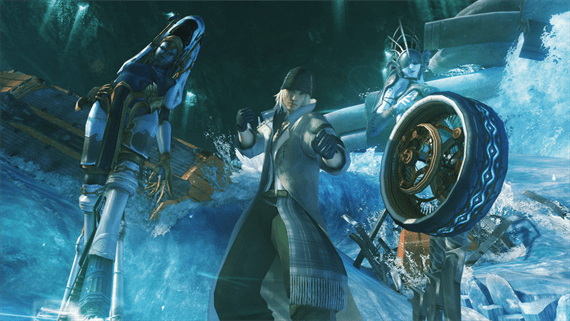
Immersion is even more important in role-playing games, and it can’t happen without a bewildering universe. Just the other day, the husband unit finally bought his copy of Final Fantasy XIII.  I’ve never played games from this franchise myself (I prefer straightforward adventure games), but if you’ve followed the series, it’s perhaps the best testament to the genre’s evolution. When you consider its 8-bit beginnings, it’s all the more astonishing that the gameplay graphics are now on par with the in-game movie sequences. FFXIII also boasts a whole ecosystem that makes me wonder how the developers came up with their flora, fauna and technology. Their world is both plausible and impossible, at least for now. And isn’t that good science fiction?

Though it’s a little dated now, my favourite game is American McGee’s Alice. Most of its reviews were the same: awesome universe, great gameplay, but the end boss sucked. In other words, the journey was greater than the destination. Since the game’s release, American McGee and his work have garnered something of a cult following, starting with toy models from Alice, including the sickly Cheshire cat and the sadistic White Rabbit. McGee, for his part, knew the Wonderland and Looking Glass mythologies so intricately that his reconstruction was solid. And the characters? Flawlessly designed.

American McGee’s Alice merch, sold at a geek store near you.

Since Alice’s release in 2000, McGee relocated to Shanghai and set up a new studio, Spicy Horse. When asked to list the advantages of working overseas, he said the biggest bonus was a “blue sky mentality. Game development [in Shanghai] is a relatively new industry, and there’s less of a ‘history burden’ in terms of conceptualizing games, studio structure, and development process. People are more open to radical ideas.” Among other things, his answer alludes to the multidisciplinary nature of game development, which, in this respect, is not unlike moviemaking.

I’m also a fan of time-management games, and while these don’t make use of mind-boggling graphics, an art team is still involved. Sally’s Salon doesn’t look realistic, but it doesn’t have to, and that’s part of the fun. We accept that in animation, so surely we can make a concession for time-killers. There are also games that take no time whatsoever to go to market (the TV franchises, the board game simulators, etc.). But that exists in the movie industry as well. It’s the part of the business that’s just business, and that can’t be helped.

In terms of the craft itself, a meticulous creative process has often been directly linked to a game’s success. And why shouldn’t it? It takes time to create a world, especially one that works. I might argue that it takes more effort than penning the next Nic Cage action flick. But I don’t think this has to be about choosing film, poetry or painting over video games. I don’t think you can only prefer one if you discredit the other. Video game creators use different tools and speak to a different audience, but there’s room for that too in the art world. Or rather, there should be.

Is playing a game an art? No more and no less than watching a movie. But as long as we rely on art to enhance the gaming experience, we simply can’t separate the video game itself from the art that’s involved in making it. To deny the artistic process that goes into creating games is, I believe, short-sighted, if a little snooty.

***

My buddy Roger has gotten a lot of flak for his piece, and while it was to be expected, I think it’s undeserved. He hasn’t discouraged dissent, he’s taken the more scathing comments in stride, and he’s even linked to this Cracked article and this academic paper on the art of video games. It’s fine to disagree with someone, but it’s important to recognize when you get to do it in the context of a discussion. On that front, Ebert’s been a real good sport.


Hello, audience! This is all about you.

In the little bit of time I worked at Cossette, one of the senior copywriters took me under her wing. Perhaps because she picked up on my insecurities about having gone from rinky-dink agency to big-time ad firm in one leap. Or maybe because we had the whole “writes English but was brought up French” thing in common. In any case, we were assigned to work together on a project, and when I made changes that involved turning an imperative into a passive, she immediately vetoed it. I wondered why, so she explained that our project was instructional. You have to use the imperative because it provokes a response, and that’s what you need when the the people you’re talking to are learning something. “Know your audience,” she said.

I loved two things about that sentence.

First, in the ad world, you’re constantly referring to targets, markets and demographics. Rather scientific categorizations, necessary though they are. On the flip side, the word “audience” doesn’t connote the idea of people; it very plainly spells it out. There’s no separation between yourself, people and the thing you use to measure them. It’s just you and the people looking at you.

And second, it’s not enough to acknowledge your audience. You also have to say, “Hey! You, over there, in the white t-shirt. I know who you are!”

Since then, I left the ad world, returned to journalism, and then found myself kind of doing both. The two professions aren’t as different as people think they are. In both cases, you have to be extremely mindful of the people watching you, because what you say weaves itself into who they think they are, and what they think they know. The method is different, but the outcome is pretty much the same.

Yet, like anyone who work in words, you end up doing some stuff just for yourself. You can’t help it. They’re your words, your expressions, your choices, and your stream of consciousness. If you can’t take ownership of these things,  you’ll be as compelling as a dictionary.

Here’s the real kicker, though. Without your audience, your words don’t exist. Sure, they’re still in that dictionary, but they don’t come from you or from anywhere, therefore you don’t exist. Not as a writer, anyway.

And I tell you what: I was more or less comfortable with that arrangement until Roger Ebert started following me on Twitter, and took it upon himself to link to my blog. The whole thing boosted my readership and followers by a hefty 500%. And just like that, I had to wave goodbye to self-indulgence.

Of course I’m flattered that Roger Ebert, who I’ve been reading for about 12 years, would even give my blog a second glance. It’s just that now I’m faced with an audience I didn’t have before, and I don’t know anything about you. Naturally, I’m grateful. I write this blog because I want to reach out to people to begin with. But if my blog stats are any indication, there’s a good chance that the majority of you who were reading me pre-Ebert were my friends. (By the way, thanks buds!)

So here’s a challenge. Why’n’t you tell me a little about yourself? If I’m not just writing for my friends anymore, I’d like to know why you stopped by.

On that note, Roger Ebert, an avid Twitter user, has made it a point to link to many blogs (after paying them a visit). Today, he led us to Miss Banshee’s blog, which, on top of being hilarious, balances confession and control. She really puts it all out there, but she doesn’t name names. Know what I mean?

I wish I could do that, but, if I’m honest, I don’t think I could even out the tensions as delicately as she does. Not until I get a better look at you, anyhow.

Roger Ebert prefers newspapers

To elaborate on the thought I started here, I thought I’d add some insights I recently found on Roger Ebert’s blog. Check it out.

As usual, Roger Ebert puts it more brilliantly than I could. Then again, he’s Roger Ebert. Here, he tells us how he’s rediscovered the pleasure of reading newspapers, and why he’s now up to 4 dailies. He explains how complex the online news experience can be, even with popular hubs like the Huffington Post. Surprisingly, he also finds reading newspapers to be faster.

A note on Roger Ebert. For a few years now, he hasn’t spoken a word as a result of numerous surgeries related to thyroid cancer, including a tracheostomy. His spot on Ebert & Roeper was subsequently taken over by a variety of humble guest critics until the show ended last year. Oddly enough, his ordeal has strengthened his writing. Don’t get me wrong. I’ve always enjoyed reading his reviews online: they’re a Friday morning delight! But his physical voicelessness seems to have made his writing voice a little more robust. Writing is his only means of reflection right now. It’s the only way he can communicate at all, and he just keeps getting better at it. What an amazing tale of resilience. When great gets better, it’s always inspiring.

That said, before you decide to watch any movie, read the Ebert review. You may not agree with what he has to say, and maybe you wouldn’t see the movie anyway. But your life will be richer for having read it.