Each morning only happens once

Me and Daddy-O on the big day.

There’s no way to dress it up: I didn’t meet my father until I was 16 years old. Circumstances, more than anything else, had a hand in it. For most of my short life at that time, my father lived on Canada’s west coast while I lived in Germany. When I returned to Canada – on the east coast, mind – I was still too young to travel on my own. So when I was 16, I finally made the cross-country trek.

Until then, I only really knew snippets about my father, mostly from my mother’s glowing reviews. He and I had also spoken on the phone a few times, but this was before phone cards, cheap long-distance plans and Skype. Otherwise, we’d gotten to know each other through correspondence.

My mother had pictures of him, but they all dated back to 1975, a little before I was born. He looked like Cat Stevens, especially with a guitar in his hands. It struck me because it provided a clue about my own musical inclination. Back then, we were all so sure that I’d turn my years of classical piano training into a career in music.

When my father and I finally met in person at the airport, he embraced me urgently, saying, “god, you look like me.” He was right. The rest of our 2-week vacation was largely spent pointing out our similarities and our uncanny body language (we seem to unwittingly cross our arms at the same time).

But it was still a little awkward for me. Being in a household with no female presence felt uncomfortable. My father was no longer a legend. He’d become a real person, with all the flaws that being human entails. He started to look less like Cat Stevens and more like himself. And in all the important ways, he was a stranger. My father picked up on it and told me it was okay for me to feel weirdness or even resentment. I couldn’t really classify any of the emotions, so I swallowed it and told him it was nothing. So he swallowed it too.

One thing I learned about him was that he loves jazz. He even had a show at the University of Victoria’s radio station. He called it Joe’s Garage (a playful cross between my father’s name and the Frank Zappa album). His show featured guitar jazz exclusively. Lots of Steve Vai, Chet Atkins, some Django Reinhardt and Béla Fleck. When I told him there were similarities between baroque music and jazz in that they’re both improvisational, my father turned it into a show, with me as the guest. I remember that he played Lenny Breau’s jazzy rendition of Bach’s Bourrée in E minor to draw the connection for listeners.

Right after the show, we stopped by UVic’s repertory theatre, which was in the same building. This was exciting for me. We didn’t have that sort of thing in Moncton yet. And when I saw that they were playing Tous les matins du monde, with Gérard Depardieu and his swoonworthy son Guillaume, I begged my father to humour me.

The next day, we attended the early show. I didn’t know much about the movie, but I’d heard about it, and Gérard Depardieu’s fame had somewhat trickled down to North America on the heels of Green Card and Cyrano de Bergerac. I knew it was a period piece, but I had no idea it would revolve around baroque music. The discovery delighted us both.

Marin Marais faces his inadequacies in the last few moments his life lets him have.

Tous les matins du monde is a fictional account of the lives of composers who actually existed. (Biopic filmmakers take note: themes are infinitely more engaging than “milestone moments.”) Gérard Depardieu plays Versailles court composer Marin Marais, and his son Guillaume plays the same character at a younger age.

The movie has an exquisite opening shot, with the action happening off-camera. Knowing that death is closing in, Marais confides in his orchestra. He admits he’s an imposter, and segues into the tale of his aloof and  temperamental music teacher, Monsieur de Sainte Colombe, played to pitch by Jean-Pierre Marielle.

Sainte Colombe outranks Marais in talent, awareness and proportion. Marais knows this and spends his life trying to understand what Sainte Colombe has that he doesn’t. The set-up is similar to Amadeus, but unlike Salieri, Marais is clueless about his inability, in part because he’s in a hurry to get famous. “You’ll wear lovely robes, you’ll dance for the king’s circus. It might impress some but it’ll never move them,” Sainte Colombe predicts. “You’ll make music, but you’ll never be a musician.” Sainte Colombe isn’t trying to condemn Marais, but he knows that ambition stunts growth.

If only Madeleine had listened to her father.

To complicate things, young Marais has an affair with Sainte Colombe’s daughter, Madeleine, only to leave her for a woman more fit for the court. Madeleine, who had taught Marais for months after her father dropped him in a violent fit, retreats into a resolute sombreness that eventually leads to her suicide.

Matins is also about mourning. Sainte Colombe owes much of his rage to unwavering grief over the death of his wife. It’s why he composes “Le Tombeau,” an opus of viol pieces. Himself a muted man, Sainte Colombe spends most of the movie trying to teach Marais that music replaces the words we can’t say, and says the things there are no words for. Of course, it isn’t until the end that Marais gathers all of his sorrows and weeps, with viol in hand, for his betrayal of Madeleine, for his decades-long ignorance, for the swanky court position he doesn’t deserve. He’s redeemed, just in time to die.

The film’s title comes from a line in Marais’s narration. “Tous les matins du monde sont sans retour.” It translates to, “all the mornings of the world never return,” which is as poetic in both languages, and possibly the most apt description of regret.

When the movie ended, there was a heavy silence in the theatre. I looked around and most people were teary, including my father. “I wasn’t expecting that,” he said. He and I spent the rest of the evening discussing the movie: its perfect soundtrack (mostly rendered by violist Jordi Savall), the way the cinematography mirrored baroque paintings, the fact that there really isn’t much dialogue, and the truth about music.

I thought of the movie’s relationships, most of them entrenched in disappointment. Is it so different from how a teenaged girl feels about her parents? As an adult, I’m going to be pleased to put all that behind me. I’ll want to have a friendship with my parents. But at 16, I’m not there yet, least of all with my father.

Later, I would learn that Guillaume and Gérard Depardieu had a tense father-son relationship, wrought with anger and envy, not unlike Marais and Sainte Colombe. When 37-year-old Guillaume Depardieu died of pneumonia in 2008, people disparaged Gérard for reading a passage from Le Petit Prince as his eulogy. They felt it was further proof of Poppa Depardieu’s rumoured heartlessness, without considering that it might have been too painful for him to speak frankly at his own son’s funeral. I suppose they would have preferred him to give the performance of his life.

Gérard never denied his difficult relationship with the troubled Guillaume, but any criticism always came with a sliver of admiration. “He’s a great man,” he once said of Guillaume, “and especially a great actor.” After Guillaume’s death, in an interview with Paris Match, Gérard said, “He had his excesses, and I had my foolishness, but there was no conflict between us. He didn’t have issues with drugs. His real problem was life.”

Family ties are complicated. Children go from needing their parents to wanting them overthrown, and that transition takes almost no time to occur. Naturally, it’s worse when children actually have a reason to begrudge their parents. It’s messy stuff, and I can’t imagine having to live it out in public.

I didn’t want my father and I to have a resentful subtext between us. So eventually, I came clean with emotions I couldn’t comprehend or name. He was my father, but we didn’t know each other yet, and it would take some time. There was bitterness and confusion and love all at once. He graciously understood. He didn’t ask questions. He didn’t try to explain his side of the story. He just made himself available for whatever I might need.

And I embraced it because I thought it would be a shame to root our relationship in regret. We had music in common. Isn’t that a good start?

Daddy-O and I singing Karaoke to "California Dreamin'" at the reception.

Nupped up

\

For those of you who know a little bit about me, I can hardly believe it either. I’ve never been the kind of woman that needed to get married to prove anything to anyone. But here I am. Married. And it’s nice for many reasons.

For one, it’s just sunk in that I’m officially not alone. I’ll admit that this is the weirdest part for me. I got used to my solitary rhythm. I had it down to a science. Now, every decision requires a vote, and that can be challenging for the modern bachelorette. The upshot is that I’m no longer flying solo through turbulent times, and that’s something I can definitely get used to.

Before the husband unit and I decided to take the plunge, his father advised us to make it as special as possible, because we only get one shot at the big day. That’s when I started doing what most brides-to-be probably do: I bought a wad of bridal mags and started sifting through reams of ideas. The fact is, I haven’t spent most of my girlhood dreaming of the perfect wedding. I wasn’t a pessimist so much as an opportunist: I figured I’d think about it if the situation ever presented itself. So here I was, flipping through these magazines, trying to pull something together, and fast.

It’s not easy. Every detail comes with its own lexicon of details. Nobody gives you a discount. Everybody has an opinion on what you should do (based on what they would do on their own big day; not what you want to do on yours). And none of this changes even if you agree on a small wedding.

Nevertheless, it all came together quite beautifully. I believe I have a solid group of friends to thank for that. Seriously: I really lucked out here. Of the 48 or so guests, about 50% of them were somehow involved in the wedding. With their help, we didn’t have to worry about music, transportation, photography, graphic design, delivering and placing chairs for the ceremony, hair, makeup, the family dinner, and fashion. My father, who’s a jeweler, also made our rings, which was the cherry on top.

Was it a perfect day? Absolutely. Did everything go as planned? Absolutely not. But it’s funny how it just doesn’t matter in the end.

The miracle of growth

Growing up, my mother was an avid gardener. Though we didn’t have land of our own in Germany, she rented out a lot in the community garden and grew vegetables in the summer. We also had plenty of potted plants in the apartment and on our balcony. When we moved to a townhouse in Riverview, New Brunswick, we had a wee patch of lawn in the front, and a bigger yard in the back. Mum asked the landlord if she could plant a garden on both sides, and he agreed. She planted some perennials in the front, and vegetables in the back. The townhouses weren’t much to look at, but Mum’s garden made a difference, and though some of our neighbours followed suit and planted gardens of their own, theirs never seemed to match Mum’s in terms of balance and beauty. When we moved to a house Shediac, the neighbours fought over my mother’s bulbs and perennials. And of course, in Shediac, Mum planted an even bigger perennial garden in the front yard, and an enormous vegetable garden in the back.

And I didn’t lift a finger to help.

I just didn’t see the point. It seemed like a lot of hard work, and boring at that. Then, a few years ago, my friend Sandrine had one of those decisive fights with her then-boyfriend and moved out of their apartment. She was perfectly willing to stay in a hotel for her remaining 2 months in Montreal, but I told her to stop being silly and move into my extra room. She brought with her a tiny, sickly Ming Aralia that was unfortunately sharing a pot with an overbearing Pothos. She didn’t know that’s what they were, incidentally. I had to find out on my own. When she left shortly after, I inherited the plants. The first ones I’ve ever really had.

Truth is, I found them quite pretty. As a little tree, the Ming Aralia looked a bit like a bonsai. But knowing the Pothos’s vine-like behaviour was probably choking the Ming, I separated them, put them in different pots, tried to find out what they needed from me, and gave it to them. For 8 years, they’ve survived a modest life in my living room. I’ll be the first to admit that I found they embellished it. The Ming is now about 2 feet tall and mighty bushy, while the Pothos is practically a weed. I had to get poles so it could wrap around something. It just won’t stop.

With that experience, I learned to appreciate taking care of plants, but I was happy to leave it at just those two. Then, last summer, I decided I wanted to grow a herb garden. It’s a culinary thing. Like anyone else, I enjoy the flavour of fresh herbs in the food I prepare. I figured it shouldn’t be too difficult to grow one, since so many people do it. And I wanted lots of herbs! So I picked up some seeds for coriander, rosemary, parsley, chives, thyme,  tarragon, oregano, dill, and basil. While I was at it, I picked up some lettuce seeds. I also bought young herbs: lemon thyme, a curry plant, and some purple basil.

I’m one of the few people in the Plateau with the good fortune of having a backyard. True, there’s no lawn or anything on it, and it’s more or less unpaved with a bunch of weeds here and there; but at least it’s mine, and the landlord is pretty open to letting me use it how I please. There are cinder blocks in my backyard, just hanging out by the garage. So I used them as a sort of surface for my herb pots. I planted the seeds, stuck labels in the soil, and waited. People warned me that seeds might be tough, especially as I don’t get huge amounts of sun in the backyard. But within a week, I started to see some growth. It started with the oregano and tarragon, then the thyme, and then everything else seemed to follow.

Not only was I not expecting the seeds to grow so quickly, I also didn’t anticipate the awesome, gratifying feeling of watching your garden literally spring to life. I called up my mother and said, “I get it now!” Naturally, she was all, “it’s about time.”

But I didn’t stop there. On a recent trip to the Atwater Market, I picked up some pots and plants for the backyard. Because I’m looking at a shade garden, my colour palette is somewhat limited (no oranges, yellows or reds, I’m afraid). Still, a shade garden can have that gorgeous zen look that spas everywhere are paying good money to copy. Right now, I have a pot on each step leading to the backyard, and two pots on the back patio. In the process, I was awed by a couple of things. Firstly, how fun it is to create floral arrangements. Secondly, how a couple of flower pots can really pretty up a place. My yard went from tool shed to back garden with a couple of Impatiens, Begonias and Vincas. That’s all it took!

I called up Mum and told her how beautiful the backyard looks now. Naturally, she was all, “how much money did you spend on this?”

Which brings me to a final point. Gardening costs money at first, but your soul will appreciate the investment.

Hard up? Start up.

One thing I love about change is the opportunity to start fresh. I like building new systems and adopting new work methods. I especially love the makeover portion of the exercise.

This time around, the apartment gets a slight review. See, when the boyfriend unit moved in, I gave him the office. After all, I was at work all day, I hardly used that space any more, and as a programmer, he really needs it.

But then fell the axe.

And then came the contracts. Last year, post-Cossette, I practically lived in my beautiful, tailor-made office, typing away and creating some of my favourite taglines. This time around, I have the same amount of work to do, but no space to do it in. The solution isn’t kicking the boyfriend out of the office. We both need an office space as much as the other, so the only way is to create another space.

At first, I couldn’t see it. I’m a bit of a clutterbug. Every inch of my apartment is inhabited by…something (I’m no good with those clean zen lines). When the boyfriend moved in, I got rid of a lot of stuff. Even so, our place is still bursting with yet more stuff.

So I invited my buddy–who, by all accounts, should be a stylist–to take a look and see what I couldn’t. Firstly, he said, if you run out of surfaces, build up. Clear up some of the surfaces by building shelves and putting that stuff there. Secondly, he pointed out, I’m not using my kitchen table. It’s just a flat spot to put things on, but I don’t use it to consume, convene, confer, concur: anything! Put it in the basement (since I’m lucky enough to have one), and put the new desk here.

“You want your office in the kitchen?” asked the boyfriend unit. “No,” I replied, “but I need a desk, and that space is the best place for it.”

So yesterday was spent getting the things I needed to make these changes. A birch shelf from Ikea. Check. A rotating shoe rack (it doesn’t seem like it should be part of the plan,but it is). Check. Frames for some new art (damn you, Ikea, for your pre-warehouse bits-and-bobs section). Check. Oh yeah, and some seeds to finally grow that herb garden (okay, this isn’t part of the apartment makeover, but it is part of the personal revamp). Yesterday evening, after a fine chick pea salad, I started clearing out the kitchen. It was way overdue. I enjoyed it, too. My spices used to be crammed, rather uncomfortably, into one of my teeny kitchen cupboards. Now they’re all laid out nicely, out in the open, on one of the shelves. They look much better, much homier. While I was at it, I also cleaned out the cupboards, cleared the top of the fridge, and just plain liberated the spaces that have been oppressed by my pack-rat gene.

Today, we go into phase 2: moving the desk into the kitchen, and moving the kitchen table into the basement, punctuated by hanging new art. This is the exciting part, really, because I’ll be that much closer to working in a new environment, and that’s the real aim. Virginia Woolf was right about the importance of having a room of one’s own: the fruits of your creativity won’t exist without it.

The lighter side of unemployment

In the past couple of weeks, I’ve received tons of warm wishes from people who are either unemployed, or trying hard not to be. When the conversation ends, I end up comforting them, stressing that “things really are okay.” (That said, thanks for the warmth. It’s cozy when it comes from friends).

But seriously, I’m really very okay with it all.

True, there’s a bit of a grieving period at first, and this guy has great tips for dealing with the newly unemployed lifestyle. As he points out, don’t waste any time. It’s okay to be a little down, but this is when you want to get your stuff together, because your brain’s still working even though you’re feeling a little anti-social. So I updated my résumé, my portfolio, and any other online profile. Then Easter weekend arrived. I had myself a wicked party, and when it was over, so was the grieving.

In the last week, I networked the old-fashioned way: by getting in touch with people in a sincere, customized way, without the help of Twitter. The response has been good so far. And very importantly, I’ve launched a few artistic projects that are set to blossom in autumn. One is an exhibit that I’m co-producing with a friend. The other is a series of webisodes that I’m co-writing and co-directing.

Perhaps I should be more focused on finding full-time work, but I’ve always preferred freelancing anyhow. And in this financially compromised era, I guess I feel that if I don’t fulfill some of my artistic pursuits now, I certainly won’t have the time when the economy picks up.

For now, I’ve posted the above picture, an example of my growing collection of Lomography, as an appetizer. Stay tuned for more bonafide Olivia goodness.

And Deri: thanks for reading!

Too much big picture, not enough story

Given the last post, it’s hardly a surprise that my last few days have been spent revamping my résumé, updating my online portfolios, and generally trying to map out what’s next.
Then a thought occurred to me. When I was younger, and in university, and even now, my goals always came in the form of an image or concept. Too often, I wasn’t altogether sure of how I’d get there. Maybe I’m just feeling a little introspective right now, but looking back on the jobs I’ve had, I wonder to what extent it was all leading to something. The positions I’ve held haven’t always been designed to pave the path towards the things I want.

Flash back to a few years ago. This guy–let’s call him Billy the Bootycall–was telling me what he wanted to do with his life was become “very famous.” In what capacity, I asked. He didn’t know. Acting, music, modeling. Whatever they ask him to do. Had he studied theatre or music, did he have an agent? No, he was just waiting to be discovered.

And that was his dream. I scoffed at the fact that while he certainly had his eye on the prize, he didn’t have much of a plan. And what he did have worked out had the misfortune of being terribly unlikely. At the time, I didn’t think Billy the Bootycall was very bright, but now, I have to wonder if I’m a little like him.

Recently, one of my former colleagues pointed out that I’m very versatile. That should get me far, he says. And I do appreciate the sentiment, not to mention the compliment. But the problem may be just that: too many possibilities but not enough focus. Goals don’t just happen. You have to work hard to get them. And in my case, I’ve certainly worked hard, but I’m not sure I stuck to a master plan. I just went with the flow and moulded to my environment each time it changed. Adaptability is the only thing that really allows a species to survive, I’ll grant you that. But at his juncture, my objectives seem further than they’ve ever been.

So now, it’s back to the drawing board. Only this time, I’m not just making rough sketches. I’m also going to carefully trace a clean Sharpie outline on the figures, and colour them in good and pastel. I’m also going to make charts and write up a list of priorities. If my expectations are unrealistic, at least they’ll be properly conceived in great detail.

Same ol’ story. New ending?

Redundancy. Restructuring. Reorganization. When it happens, it seems pointless for HR departments to bother finding diplomatic terms  for ” lay-offs.” At the end of the day, the boot is the boot.

Maybe I’m saying this because I’ve been in this position before. It happens when you choose a life not lived as a civil servant. As a former government employee, I know the difference between unions and corporations intimately. Government jobs are  certainly cushy, but they also come with ineffective (& unquestioned) bureaucratic protocols, (seemingly inevitable) drab office décor, and (slow-as-molasses) water-cooler dinosaurs. Corporate environments are fresh, exciting, invigorating, and unfortunately unstable.

A couple of days ago, my daily routine was “restructured”…The new structure involves not having to work every day. I’m not panicking. The news is always a bit of a relief when it arrives. Not because you’re happy to lose the job, but because for a moment, it means you can take a breather. You’ll soon have the opportunity to start fresh, and that’s interesting. Plus, Employment Insurance, while not a solution, is a nice temporary safety net. And honestly, there are worse things than being laid off during spring.

The only problem is that every time it happens (the second time in the last 12 months), I inevitably question my career path. It’s not that I haven’t enjoyed being a writer, either as a journalist or a copywriter. It’s more that I’ve always wanted to work in cinema, and each time I just carry on writing because I have student loans to pay off. It’s easier, and the positions are just more readily available. It’s not an impractical move. And really, as I’ve said before, Plan B is the only thing that’s really worked out. Also, I love writing. I always want writing to be part of whatever I do.

But then something hit me a couple of weeks ago. Am I too old to start over? I’m in my early 30s, which is far from aged. But is it wise to take a risk at this point, either by going back to school, or by starting at the bottom and working my way up in a new career path?

Meanwhile, the student loans don’t cease to exist. Whether in the background or the forefront, I can’t ignore them. Not for a long time.

So what gives? The idea of not even trying to do something I’d really like to do seems like a wasted opportunity. Namely, the one I could be giving myself. But then, I’m getting tired of living like a nomad, chasing the next job. I’d kind of like to start thinking about having a home anchor, saving some money, travelling to interesting places and staying in hotels rather than hostels. That’s what getting older does to you. It’s not a bad thing, it just is.

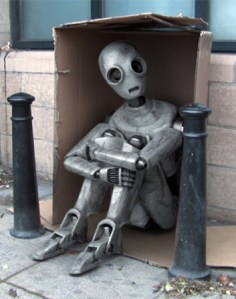
And that’s where I am. In between. A lot like this fella.

New floors, aaaaaaaaaaaaand we’re back

No this is not my floor, but I wish it wereAfter a full week of more dust than I’ve ever inhaled, bags upon bags of cement, all the furniture in the wrong place, and walking on planks to get from the bedroom to the kitchen sink, we finally have new floors. 7 days might as well have been 7 months. And the landlord, bless him, kept apologizing for the inconvenience and trying to impress me with his progress. But after day 3, I was all, “get the bloody thing done before I eat your young!”

So now we have some tiling. A step up, or four, from our former cheap linoleum that was stapled to the floating wood. Yep. Stapled. It actually took years to get the landlord to agree to do this, not that it should have. He didn’t take me seriously until I demonstrated exhibit A: the linoleum was literally disintegrating, to the point where a hole had developed between the hallway and the kitchen. I kept tripping over it, and when I used the safety argument, he caved in.

I won’t lie. It looks so much better. I can also do a fun “run and slide” maneuvre now. But what I love the most is having my home back. My furniture is where it’s supposed to be. The dust and dirt have been vigorously removed from any surface. I’ve actually never taken so much pleasure in cleaning.

During the ordeal, the weirdest thing was feeling displaced while I was still in my home. I felt like a nomad. I couldn’t cook because my kitchen was off limits, which threw off my nutritional clock for a good week. I had to chase food. I love to make my own meals, and healthy ones at that. So when I had to get take-out every day, I felt utterly unsatisfied. When I grew up, take-out was a payday treat. The custom still applies. But more than anything, cooking is me time. It’s the only time I’m ever really in the moment. The gym might be a catharsis, but cooking is my meditation. So yeah. I was a bit loopy for a week.

But now it’s done, and the boyfriend unit and I are back to nesting. It’s certainly an interesting time. I feel like I’m getting to know him, even though we’ve been together for 2 years. Living together brings couplehood to a new dimension. I’ve tried this experiment twice before, and each was very different. It’s working out a lot better than I thought it would. Not that I was expecting disaster, but moving in together takes some getting used to. I think there’s a 1- or 2-month adaptation period. During that period, you get annoyed by the most trivial things, but that doesn’t mean your irritation isn’t completely valid. My theory is that if you can survive the itch, you’ll be juuuuust fine.

So far, I can’t complain. Okay, so he leaves glasses everywhere, and I seem to find bottle caps in places where they shouldn’t be. But overall, we’re getting along. And that’s all we can ask for. Small victories by way of baby steps. Just like that cursed floor!

New floor

I know I asked for it, but I think I want to consider taking it back. My landlord is finally giving me a new floor, only I’m still here. It’s been 4 days. He’ll be done before Friday, he says. Until then, the furniture’s displaced, there’s cement on the floor, dust in every crevice, and I can’t walk anywhere without hearing a crunching sound.

It’s for a good cause, but…

I. Want. My. Life. Back. Now.

If you have trouble getting back up on that horse, use a bigger ladder

A few months ago, I started a new job and people have often asked me how it’s going. Here’s the answer.

It’s the hardest thing I’ve ever done. The learning curve is huge. I took a break from journalism for three years, struggled in advertising, and now I’m struggling with something I wanted to do to begin with. It’s anything but easy, and part of the reason is that for the first time – ever – I’m surrounded by a bunch of people who are really good at what they do. Actually, that’s a lie. I was surrounded by the same kind of people at Cossette, but once I got there, I realized I didn’t really want to work in advertising, so it didn’t seem to count. It really should have. These are not the kinds of things we should only realize in retrospect.

Anyhow, despite the difficulty, I’ve decided that only arrogance would prevent me from giving this my bestest shot. So I’m just swallowing it, learning, working harder than I ever have, and turning the other cheek to all manner of criticism. After all, this is exactly what studying music is like: laborious, unforgiving, but so satisfying when you nail that crazy-ass cadenza.

Along the way, I’ve made mental notes on how to maintain stability. Here’s how I’m keeping afloat.

  1. It’s incredibly important to remember what you’re good at. Find as many opportunities as you can to make it surface. It’s a wonderful exercise to do something confidently.
  2. If someone else notices your strength and praises you for it, that’s gravy, but don’t seek praise and don’t dwell on it. Focus on the work.
  3. It’s incredibly important to know what you’re not so good at. If you don’t know and someone else tells you, and you trust the source, take it seriously. The truth is, there are only a handful of people who revel in putting others down. The rest are actually trying to help.
  4. Get better at everything. Get better at what you’re good at and what you’re not. Being great doesn’t last. You always have to do one better.
  5. Practice, practice, practice. If you can, spend more time practicing than you do working. Practicing will inform your work, and it’ll show.
  6. Give yourself a day or two to not worry about any of this. During that time, be lazy. Relish in recupe time.
  7. Don’t take your frustrations out on other people. If you have to criticize someone else’s work while yours is going through the ringer, remember the awesome responsibility of helping them grow. It’s so easy to be driven by bitterness, but it’s much more effective when you’re not. Also, people can always smell bitterness, and it’ll cut your credibility in half if you don’t stow it somewhere where it can’t emerge.
  8. When things get tough, find a figure who seems to have it together, and ask yourself what they would do. For me, it’s Scarlett O’Hara. I’m not sure Scarlett would do any of the things I’ve asked her to do so far, but projection is a good exercise. It takes you out of yourself for a moment and makes the difficulty seem feasible.
  9. There’s no way to medicate the problem. Like physio, it’s hard, it’s rough, it’s painful, but it’s the only way to get well. So savour the small victories.
  10. Remember, jockeys are about a quarter of the size of the horse, but ultimately it’s the rider that wins the race.

Maybe it sounds like I’m not happy, but it’s actually quite the contrary. This has been the most satisfying period of my life. Then again, I love a challenge.

We’re life-ing

Lately, I was describing my experience of moving in with the boyfriend unit to a colleague. In my spiel, I got to this point where I couldn’t quite find the word for what was happening. To which she contributed, “you’re life-ing.”

What a wonderful way to put it. That’s exactly what’s happening. We’re life-ing. And here are the telltale signs.

  1. You start getting new furniture and appliances after living together for, like, 5 seconds.
  2. You talk about the furniture and appliances that you can’t get right now, but plan to in the future.
  3. You also talk about the bigger place you’re going to get after living together for, like, 1 day.
  4. You’d rather cuddle up to TV on a Friday night than go out with your friends.
  5. You start tag-teaming things like housework, groceries and naps.
  6. Watch for more high-fives.

Incidentally, here’s how to know for sure you’ve just moved in with a boy.

  1. Your TV gets bigger, almost immediately.
  2. If you didn’t have cable TV, you get it. If you had cable TV, you get a satellite dish.
  3. Every plug in the wall is attached to a power bar, and the mass of electrical wires lining the floor quadruples.
  4. There’s meat in the fridge. Always.
  5. You try to work bottle caps into your interior design concept.

This is the life.

Reason not the need

Ahhhhhhhhh.

It’s so good to be back. No Internet for a whole week. Well, not at home, anyhow. And how I missed my blog…

As a result of the big move, the tech-savvy boyfriend unit wanted us to switch Internet providers (he needs more downloading power). So we called old provider (who is not Bell Canada), ordered a shut-down, called the new provider (also not Bell Canada)  and ordered a power-up. So far, no problem.

Then, a few days later, new provider called us up, said Bell Canada owns all DSL circuits, and there’s no room for a new one (confusing, really, since we’re already on a Bell-owned DSL circuit, just with another provider). Alrighty, then. Not the scenario we preferred, but there could still be time to salvage the situation. I call up the old provider, ask if I’m calling in time to withdraw my shut-down, they say that I am, so I figure that’s that.

On Monday, the problems begin. For a whole week after that, the boyfriend unit and I have no Internet at home, and for a programmer (his profession; not mine), that’s disastrous. All week, I’ve been on the phone with my Internet provider, who, unfortunately, was waiting for Bell to clear up the issue.

Note to lawyers: Do anti-trust laws protect us against a telecommunications company that clearly has a monopoly over all phone lines and circuits?

Living without the Internet wasn’t as difficult as all that. It was the principle of the thing: being told I’d called on time to cancel the shut-down; being told each day, “another 24 hours…another 48 hours”; and each day turning into a bigger lie.

As a once-ago political journalist, I’ve learned to be tenacious with these people. I’d call every day, twice a day, sometimes more. I knew it was annoying, and I wanted it to be. I’m paying for this service, damn it! My boyfriend depends on it to do his work, and on occasion, so do I. We can’t be given the runaround on this. They didn’t do their job properly, they admitted that it wasn’t my fault, but somehow, I was still paying for it. It was unfair, and the wait was unreasonable. I was more frustrated than I’ve ever been. Then one agent said (and I’m paraphrasing), “listen, lady, you didn’t call 9-1-1 and this isn’t an emergency.”

All this to say it’s been a hellish week, not because I had no Internet at home, but because I had to deal with those half-baked, lame-brained numb-skulls.

For now, the struggle has passed…mostly. Though we have Internet now, our high-speed isn’t as fast as it was. Bell is apparently on it. We’ll see if that causes more problems. If it does, I’m switching to cable Internet, despite my better judgement (I despise Videotron, its offspring, and its tech support; oh lord, how I hate their tech support).

In case things don’t backfire, the last week has allowed me to stew on the following blog topics that I can’t wait to address:

  1. Reality shows are scripted by writers and performed by actors, and I have proof.
  2. Advertising is not evil.
  3. Things that make you a snob, and things that make me a snoot.

Until then, I’ll respond to my buddy AD’s blog entry on the importance of sexual attraction in a relationship: yup.

Chemistry is not love, and love is not always enough, but love without satisfying sex inevitably turns to distaste. So something’s gotta give.

Otherwise, my criteria for what I used to look for in a mate was once very complex: tall; lanky; preferably unkempt, shaggy brown hair; artistic; sensitive; watches a certain kind of movie; reads a certain kind of book; listens to a certain kind of music; and has known me for at least X amount of time before we started dating.

Now it’s simpler. I really dig it when he gets me and I get him, and when it doesn’t take too long to get there. That’s the best.