Originally published on Vulture on April 21, 2015. Photo Credit: Courtesy of AMC Photo: Courtesy of AMC
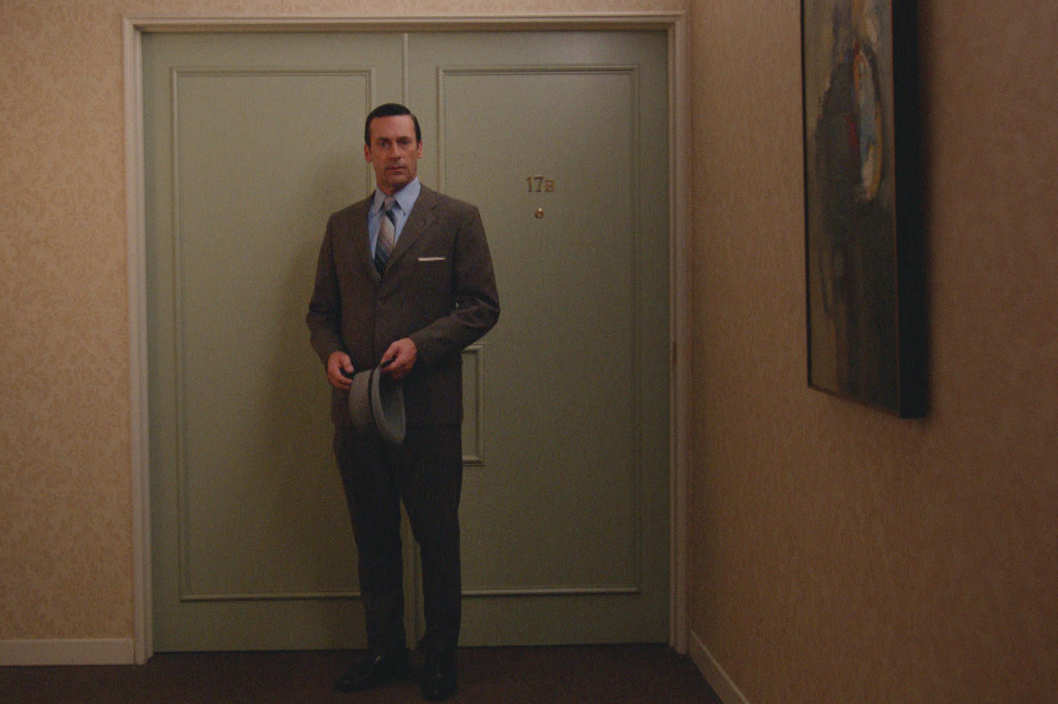
“When he returns home to find that Melanie hasn’t sold the place, she tells him, “They loved the lobby, but the emptiness is the problem…this requires too much imagination.” He doesn’t see how that could be a limitation: “That’s the best opportunity in the world!” Don concocts a whole fairy tale for Melanie to tell visitors, but he doesn’t get that because his penthouse looks so glaringly uninhabited, it also feels uninhabitable.”
Originally published in Vulture on April 14, 2015. Photo: Justina Mintz/AMC
“Failure is a very personal word in English. It’s an insult to your abilities. As a verb, it’s passive, in that there’s no act of failing; it’s a state of being. If you fail, it implies that you are a failure. In French, échec has military qualities. It’s not just about coming up short on expectations or aspirations. It’s about losing everything.”
When I wrote about A Serious Man for Roger Ebert’s Far-Flung Correspondents, I got some flak for misrepresenting the Christian god, even though I was specifically writing about the Jewish god. Because I also cited a Gnostic myth, another commenter told me I didn’t understand Gnosticism.
Well, what are you going to do? I actually had done my research, but people on the Internet are mean. And the fact that it’s unlikely you’ll ever confront them in person makes it so much easier for them to hit and run. Still, I’m getting better at brushing off the kind of criticism you get from willingly writing on the Internet. So I summoned the courage to finally provide a response to a previous post on my favourite devils in cinema. Here, I rounded up some of my favourite gods in movies and TV. Before reading on, please note the following:
I will not engage in a theological debate in the comments because…
This entry is about interesting characterizations of god or gods. Think of it as a literary review, because after all…
These characters are fictional.
So here they are, one blaspheme at a time.
Bender: Futurama
Perhaps because he’s science fiction’s most self-aware robot, Bender’s had two run-ins with godhood. The first occurs in A Pharaoh to Remember, where Bender contrives events to become the next pharaoh, forcing the Egyptian slaves to build his mile-high effigy. Like the Tower of Babylon, Bender’s shrine breaks records before completely breaking down. Only 3 episodes later in Godfellas, when Bender is sent hurtling into space, his godly ideals are challenged when he becomes a god to the tiny organisms that have formed on his body. They worship him unflinchingly, even if his demands ultimately harm them. Eventually, a war breaks out between the organisms and everyone is destroyed. Mournful, Bender continues to hover aimlessly through space where he encounters a galaxy that reveals itself to be the one that hears all of the Earthlings’ prayers. This makes for one of the most interesting conversations on godhood that I’ve heard.
Bender: You know, I was God once.
Galaxy: Yes, I saw. You were doing well until everyone died.
Bender: It was awful. I tried helping them. I tried not helping them. But in the end, I couldn’t do them any good. Do you think what I did was wrong?
Galaxy: Right and wrong are just words. What matters is what you do.
Bender: Yeah, I know. That’s why I asked if what I did was…oh, forget it.
Galaxy: Bender, being God isn’t easy. If you do too much, people get dependent on you. If you do nothing, they lose hope. You have to use a light touch, like a safecracker or a pickpocket.
Bender: Or a guy who burns down a bar for the insurance money!
Galaxy: Yes, if you make it look like an electrical thing. When you do things right, people won’t be sure you’ve done anything at all.
God: Dogma
Though God’s appearance is short and sweet, it’s still impactful. A lot of time is spent building up God, especially through two fallen angels played by Ben Affleck and Matt Damon. They question God’s authority and intentions, while wreaking havoc like little children to get her attention. Yep, turns out God’s a “she.” Which wasn’t as much of a twist as Kevin Smith’s playful treatment of her. In one minute, she’s blowing up an angel’s head with the sound of her voice; in another, she’s doing handstands against a tree. Her expression is solemn for a moment, then her head tilts and she flashes a quick smile. Still, she manages to answer the question, “what’s God playing at” by cleaning up a large mess that was left in her name (an all-too-common scenario). Light-hearted and funny? A trifle. Irresponsible and thoughtless? Never.
Sita Sings the Blues
What I love about this movie isn’t the way its deities are portrayed; it’s the multi-layered storytelling, which so aptly echoes the nature of such myths and sacred stories. There are four narrative levels in all. The first tells the story of Sita and Rama in the form of the Rajput paintings we often associate with Indian art. When narrators interject to debate certain story details, they appear as shadow puppets. At various points in the movie, different Annette Henshaw songs are used to illustrate events in Sita’s life, and these are choreographed in distinctive flash animation. Finally, as the story itself is a parallel between Sita and lead animator Nina Paley, the “real life” bits are animated in a less ornate, more primitive “squiggly” style. There are many ways of telling a story, and even more ways of looking at it. That’s Sita in a nutshell.
God: Joan of Arcadia
Though it was a short-lived series, what I liked about this show was its ambiguous portrayal of God. The writers seemed aware that so much was riding on this interpretation, and that it had to be fair and modern while also reflecting well known theological notions. There were even a set of commandments that writers had to follow when creating God. In one of the more powerful episodes, Joan deals with the sudden and cruel death of a friend. Her boyfriend Adam offers the first bit of wisdom when he tells Joan that her friend indirectly killed herself by constantly chasing dangerous situations. Just then, Joan spots God walking three dogs (allusion alert!), and she does what most people do when they have the opportunity to speak to God directly: she asks why. God doesn’t have an answer, perhaps because Adam already gave it. All he can do is show her how to cope: put your feelings in a box and juggle them so you only ever carry as much as you can.
God: Des nouvelles du bon dieu (Eng. “News from the Good Lord”)
In the only veritable on-screen existential crisis I’ve seen, a brother and sister figure their bad luck is down to them being characters in a novel. So they start spreading mayhem to get the author’s attention. They commit just about every crime: they rob a pharmacy; they shoot people; they kidnap a policewoman, who becomes their willing accessory (not to mention the brother’s lover). On the journey, they recruit a number of accomplices, including a priest and a suicidal woman, believing that each might bring them closer to God. Finally, they meet the big G, who’s busy throwing novels into the air and shooting them with a rifle. Is each novel a life that’s come to its merciless end? Perhaps, but that’s different: God has a plan. “You guys can’t just go around exacting chaos because you’re pissed at me,” he warns the brother and sister. But they don’t listen, and shortly after, the whole horde dies in a violent car crash. Maybe we’re all writers and God is the editor, who decides when it’s a good time to finish the story.
The Demiurge: Aeon Flux
You don’t have to know the story of the Demiurge to appreciate this episode. I like to focus on the main conflict. Aeon, who represents anarchy, wants to send the god-like Demiurge into space and rid the world of its presence. Trevor, who represents autocracy, wants to use it to enlighten the masses. The two argue back and forth about knowledge. Aeon wants the opportunity to acquire it for herself, to extract significance from her existence through her own means. Trevor sees the Demiurge as a chance to live in collective peace under the influence of one governing truth. Several characters are resurrected in this episode, each more powerful and virtuous than in their previous form. Trevor tells Aeon she wants to get rid of the Demiurge to avoid facing her sins. Conversely, Aeon calls Trevor on desiring the Demiurge’s salvation for the same reasons.
God: Mr. Deity
This isn’t on TV, but it should be. Until it finds a suitable, gutsy network, it’ll reside on its Youtube channel, where it gets the accolades (and occasional trolls) it deserves. Creator Brian Keith Dalton came from a Mormon family and eventually decided not to follow along. This guy knows his theology, which is what makes the satire so tight. The premise is that God plans to create a world and needs the help of his staff to make sure the whole thing works out. He isn’t particularly smart, he’s rather vain and parts of his plan don’t really hold together well (“We can fix it in post,” his staffer tells him when someone points out that you can’t create flowers without first creating the light they need to grow). The Larry David comparisons are understandable, but Mr. Deity is slightly more likable. Slightly.
Jesus: That Mitchell and Webb Look
As an agnostic, I don’t accept that Jesus is God. I do, however, accept that to many people, Jesus and God are the same person. So it’s worth noting this construct, which takes the Good Book at face value. Was Jesus a racist or wasn’t he? I suppose you’d have to ask a Samaritan.
Not that I’ve ever gone to any trouble to deny it, but I can’t, for the life of me, sit through even 5 minutes of a zombie movie. Hell: I even put off watching Zombieland, a comedy. It’s never the zombie film itself that scares me. It’s more about what happens after. Each time I see a zombie on screen, I dream of zombies that night. And that’s the part I try to avoid.
My zombie dreams are terrifying and rather difficult to get out of. The set-up tends to be the same. Whether I’m in the city or country, it’s down to me and maybe 1 or 2 other living people. We know the world’s been taken over by zombies, and we simply wait for them to close in on us. I’m either lucky enough to wake up just as they’re about to get us, or I have to endure becoming one of them. Just to be sure, in my dreams, there’s never a way out. No heroic Woody Harrelson figure bursts through my door wielding a bazooka. I usually don’t scream much either, not because I’m paralyzed but because what’s happening is inevitable and the only thing to do is wait. I’m trapped. End of.
If I’m transformed into a zombie, I don’t suddenly scour the neighbourhood for non-dead brains. I just stop…being. I don’t do anything, really. I don’t move around or think things or want things. I am nothing. For a very long dream-time minute, until I wake up, my existence is nothing.
Save the brain-chasing, that pretty much sums up your average zombie reality. They seldom, if ever, get characterized in movies, because you can’t give “nothing” a personality. Vampires? Werewolves? Man-eating monsters? They sometimes get the artistic treatment. But zombie stories tend to focus on the experience of the living rather than the thing that’s challenging their living experience.
For many years, I’ve tried to figure out why I have a zombie phobia. Then recently, it dawned on me. I believe what scares me about zombie dreams is what’s scary about zombies in general: they are death itself.
Zombies force us to deal with death. They even force us to look death square in the face: warts, decomposed flesh and all. Zombies differ from vampires, monsters and aliens in that we can’t assign them any sort of “otherness”: they’re us. Not now, but soon enough.
And it’s a bleak future. They weren’t rescued by a forgiving god or a noble scientific process. They just laid there rotting in the ground until some unknown source animated their bodies. But they’re not sentient. They’re not really beings. They’re just piles of worthless flesh that we don’t even pity once they’re shot dead(er).
If zombies took epidemic proportions, we probably wouldn’t have much of a chance against them. We’d all die, but not just because zombies would kill us or turn us into them. Zombies’ food supply would eventually run out and they’d just starve to death. In other words: Buh-bye human race!
Death is already an idea most of us aren’t comfortable discussing. It’s the usual things: the lack of control, what the afterlife has in store, the possibility that there is no afterlife.
Extinction is far worse. It confirms our vulnerability as a species. It’s death with no legacy. It’s as if we were never there, which invites us to wonder if it even mattered that we were. This, of course, suggests that we believe we matter only if we are.
Meaninglessness is something people have never been very good at reconciling. Nihilism comes close, but it’s just no fun. And that’s the problem. Maybe life means nothing at all, but that’s hardly a reason to not have fun doing it. If anything, it’s an incentive to have a massive party.
So while people are hosting Walking Dead parties, I’m still working up the courage to watch the pilot. Some of you might egg me on, telling me to face my fear. And sometimes, facing fears can be fun. But I understand this phobia. I think I’ve been working it out in this post pretty efficiently. What scares me now is the prospect that having figured out the wherefore of this thing won’t prevent me from having more zombie dreams.
Okay, I admit that I was happy these two found each other again. Just once, though, I want to see a character called "Juliet" not perish in a most tragic death.
You watched it, didn’t you? If you didn’t, you’re more of a statistic than I am. Because according to ratings reports, 20.5 million of us watched the Lost series finale. All of us optimistically expecting a resolution, despite the inkling that 1 hour and 40 minutes (sans commercials) probably wasn’t enough to cover even the basics of the island’s time-travel properties, let alone most of these unanswered questions.
Based on message boards, reviews and Twitter, the big finish was a big let-down for many. The consensus is that while we’re glad these long-tortured characters get their happily-ever-after, we sure as hell would have liked the writers to throw us a bone about that other character: the flippin’ island.
After a lot of reflection, I’m finally able to articulate the wherefores of my disappointment. You see, the Lost ending decided that the island was a MacGuffin at the last minute, when it had already become much more significant to the audience. And the reason it did was the creators’ fault: they made us care about the island and its mysteries by constantly reminding us that they existed. They even went so far as to imply that the island had motives (quote Benjamin Linus upon Ilana’s explosive death: “I guess the island was done with her”), with the omnipresence of a fickle god.
The thing about a MacGuffin is that no matter how you define it, it’s a plot device. It’s functional. It doesn’t have a personality. While fictional characters can care a great deal about that MacGuffin (be it stolen diamonds or some covert operation), it should almost be a moot point to the audience. It doesn’t really matter why Kate Austen blew up her stepdad. What matters is that she’s convinced she’s not a murderer, and her character’s development relies on her redemption to others, to herself and to you. It’s the story’s job to show you she’s a murderer, but it’s her character’s to convince you she’s not.
In many respects, the creators allowed the island to act like a MacGuffin. It often seems to drive the characters to do things, until the characters make it clear that the island is more than a cluster of still life. The characters often suggest that the island doesn’t just have eccentric, sometimes contradictory functions. Some of them believe these are actual behaviours, that the island wills people to either come to it, to fulfill a duty, to live or to die.
The island occupies an awful lot of space for a mere MacGuffin. It has to be protected; it has electro-magnetic properties; it heals certain types of illnesses; its brightly lit spring needs to be corked or a whole lot of evil will be let loose; babies conceived on the island have a hard time being born; and so forth. In addition to all this, the island’s idiosyncrasies are ultimately consequential to the characters. And this is how it is most unlike a MacGuffin.
An ending not unlike the beginning.
The whole thing feels rushed. The Lost creators didn’t fully demystify the island, and to me, that’s tantamount to not finishing what they started. I came to terms with the “what” of the island, but I wanted the creators to fill me in on the “why.” I wanted to believe that the creators knew exactly what the island was, and not just how it worked. But the ending suggests what many viewers feared throughout the series: the creators were making it up as they went along and didn’t actually understand the island themselves. The creators will argue that they wanted to tell the characters’ stories in the end, but the island had so much to do with the characters we got to know. It’s impossible that the creators didn’t understand that, and entirely likely that they ignored it. Maybe because the hole they dug themselves was too deep. Maybe because they should have started explaining some of the mysteries in Season 4 instead of introducing brand new enigmas. It’s very simple, though. If they didn’t want the island to matter as much as it did, they shouldn’t have let it get so big.
Even the head writers admit that not everything was thought through. When asked what his least favourite Lost episode was, executive producer Carlton Cuse said, “’Strangers in a Strange Land’ (Season 3, Episode 9)… We didn’t yet have an end date for the series, and we were stalling, hoarding our mythology. So the big question/revelation in that episode is how did Jack get his tattoos? And he’s flying a kite with Bai Ling. That really didn’t cut it.”
In the end, the intrigue drew in millions of viewers, which, as creator Damon Lindelof explains, was the point. “Would it be easier if [Jacob] stopped bringing people to the island? Sure. But then our characters never would’ve crashed…and who wants to see a show about a guy weaving?”
Word is, Cuse and Lindelof plan on exposing some of the secrets on the Season 6 DVDs. And if they do, I challenge them to answer at least 25% of these questions:
***
All photos used in this blog are courtesy of ABC/Mario Perez. This blog is not for commercial purposes, nor any of the material used herein.
To cap off what’s been a surprisingly successful series on the ‘90s, I want to impart some wisdom that could very well save our culture. Not everything from the ‘90s is worth hanging on to. So when we plan our revival, let’s carefully curate the things we revisit and leave these duds behind.
1. The laugh track
No, it wasn’t invented in the ‘90s, but near the end of the ‘90s, good writing started to phase it out. Shows like Dream on, Ally McBeal and Sex and the City proved that people could laugh in all the right places without taking cues from a phantom audience. Sure, the ‘90s gave us Seinfeld and Frasier, but they were also responsible for Caroline in the City, Just Shoot Me and The Fresh Prince of Bel-Air. When you look back at some of these, it’s staggering how un-funny they are. Such punchline-driven cheap shots. Such meaningless catch phrases (or in the case of The Nanny, a series of grating groans). So will someone please send Two and a Half Men back to 1995 where it belongs? We’ve got 30 Rock and The Office now. We’ll just take it from here.
2. Dimestore spirituality
Though I’m not the biggest fan of self-help, some of it speaks on a tangible, grounded level. Unfortunately, the ‘90s wanted to balance that out with a new brand of New Age, and it was never very clear what doctrine a person was following. Oprah’s “Remembering your Spirit” segment invited guests to describe their calming rituals, like drawing a bath or, in the case of Martha Stewart, berating the help. Books like The Celestine Prophecy became hugely popular, and despite being a work of fiction, some still adhered to some of its proposed “insights.” And TV producers played fast and loose with Christian dogmas to make Touched by an Angel and Seventh Heaven more mainstream. The ensuing melting pot didn’t use the best ingredients, just the most popular.
3. Whiny pop that tried so, so hard to sound like alterno
Grunge did something to the music industry. It opened up a whole new market. But true-blue grunge artists cared a lot more about the music than their labels did. So labels started working with musicians who were willing to follow orders. That’s how we ended up with the radio-friendly, easy-listening drivel of the Goo Goo Dolls, the Gin Blossoms and that Friends band. There’s still some of that going around today. You have the Stereos, who are just enough emo to bellyache through each song, just enough rock to distort their guitars, and just enough hip-hop to sing every note on auto-tune. It’s just awful. And hopefully it’ll move back in with its mother Cher, circa “Believe.”
4. Khakis
Despite one very enticing Gap ad campaign, khakis just don’t look as good on people who aren’t professional dancers or models. They seem so promising because they’re classic, but that doesn’t translate into staying power when the trend resurfaces. So this time around, if the khaki comes back, let’s just act like we don’t know it.
5. Will Smith
He and I were cool until he became a Scientologist.
I actually liked the Fresh Prince in Six Degrees of Separation. Why didn't he go all Stockard Channing instead of Tom Cruise?
Oh, how we loved poking fun at the ‘80s! But when the things we hated most about them were brought back by American Apparel and possibly Marc Jacobs, old was new again. So I’m convinced that we’ll come to a similar conclusion about the ‘90s because they really weren’t so bad, and, if we want to get all sentimental about it, they helped us build the new millennium. Plus, good or bad, we actually held on to some ‘90s stuff. Here’s proof.
1. The a-ha! ending
What do TheUsual Suspects, Fight Club and The Sixth Sense have in common? An unexpected, what the?, second-viewing-required ending. If anything, these movies improved the suspense genre. Alfred Hitchcock was a strong enough storyteller to tell you who the killer was right away and make you itch in discomfort until they got caught. But replicating that experience has been a challenge. And then writers realized they just had to be more clever to build a better mystery. The best example is probably Memento, but the tradition carries on with pictures like The Machinist and Shutter Island.
"The greatest trick the devil ever pulled was convincing the world he didn't exist."
2. Here, queer & (getting) used to it
There’s nothing pretty about it: right up until the ’90s, gay and lesbian characters in movies or novels were often crazy, obsessed with the object of their affection, and/or just plain evil. AIDS gave people one more thing to blame on homosexuality, but when hetero women started contracting the disease, we couldn’t generalize these things any longer. That’s when we had to acknowledge the LGBT community, its budding voice and its rights. Then, on the heels of pop artist Keith Haring’s death, Madonna went into public service. She commented on religiously-backed bigotry and sexism in “Like a Prayer,” encouraged women to demand an orgasm in “Express Yourself,” celebrated/stole a gay club dance trend with “Vogue,” and hired mostly queer dancers for her Blond Ambition tour, as documented in Truth or Dare. That’s how the ‘90s started, and those sensibilities about the LGBT community remained in our consciousness. Though homophobia is still present and marring equality to the tune of Proposition 8, it didn’t quell Ellen’s eventual coming-out or the popularity of Will & Grace and The L Word. Today, we’ve replaced the term “lifestyle choice” with “orientation” (but we could still do better), and more people accept that sexuality, in all its forms, is biologically assigned. Maybe it’s because we dealt with so many LGBT issues in the ‘90s and part of the 2Ks that Lady Gaga’s butch-on-girl kiss in “Telephone” is a relative non-issue now. Certainly compared to how people reacted to “Justify my Love” in 1991. There’s still a whole lot of progress to be made. But we’re lightyears away from 1989, thank goodness.
3. Political correctness
Having hoorayed for gays, it must be said that the ‘90s also introduced a whole slew of new terms to replace old words that were borne of racism, chauvinism and general power structures that no longer reflected our new equal & empowered reality. I’m not saying it was a bad thing, and I couldn’t because I’m a woman. I personally benefitted from these changes. Still, the double-edged sword of political correctness is that it essentially masks old views instead of replacing them. A word can alter your language about an issue, and that’s certainly important. But it takes conviction – not just vocabulary – to create a revolution. That’s why words like “tolerance” have always irked me. It means putting up with something you don’t like, when, especially in the case of discrimination, it’s the dislike that needs to change.
4. “I’ve never been to me”
This is probably one of my least favourite ‘90s hangers-on, but it’s so popular that I have to address it. From John Gray to Alanis Morissette, if there’s one thing the ‘90s taught us, it’s that people in the westernized world have the luxury of spending a lot of time on their own problems. Enter Self-Help, which has its own bookstore section, right in between “Psychology” and “Cooking.” It taught us phrases like “scarred for life” and “you can’t love others until you love yourself.” Since the ‘90s, this trend has gotten bigger and, I would argue, more dangerous. Case in point: The Secret is still riding high on Oprah’s endorsement, and it teaches little more than you will get rich just by sitting on your ass and thinking positive thoughts. Why? Because the universe owes you. Which is exactly like saying that children toiling in sweat shops could change their fate if only they thought of bunnies and flowers instead of, you know, eating.
5. The Internet
Okay, so the Internet, as a technology, has actually been around since the ‘60s, but it wasn’t used by the public until 1991, and it only became commercialized and widespread in the mid-‘90s. If Twitter’s taught us anything, it’s that the way people interact with your invention is often more important than the invention itself. Although the Internet has all but replaced the library, abbreviated your TV and usurped the Associated Press, its most considerable achievement, I believe, was to make Playboy kind of soft core.
Laugh if you will, but back in the day, this machine was the shizzle.
Coming up: things the ‘90s can bloody well keep to themselves!
Remember the ‘80s? Or rather, our once-collective hatred of the ‘80s? Then American Apparel came along and used that washed-out Polaroid aesthetic to sexify Flashdance shirts, and we bought it, along with some leggings and legwarmers. We thought, “okay, so long as mullets don’t come back.” Then the faux-hawk went emo and everything from the Ziggy Stardust to the Farrah got an asymmetrical, jagged-edged revamp. And we thought, “that’s alright, so long as big shoulder pads are gone for good.” Then Lady Gaga…well…Lady Gaga.
I’m not incensed by any of this. What I find odd is that since the ‘80s went retro, the ‘90s have taken a beating. Thing is, I liked the ‘90s. Possibly because that’s when I was a teenager and life seemed simpler, if disproportionately more dramatic. But I really did have fun then. The grunge scene. Mosh pits. Pop psychology. I miss that whole era, and I’d bet if any of you think long and hard on it, you’ll get a bit nostalgic. So before you go treating the ‘90s like your dweeby kid sister, I want to point out which parts of that decade are worthy of a revisit.
p.s. I’m going to follow this up with a list of things that should have stayed in the ‘90s, and things we mercifully kept.
1. The Sixties
The first thing to mark the ‘90s was a ‘60s revival. It started with the big fat headband, made popular by Lady Miss Kier, followed by flower-power t-shirts, babydoll dresses and chunky heels. Hippy trends eventually ensued, from the long hair to the surprising return of bellbottoms and peace signs, which somehow got intermingled with grunge. Still, I’ll romanticize the ‘60s any day, and if Amy Winehouse and Mad Men are any indication, we can look forward to one swinging déjà vu.
Lady Miss Kier, from Deee-Lite. Is groove in your heart?
2. Beige and burgundy lipstick
In the 2Ks, makeup went the way of the fallacious “let’s look like we’re not wearing any” trend. Not so in the ‘90s. I can even date a ‘90s flick based purely on the shade of lipstick. Back then, wearing makeup meant observing the rite with the dutiful application of noticeable colours. I’m not sure why nobody committed to all-out red, but burgundy was the shade you wore to work, to dinner, or to the club if you wanted your style to say, “I’m a lipstick kind of woman.” For a more “natural” look, women wore beige. A very thick, opaque, heavily lip-lined beige. Resist it if you will, but remember that we long thought blue eye shadow was reserved for theme parties and John Waters drag.
Before, when you knew where the lips were.After, with invisible mouths.
3. Contrasting colours and geometry
When I think of ‘90s fashions, I’m in the early years, when guys tucked silk dress shirts into a pair of baggy Edwins. There were different patterns on the shirts, and I even remember a Mondrian-inspired trend. It was all about very bright colours against white and black. Bold, wacko type came with it too. Before the ‘90s got all grungy, they were really clean-cut. I’m not sure how this could work again, so I’m looking forward to seeing how designers pull it off. And they will, because the revised ‘80s are on the brink of exhaustion.
Yes, it's who you think it is. Before he became the punchline of every joke about the '90s, he had the swoon-factor.
It's funny. I don't remember there being less copy on the cover. But come to think of it, that's not a bad idea.
4. Supermodels who aren’t identical to one another
Gemma Ward isn’t modelling anymore, but who can tell? Today’s models look like porcelain dolls: long, strawberry blond hair with widely set-apart eyes, small, round lips and a heart-shaped face. That’s the mould, and the ‘90s would have had none of it. Supermodels had to have a distinct look that almost suggested a personality. They had real bodies, too, even if they were still impossible thinner than you or I will ever be. They were also asked to speak on occasion, which meant we could associate them with opinions and views (vacuous though they were). You even know who I mean when I refer to them using their nicknames: the Chameleon, the Body and the Heroin Addict.Today, people are still frettingabout how skinny models are, but I’m more miffed that they all look the same.
Remember when we were on a first-name basis with these ladies? Also note the lipstick.
5. Susan Powter
Fad diets are still around, but where’s the entertainment? Where’s the housewife who starved herself to get into her wedding dress, ballooned to over 200 lbs after popping out a couple of kids, then shaved her head and went all nutty when her husband cheated on her. Many moguls tried to sell their new-fangled weightloss technologies on shopping channels and infomercials, but only Susan Powter thrust dieting into the theatrical realm; rants, raves and all. And if you’ve ever been on a diet, your body will confirm that that’s about right. Sue’s still kicking about, but she’s quieted down, and her vlogs are downright boring. Where’s the anger, Powter? The low-carb trend is insanity! Make it stop it.
6. The electric piano riff
You know the one. It was in “Freedom,” “I’m too sexy,” “Good Vibrations,” and even EMF’s “Unbelievable.” I don’t know why recording studios chose this instrument to compel us to dance, but there it is. I’d love for it to replace the god-forsaken vocoder that’s become the conceal-my-terrible-voice device of choice for will.i.am, Kanye and co. In the meantime, here’s a video that combines a few of my favourite ‘90s things.
7. Masculine dance moves
Before grunge, many guys got all preppy. They dressed well, were more or less groomed, and really dug rap and soul. This usually meant they had a few cool dance moves to show off. There was the Running Man, the Hammer Dance, and that thing Kid ‘n’ Play did where they’d kick each others’ feet. But then grunge came, and suddenly your shirt was tied around the waist, your jeans were (sometimes intentionally) ripped, and each sentence expressed some form of disdain. And the dancing? The idea was to sway your body incoherently back and forth, keep your head down, make sure your hair was long enough to cover your face, and whatever else made you look stoned, if you already weren’t. Guys dance now, but only if they wear skinny jeans. Otherwise, they’re a little awkward, and it’s not right! We need decent moves for non-ironic non-hipsters. Now.
8. Raves
In Montreal, every Sunday afternoon means the Tam-Tams. Here, a bunch of people bring their djembes to Mount Royal park and jam it out while Montrealers dance, lie on the grass, have a picnic and/or smoke pot. When I moved to the city in 1997, the tam-tams were split into two parts: the tribal drums, and the drum ‘n’ bass. They’d found a way to work techno into the thing, and it wasn’t altogether inappropriate. I knew a lot of ravers when I came to Montreal, but I didn’t join in the fun. Now I wish I had, at least once. Sure, I’ve been to afterhours clubs since then, but it’s not the same. Lots of raves were about bringing the party out of the club. The spirit of the thing is gone, and so are the cargo pants. But I’d still love for a group of people to decide on a secret location, find a couple of DJs who are willing to spin it out in some abandoned field on the South Shore, and dance until tomorrow afternoon.
Trippy.
9. Movie or TV shows about a bunch of friends just, y’know, hangin’ out, talkin’ and stuff
When Aaron Spelling created 90210, he actually wanted to create another Degrassi, minus the ugly, acne-covered kids, of course. But we liked our people unattractive and riddled with angst. Maybe that’s why we craved entertainment that reflected what we thought our lives were like. Gone was the comedy of errors à la Three’s Company, and in were conversational classics like Seinfeld, Friends and Reality Bites. Today, authenticity comes in the form of reality shows. And the only thing that’s real about them is the writers. A weird shift.
10. The unbranded coffee shop
Remember those smoky, wooden, disorganized cafés with mismatched furniture, vegetarian menus and bohemian staff? Yeah. Neither do I.
Inside the old Café Calactus in Moncton, NB. I love their new restaurant and menu (and especially its popularity), but I kinda miss the vibe of the old digs.
Like many Montrealers, I take Halloween seriously. It’s not just an excuse to get dressed up; it’s an opportunity to express that latent part of your personality. Ah yes, and get sloshed with a few of your favourite friends. In due form, I spent one evening preparing my costume with my buddy G, who, incidentally, is a horror movie filmmaker. To entertain us as we worked on our Halloween creations, G asked me to pick something to watch from his extensive slasher collection. His eye lit up when I brought out Night of the Demons.
Before judging us, you have to appreciate that I selected it only because it’s so much worse than you think. From Linnea Quigley‘s b-movie training to that disembodied demon head, whose superimposed appearances are clearly being played on a loop. But then there are classic moments: the “lipstick-nipple,” Angela’s grotesque transformation from human to second-hand demon to lead monster, and the razorblade apple pie. True to the genre, those clueless teenagers get viciously massacred one by one, until nobody is left but the Vestian blonde. At least, that’s how I remembered it.
It wasn’t until I saw it again that I realized none of the characters actually die. Except for the two survivors, Angela and gang are merely turned into demons, whether by attempted murder or serious injury (one guy gets his arm chopped off; don’t know how that makes a demon, but that’s for another blog post). Naturally, one of the characters who gets away is poor, virginal, I-just-wanna-cuddle Helen, played by flaxen-haired Allison Barron. The brunettes, sexual deviants, and brown-haired sexual deviants all get it in the end, if not at first.
Today, there was some back-and-forth between Adam Lambert and Out magazine’s editorial staff over the singer’s “handlers” asking the publication to make sure their client didn’t appear too “gay” in their cover story about him. This all reminded me that big gay Glambert only ranked runner-up to squeaky-clean Kris Allen (so immaculate, in fact, that he married his junior high school sweetheart when he was just 23). Will Kris Allen sell more records than Adam Lambert? Of course not. His role will be that of American Idol victor, not successful recording artist. Don’t get me wrong, it’s not that I don’t like Krissypooh! But this is a publicity contest, and Adam Lambert doesn’t need a dull press release to make headlines.
In much the same vein, who did they bring back for the Night of the Demons sequels? That’s right: Angela.
It’s a bit like the Quebec referendum, isn’t it? Quebecers say they want something fresh and revolutionary, but when push comes to shove, the devil you know always wins. On a day-to-day basis, many francophone Quebecers still want that sexy, dirty, dreamy sovereignty, so long as they don’t have to vote for it.
What’s getting tiresome for me is the long, overdrawn process of attrition. In a slasher flick, this describes when (sexually active) characters drop like flies at the hands of a masked murderer/monster. In singing competitions like American Idol and X Factor, it describes those painful weekly eliminations that ultimately betray the audience’s hypocrisy.
Often, the chasm that divides who should have won and who actually won is wide and deep. Why don’t we just own up to our desires and vote for the Adam Lamberts and Rhydian Robertses of the world? Who cares if they’re gay or worship David Caruso. Shouldn’t our loyalties lie with the people who interest us most? This isn’t like separating a country; it’s about performance! I don’t remember a single thing that Kris Allen sang, but I recall specific Glambert hairdos. And most people agree the latter was the better singer.
Do we really need more disappointing post-competition careers from our safe choices? Let’s have some fun! Let’s give ourselves what we want!
Does this mean that Jedward are growing on me? Goodness no! They’re really terrible. But like Angela, no matter what happens to them, they’ll come back. The good news is, they’re both blonde, and they’re very likely virgins.
A few years ago, reality TV became an official genre, and a legitimate format for almost any type of scenario: matchmaking, job interviews, talent competitions, home renovations, and even plastic surgery. For a while, it was a staple of summer TV programming when nothing else was on. Not even repeats!
And it was during the summer of 2004 that I caught an episode of For Love or Money, apparently in its third series. At the time, I couldn’t believe that this kind of show existed. I mean, really? A matchmaking show that asks people if they’ll hook up with someone in the end, or take money instead? It’s a fair question, I’ll grant. But what an awful test to put people through. Of course, it seems more awful that people are willing to put themselves through it just to be on TV.
Anyhow, by the time I caught the show, two ladies were fighting over some bloke. One of the ladies was identified as Rachel Veltri, and the other as “Event Planner” Andrea Langi. A couple of weeks later, I rented episodes from Sex and the City’s season 5. During the last episode of the season, I was struck with an actual instance of the uncanny. In the episode, called “I love a charade,” Samantha takes over her ex-lover’s Hamptons villa and discovers he lets random young women stay there as they please. One of them seemed incredibly familiar. Then it struck me: it’s Andrea Langi!
My next stop was IMDB, and sure enough, there she was. Bloody event planner is an actress. (p.s. Most recently, she played the random blond girl who has a bathroom romp with Mickey Rourke in The Wrestler……..p.p.s. Rachel Veltri is an actress too.)
This isn’t so unusual. After all, most of us thought it was a brilliant idea for Jerri Manthey to join Survivor in its second season. Best screen test ever, we thought. Still, I couldn’t help but feel that there was a touch of dishonesty in identifying Ms. Langi as an “event planner.” Sure, it’s a vague enough description, and while it could mean “plans her next audition and hopes it’ll be an event,” the term very much implies that she organizes parties.
I didn’t think much of it until I got caught up on season 5 of The Apprentice. I’ll be honest: I used to love this show. I especially used to enjoy how people always screwed up the most basic marketing tasks. That season, Sean Yasbeck earned what I thought was a richly deserved victory. Though I always found it odd that a real estate mogul would actually hire a CEO based on how well they did on the show’s series of rather unfair, if rinky-dink challenges. I never gave it a second thought until I decided to google Sean Yasbeck. Naturally, his first entry was an IMDB page. I checked it out even though I only thought I’d find Apprentice-related info. To my amazement, it seems Mr. Yasbeck is also of the theatre arts. He’s an actor. And not just in b-movies. He had a role in EastEnders!
And another one: Heidi Mueller, one of the kids on Who Wants to Marry My Dad?, ended up in a leading role on Passions.
I can understand why producers would rather work with actors. When they improv, actors turn out better than real people off-the-cuff. Fair enough. Still, the “reality TV” packaging needs a revise.
But then, other clues emerged. It dawned on me when I saw an episode of Gene Simmons Family Jewels. Okay, okay, you’re allowed to judge me. I can take it. In my defense, he’s immortal.
Anyhow, in this episode, Mr. Simmons is on his way to Las Vegas and his car breaks down. He gets out of the vehicle, stands in the middle of the desert, and, in his frustration, lets out a primal scream. From three different angles. You know, like they do for explosions in action flicks?
This added another dimension to the reality realm: direction. Maybe Mr. Simmons didn’t take three cameramen with him on his trip to Vegas, but even if there was just the one, they got a cue from someone to film one moment from three different angles. For effect.
Reality shows have often been criticized for altering the truth through cunning edits. This is a more complex version of the same critique. In documentary movies, we’ve often accepted that once “a” reality is filmed, it’s already slightly altered. Other than the passage of time, editing is another factor that creates a cinematic filter.
But this is entirely different. This is staging a scene so that it’ll end up looking a certain way once it gets on screen. This is making sure a shot is perfect. This is drama. This is fiction.
Then I started to see it everywhere. The Hills. The Osbournes. Hogan Knows Best. Celebrity Rehab.
Truth be told, some of the set-ups always seemed absurd. Meeting the love of your life by a process of elimination, whereby you barely get to know the people in the running. Choosing your best friend based on ridiculous competitions. Following celebrities around as they do mundane things, like buying a toy for their chihuahua. But I guess I was able to accept a certain amount of contrivance, provided that some of it was real. That’s what made it compelling, right?
Well, it turns out that what really makes reality TV interesting is what makes any program work: show business. Writers giving actors their cues. Producers making decisions that will sell the product to a captive audience. Directors creating drama where there is none. Editors turning it all into TV magic.
Do I feel duped? Yes, but mostly by myself. The good news is that I can stop feeling guilty for watching Paris Hilton’s New BFF. When it was reality, it was trash. But now that it’s drama, it’s okay.
As a general rule, I don’t care for daytime TV. It’s the soap operas, really. Perfectly made-up rich people who have nothing better to do than worry about their love lives. The setting is irrelevant. It’s all they’re wired to understand. Then, when writers want to make a storyline “progress,” one half of the couple either dies or dallies.
I’m not being funny: I honestly don’t understand how this can be appealing to anybody. Housewives are intelligent people (not to mention admirable multi-taskers). I can’t imagine them finding any of this stimulating.
Which isn’t to say I don’t like soap operas at all. Au contraire. I’m a faithful Coronation Street fan, like many British “Northerners.”
I once told a friend how much I enjoyed Corrie, and he had the snootiest response. “I can’t stand shows about the mediocre masses,” he said. Butcha know what? That’s what I love about it. Romantic entanglements figure into the plots, but mostly, characters worry about making rent, keeping their jobs, and how the kids are getting along. They dress according to their means, and apparently, their budgets don’t include a line for superfluous glamour. Some are fat. Some are ugly. And they’re all so blissfully real.
Remember the original Degrassi? We, as teenagers, loved watching other kids with acne, thick glasses, braces, and awkward mannerisms. Sure, we can escape with the 90210s of the world. But when the show’s over, we just want to connect. Mediocrity helps with that.
In one of my least favourite episodes of Sex and the City, Carrie Bradshaw wonders how we know whether or not we’re any good in bed. She then dates a recovering alcoholic, who thinks she’s the best lay ever. But when he can’t get enough, she realizes he’s just addicted to being addicted.
This is more or less the point: how do we know if we’re good at anything? And who’s going to tell us if we’re not?
You’ve seen American Idol, Dancing with the Stars, and all those other train wrecks. There are tons of people out there who think they rock, when they mostly rot. Why hasn’t anyone told them?
Sure, you’re supposed to go through life feeling confident. Dr. Phil has all sorts of neat tricks to boost your self-esteem (which involve tolerating his non-arguments leading to non-conclusions), but is there such a thing as too much esteem? When does confidence become arrogance, or worse, delusion?
This isn’t where I start naming off people I think should have been told they’re not any good. This is where I worry that I’m not actually good at doing something that I thought was a talent, and that I haven’t been for a long time. This is where I wonder what it is, who knew, and why they didn’t tell me. And I only hope it’s not something that’s gotten me any jobs. Don’t get me wrong, I can live with not being good at everything (and I know I’m not: sewing, for example…just terrible). I just hope I’m not actually awful at something I think I excel at.


 And it was during the summer of 2004 that I caught an episode of
  I didn’t think much of it until I got caught up on season 5 of
 As a general rule, I don’t care for daytime TV. It’s the soap operas, really. Perfectly made-up rich people who have nothing better to do than worry about their love lives. The setting is irrelevant. It’s all they’re wired to understand. Then, when writers want to make a storyline “progress,” one half of the couple either dies or dallies.
 In one of my least favourite episodes of Sex and the City, Carrie Bradshaw wonders how we know whether or not we’re any good in bed. She then dates a recovering alcoholic, who thinks she’s the best lay ever. But when he can’t get enough, she realizes he’s just addicted to being addicted.
 OLIVIA COLLETTE
